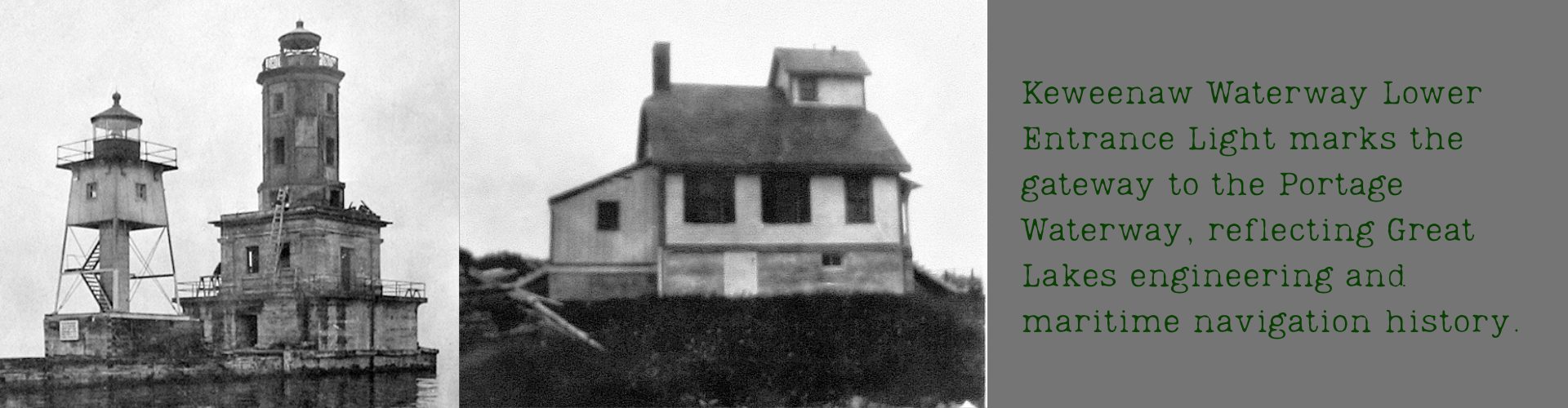
At the southern end of a long breakwater on Lake Superior stands the Keweenaw Waterway Lower Entrance Light, also known as the Portage Entry Light. Positioned at the mouth of the Portage River, this lighthouse has guided vessels into one of the most important interior waterways on Michigan’s Keweenaw Peninsula.
Opening a Route Across the Peninsula
The Portage River was first dredged in 1860, creating a navigable route that allowed vessels to cross the Keweenaw Peninsula rather than travel around its rugged northern shoreline. As traffic increased, it quickly became clear that reliable navigation aids were needed to mark the waterway’s entrance.
Congress responded in 1866 by appropriating funds for a pair of range lights. These early structures, completed in 1868, provided initial guidance for vessels entering the channel. After the federal government acquired the waterway in 1891, the United States Army Corps of Engineers undertook extensive improvements. By the end of the decade, a breakwater and western pier extended into Lake Superior, reshaping the harbor entrance.
Early Towers and Improvements
A wooden tower was erected at the end of the pier in 1902, but it proved inadequate in the face of Lake Superior’s demanding conditions. In 1911, it was replaced with a more durable iron structure.
Further harbor development soon followed. In 1917, Congress authorized significant funding for new navigation aids connected to the expansion of an interior harbor. Construction of the present lighthouse began in 1919 and was completed the following year. The fourth order Fresnel lens from the earlier pierhead light was transferred to the new tower, and previous entrance lights were removed.
Architecture and Engineering
The Keweenaw Waterway Lower Entrance Light reflects the robust engineering methods typical of early twentieth century Great Lakes lighthouse construction. The structure rests on a heavy timber crib foundation measuring approximately thirty two by fifty feet. Filled with concrete and supported by piles, this base provides stability against powerful waves and shifting ice.
Above the foundation rises a reinforced concrete pier and machine room, designed to house the equipment required for operating the light and fog signal. Classical revival elements, including molded pilasters and a projecting cornice, give the building a distinctive architectural character.
A white painted octagonal steel tower crowns the structure. Rising roughly thirty feet, it contains multiple levels connected by interior ladders. At the top, a circular lantern room once housed the original Fresnel lens. Today, a modern automated optic stands on the original brass pedestal.
Automation and Preservation
The lighthouse was automated in 1973, ending the era of onsite keepers. Technological upgrades continued in the twenty first century, including the replacement of the historic Fresnel lens with a modern LED optic in 2010.
In 2014, the United States Coast Guard declared the lighthouse excess to its operational needs. The Keweenaw Waterway Lighthouse Conservancy later took ownership, ensuring local stewardship of the structure. That same year, officials listed the lighthouse on the National Register of Historic Places.
A Gateway to the Interior Waterway
Today, the Keweenaw Waterway Lower Entrance Light continues to guide vessels entering the Portage Waterway. Its presence reflects the long history of engineering efforts aimed at improving navigation along Lake Superior’s rugged shoreline.
Standing at the edge of the breakwater, the lighthouse remains both a working aid to navigation and a reminder of the industrial and maritime heritage that shaped Michigan’s Keweenaw Peninsula.
Explore our full collection of Northern Michigan lighthouse stories here
Start planning your trip today and explore the legacy of Michigan’s maritime history!
📍 Explore the Map Below