A Beacon in the DeTour Passage
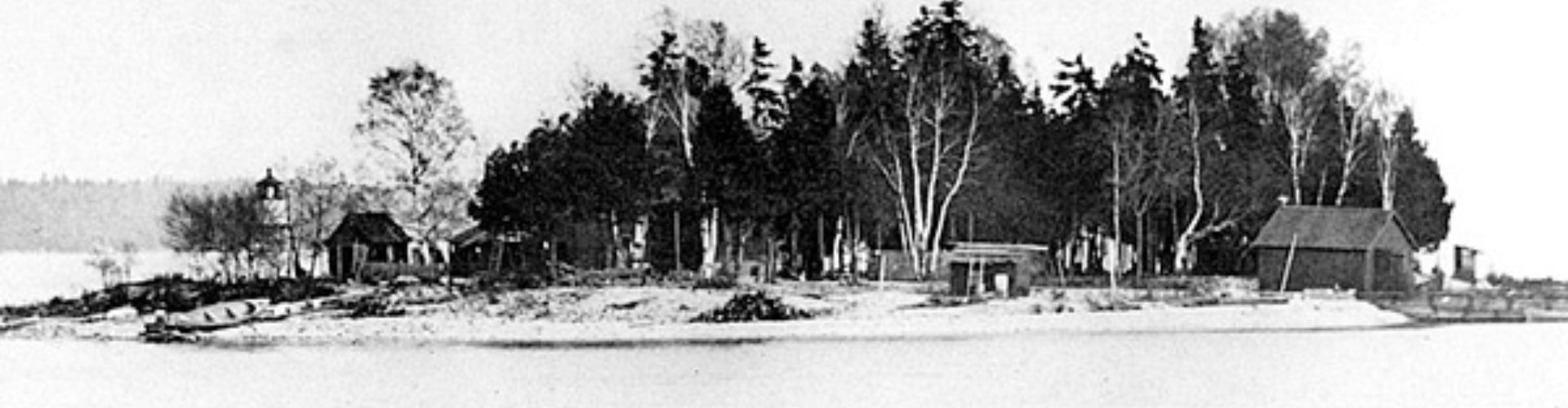
Just offshore from DeTour Village, in the waters where Lake Huron meets the St. Marys River, sits a tiny scrap of land known as Frying Pan Island. Barely more than a rocky bump in the channel, this island has played a surprisingly big role in the maritime history of Michigan’s eastern Upper Peninsula.
Legend has it that Captain William Thorn, the first mariner to navigate the St. Marys River into Lake Superior, was once stranded here waiting out rough winds. When he came ashore, he found a cast-iron frying pan left behind by Native Americans — and the name stuck.
Lighting the Way
On March 3, 1879, Congress appropriated $2,000 for a light to guide ships through the busy passage near DeTour Village. However, bureaucracy moved slowly. A deed for the tiny island wasn’t finalized until January 4, 1881. With a modest budget, the government erected a simple, wrought-iron tower. There was no dwelling, no storage shed, just a solid 18-foot cylinder of steel riveted together.
Despite its humble design, the Frying Pan Island Light stood proudly atop a five-foot masonry foundation, capped with concrete. A spiral iron staircase led up to the lantern room and circular gallery, where keepers could clean the windows and maintain the light. The first keeper, J.W. Church, lit the beacon for the first time on October 1, 1882. Apparently, he didn’t take to island life — he resigned the next month.
His replacement, Frank Bernard, took to it much better. Bernard tended the light until 1891, when he transferred upriver to Pipe Island Lighthouse, serving there for nearly two decades. During his tenure at Frying Pan Island, the government added small comforts: an oil shed in 1884 (complete with a bunk for overnight stays) and a larger wooden oil house in 1890.
Family Ties and Lonely Nights
When Bernard left, Keeper Joseph Riel took over — a man with an intriguing lineage. He was a close relative of Louis Riel, the Métis revolutionary and founder of Manitoba. Like his famous cousin, Joseph Riel spent his days in isolation, surrounded by rugged wilderness and vast water.
In 1884, the nearby Pipe Island Light was built. Together, the two lighthouses formed a navigational range for ships entering DeTour Passage. In 1894, Frying Pan Island’s tower was repainted from brown to white to make the range more visible by day.
Island Conditions
By the turn of the century, the island’s conditions were described as bleak even by lighthouse standards. The 1902 Lighthouse Board report painted a stark picture:
“The island is a rock only a few hundred feet in circumference and but a few feet above the water’s surface. No other structures are upon the island than those belonging to the Government. The keeper lives in a sort of shed consisting of but two rooms, and affording no adequate protection from the weather.”
Fortunately, that same year, Congress approved funding for a proper keeper’s dwelling — a seven-room, two-story house painted green and red. For the first time, the Frying Pan Island keeper could live with a bit of comfort and shelter from Lake Huron’s fierce winds.
Keeper Heroics
From 1900 to 1920, Keeper Nelson Abear tended the light and became one of the Great Lakes’ unsung heroes. In the brutal winter of 1916, Abear rescued two men from a disabled motorboat. Then, just days later, he saved nine more stranded aboard the ice-trapped tug Rambler. He also delivered their mail — because in those days, lighthouse keepers were as dependable as the lights themselves.
The Secretary of Commerce later commended Keeper Abear for “saving life or property under conditions of peril or great difficulty.”
The Light Fades
Originally, Frying Pan Island Light displayed a fixed red beam through a sixth-order Fresnel lens. In 1921, it was updated to a red flash every two seconds. But automation soon followed, and the need for a resident keeper faded.
By 1935, a new beacon called Frying Pan Island Dock Light was installed atop a coal elevator nearby. By 1937, the original iron tower was officially discontinued.
In the 1950s, the Coast Guard established new lights on the island — Frying Pan Upper and Frying Pan Lower, both flashing green. They also added a fog signal to guide vessels through the area. Over time, these too were simplified, replaced by a single quick-flashing green light that still marks the island today.
A New Home for an Old Light
After decades of neglect, the original Frying Pan Island Lighthouse was removed by the Coast Guard on August 8, 1988. The iron tower was taken to Sault Ste. Marie, restored with new windows, and placed on display outside Coast Guard headquarters — a fitting retirement for one of Michigan’s most tenacious little beacons.
From its humble beginnings to its quiet preservation, Frying Pan Island Lighthouse stands as a reminder of Michigan’s maritime legacy. It also honors the hardy souls who kept the lights burning in all weather, on the smallest of islands, for the safety of all who sailed the Great Lakes.
Explore our full collection of Northern Michigan lighthouse stories here
Start planning your trip today and explore the legacy of Michigan’s maritime history!
📍 Explore the Map Below