A Beacon Born from Necessity
Long before a lighthouse ever stood at the mouth of the Cedar River, this slice of shoreline along Green Bay was already an essential stop for mariners. The river’s natural harbor offered some of the best anchorage along the west coast of the bay, making it a frequent refuge for vessels navigating between Menominee and Escanaba. But the river entrance was far from perfect—shallow, obstructed, and risky for even the most seasoned captains.
As shipping traffic increased in the late 1800s and private efforts to deepen a narrow channel weren’t enough, pressure grew for federal intervention. What followed was the creation of one of Northern Michigan’s lesser-known but historically fascinating lighthouses.
Early Improvements to the Cedar River Harbor
Before federal involvement, the mouth of the Cedar River was blocked by a sand bar submerged under only three feet of water. Private interests carved out an eight-foot channel, but conditions remained challenging. In 1882, Congress allocated funds for harbor improvements, and in 1883 construction began on a pair of parallel piers spaced 200 feet apart, stretching out to the sixteen-foot depth line in Green Bay.
These improvements made the river usable—but mariners still faced enormous hazards, including the infamous Whale’s Back Reef and the heavy vessel traffic funneling through nearby Death’s Door Passage.
Why Cedar River Needed a Lighthouse
In 1888, the Lighthouse Board made a compelling case to Congress: between Menominee and Escanaba there wasn’t a single lighthouse. The Cedar River harbor was uniquely positioned and heavily used, but dangerously dark at night.
Their report highlighted three key concerns:
- The Cedar River anchorage was the best shelter on the west side of Green Bay.
- Nearly all vessels passed through Death’s Door en route to Green Bay ports.
- Whale’s Back Reef remained a major navigational hazard with no light to warn ships.
Congress agreed—and on October 2, 1888, appropriated $25,000 to build the long-awaited Cedar River Lighthouse.
Construction of the Cedar River Lighthouse
Work began in September 1889. By November 20 that same year, the new lighthouse was lit for the first time.
The finished structure was impressive:
- A 67-foot-tall pyramidal wooden tower, with an open lower framework
- A watchroom enclosed in the upper section
- A stairway climbing three landings to the decagonal lantern
- A fourth-order Fresnel lens casting a bright fixed white light
- Heavy one-foot-square timbers and ten-inch diagonal supports for durability
The lighthouse originally stood on the east pier, with living quarters planned for shore.
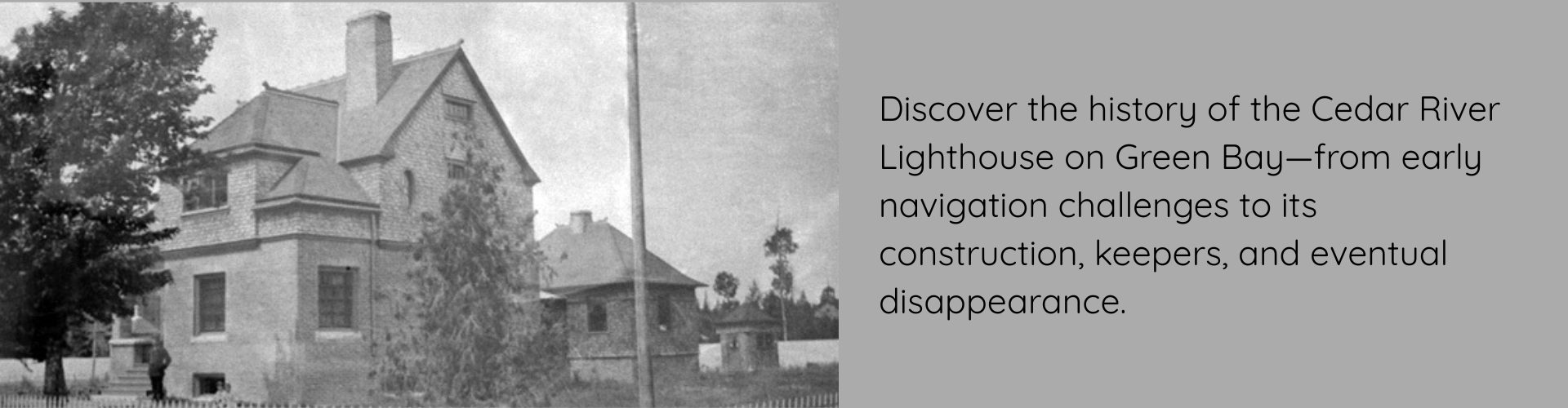
The Keeper’s Dwelling and Station Grounds
In 1890, the Lighthouse Service purchased a one-acre parcel from lumberman Jesse Spaulding for just one dollar—a symbolic contribution from someone heavily invested in local navigation improvements.
A comfortable keeper’s dwelling soon followed:
- Two stories and six rooms
- Red brick construction on the bottom level with a shingled upper story
- A brick cistern in the cellar
- A 300-gallon brick oil house nearby
- Board fencing and picket fencing defining the property
Improvements continued: a well drilled to 120 feet in 1895 ensured a reliable water supply, and a set of range lights was added in 1891 to guide vessels safely through the harbor.
Life at the Lighthouse
Early keeper turnover was high—four men served short terms before Gustavus Umberham arrived in 1890. He held the post for over a decade before swapping assignments with Nelson Knudsen of Algoma, Wisconsin, in 1901. The lighthouse remained a busy and important post during an era of bustling Great Lakes shipping.
Changes in 1908: Lighthouse Relocation and New Range Lights
In February 1908, the entire wooden lighthouse tower was moved off the pier and placed 17 feet north of the keeper’s dwelling. Its function shifted slightly, but it still served as an essential fixed beacon on Green Bay’s shoreline.
Meanwhile, the range lights were relocated to the west pier. Both were fixed red lights—one on an 8-inch-square post, the other on a slightly taller post 500 feet away, complete with a six-foot square lantern house.
Automation and the End of the Cedar River Light
By 1922, technology was beginning to replace light keepers and stations. The Cedar River Lighthouse and its range lights were discontinued, and on August 9 an unattended acetylene light mounted on a 31-foot steel skeletal tower took over navigation duties. It offered a white flash every three seconds—modern, low-maintenance, and effective.
The River and Harbor Act of 1965 later established Cedar River State Harbor, creating a safe harbor of refuge and installing the flashing green light still used on the west pier today.
What Remains Today
The once-busy lumber community that grew up around the Cedar River sawmill has mostly faded away. Only two churches and a handful of homes along M-35 survive as reminders. As for the lighthouse itself—almost nothing remains.
All that hints at the past today are:
- The former keeper’s dwelling, tucked quietly among the trees
- A faux lighthouse incorporated into a local restaurant’s architecture
Though the original tower is long gone, the story of the Cedar River Lighthouse remains an important chapter in Northern Michigan’s maritime history.
A Light That Guided More Than Ships
The Cedar River Lighthouse may not stand anymore, but its legacy lives on in the safer routes it helped carve through Green Bay, the harbor improvements it inspired, and the community that once thrived alongside it. When you pass through Cedar River today, take a moment to imagine the tall wooden tower that once watched over the shoreline—its beam stretching out across the water, guiding countless mariners home.
Explore our full collection of Northern Michigan lighthouse stories here
Start planning your trip today and explore the legacy of Michigan’s maritime history!
📍 Explore the Map Below