Guiding Ships Through a Rocky Entrance
Eagle Harbor has long been an important refuge along Lake Superior’s rugged Keweenaw Peninsula. However, getting safely inside the harbor was never simple. Shallow water, a rocky reef, and increasing ship traffic from the region’s booming mining industry made navigation tricky. That challenge led to the creation of the Eagle Harbor Range Lights. These are a lesser-known but vital part of Northern Michigan’s maritime history.
Early Navigation Challenges at Eagle Harbor
A lighthouse was first established on the western side of Eagle Harbor in 1851. While it helped vessels locate the harbor, a rocky reef stretched across the entrance with less than ten feet of water above it. Therefore, only ships with a shallow draft could safely enter, limiting the harbor’s usefulness.
By the early 1860s, shipping traffic had increased dramatically due to mining operations on the Keweenaw Peninsula. In 1863, a Lighthouse Board committee recommended additional navigational aids on the Great Lakes. They suggested range lights for both Copper Harbor and Eagle Harbor. The committee noted that, while Eagle Harbor’s need was “less in degree,” the shallow, rocky bar made precise navigation just as critical.
Blasting a Channel and Improving the Harbor
In 1866, a major improvement project was approved to transform Eagle Harbor into a true harbor of refuge. Over the next several years, workers blasted a 130-foot-wide channel through the reef, deepening it to fourteen feet. Wooden, rock-filled cribs were placed on each side of the entrance to mark the new channel.
The project was completed in 1879 at a cost of $95,896—a significant investment at the time. This paved the way for the installation of range lights to guide vessels safely through the entrance.
Construction of the Eagle Harbor Range Lights
Congress appropriated $8,000 for the Eagle Harbor Range Lights on March 3, 1875. About three acres of land on the south side of the harbor were acquired that same year. Construction took place during the 1877 season.
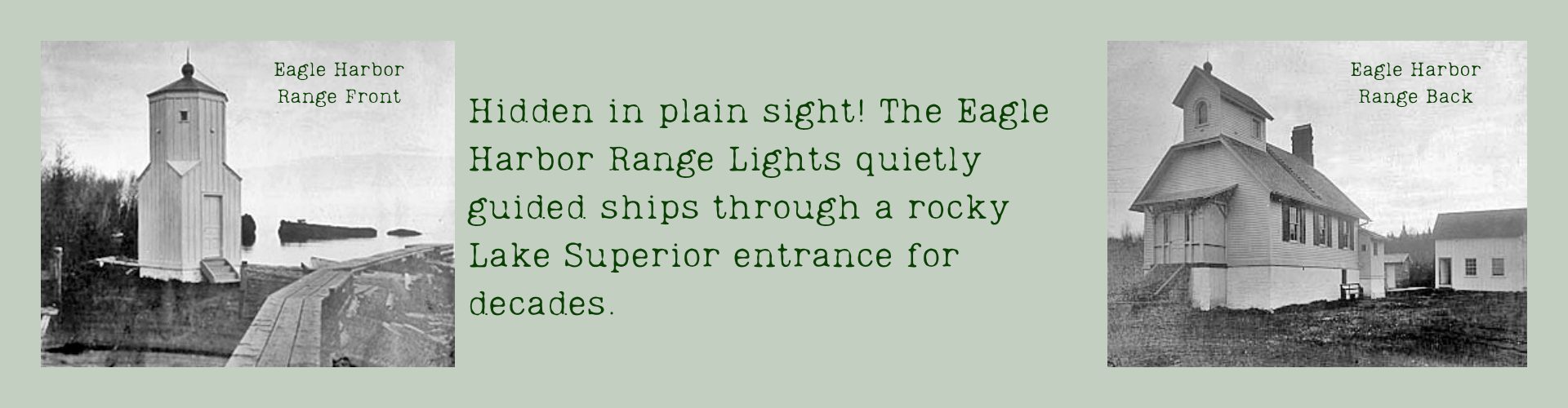
The rear range light stood 1,000 feet south of the front light and had a focal plane twenty-nine feet above the harbor. It was displayed from a rectangular tower mounted on the lake-facing gable of a six-room, one-and-a-half-story keeper’s dwelling. The front light, closer to the shore, shone from a twenty-four-foot-tall wooden tower. This tower was square in its lower half and octagonal above. A small rear window allowed the keeper to confirm the light was burning without leaving the house.
The design closely resembled other Great Lakes range light stations. These include stations at Copper Harbor, Grand Island Harbor, and Presque Isle.
Life at the Range Light Station
A 1,000-foot boardwalk connected the front and rear lights. Keepers could reach the station by an old military road or by a wooden-pile landing extending into the harbor. The property included not just the towers and dwelling. Also, it had a barn, privy, hen house, and a well house built over a nearby creek to supply water.
Surrounded by swampy land, the station’s healthfulness was officially described as only “fair.” This detail likely mattered quite a bit to the families who lived and worked there.
Guiding Ships Safely Inside
When the range lights were officially lit on September 20, 1877, mariners gained a precise way to navigate the harbor entrance. Ships would first spot Eagle Harbor Lighthouse. Then, they would align the front and rear range lights vertically to pass safely through the blasted channel and over the former reef.
Originally illuminated with tin tubular lanterns, the lights were upgraded to lens lanterns in 1894, improving their visibility and reliability.
Keepers of the Eagle Harbor Range Lights
The first keeper, George Howard, served from 1877 to 1879. He was followed by Henry Pierce, a former head keeper at Manitou Island. Pierce spent ten years at the range lights. In 1889, he moved across the harbor to take charge of Eagle Harbor Lighthouse after its keeper died of pneumonia.
That same year, Thomas Thomson became keeper of the range lights. He later succeeded Pierce at Eagle Harbor Lighthouse, continuing a pattern of keepers moving between the two stations.
In 1898, Mary Wheatley became the first female keeper of the Eagle Harbor Range Lights. Widowed earlier that year when her husband drowned at Marquette Harbor Lighthouse, Mary served for seven years. In 1905, declining health forced her to resign, a decision she clearly made with regret.
Charlotte E. Thomson briefly took charge after Mary’s resignation, holding the position until her son, Thomas G. Thomson, could be transferred from Gull Rock Lighthouse later in 1905.
A Keeper’s Career Beyond Michigan
Thomas G. Thomson served at Eagle Harbor Range Lights until 1908 before transferring to Sand Point Lighthouse near Baraga. He later made the rare move between lighthouse districts, relocating to California. There, he served at Alcatraz Island, Pigeon Point, Point Reyes, Table Bluff, and finally as head keeper at Humboldt Harbor. He retired in 1923.
After leaving lighthouse service, Thomas worked as an engineer before suffering an injury that left him paralyzed. He passed away in 1937, ending a remarkable career that spanned both the Great Lakes and the Pacific Coast.
Discontinuation, Relocation, and a Second Life
The Eagle Harbor Range Lights were discontinued on June 30, 1912, and the last keeper, Norman W. Smith, was transferred to Portage River. In 1930, the abandoned dwelling was auctioned with the requirement that it be moved off government property.
Gertrude Rowe of Detroit, who had Keweenaw roots and property in Eagle Harbor, purchased the building for $400. During the winter of 1932–33, the frozen ground allowed the County Road Commission to haul the structure to its new location. Despite losing its attached kitchen along the way, the former lighthouse dwelling arrived mostly intact. It has since served as a summer cottage for the Rowe family.
Later Changes and What Remains Today
The range lights were briefly reestablished in 1939, using a white octagonal tower for the front light and a post-mounted rear light. The octagonal tower—likely the original front tower—was replaced by a pole light in 1962. Its ultimate fate is unknown.
Today, the only historic structure still standing along the original range line is the brick oil house. It is located near Highway 26. This serves as a quiet reminder of a time when precise alignment of two small lights meant the difference between safe harbor and disaster.
A Quiet but Crucial Chapter in Great Lakes History
While Eagle Harbor Lighthouse often gets the spotlight, the range lights played an equally important role in making the harbor usable and safe. Their story weaves together engineering, perseverance, and the personal lives of the keepers who maintained them. This is an essential chapter in Northern Michigan’s rich maritime past.
Explore our full collection of Northern Michigan lighthouse stories here
Start planning your trip today and explore the legacy of Michigan’s maritime history!
📍 Explore the Map Below