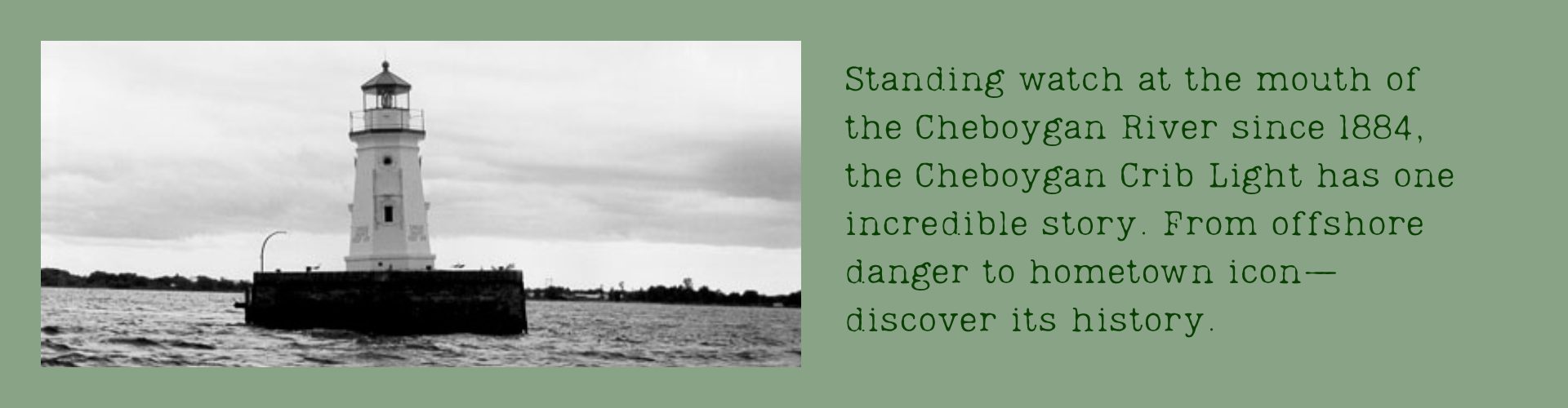
From Offshore Hazard to Hometown Icon
At the mouth of the Cheboygan River, where it meets Lake Huron, stands one of Northern Michigan’s most distinctive navigational lights. Known as the Cheboygan Crib Light, this small but storied beacon has guided vessels for well over a century. Today, it sits proudly at the west pier head in Gordon Turner Park. This location is a familiar landmark and symbol of Cheboygan’s deep maritime roots.
Where the Cheboygan Crib Light Is Located
The Cheboygan Crib Light marks the west pier head at the entrance of the Cheboygan River into Lake Huron. It stands at the lake end of Huron Street, right in the heart of the city. This makes it one of the most accessible historic lights in Northern Michigan. Its location within Gordon Turner Park has turned it into both a navigational aid and a community gathering point.
Why It’s Called a “Light,” Not a Lighthouse
Unlike traditional lighthouses, the Cheboygan Crib Light was never designed with living quarters for a keeper. Because there was no structure for habitation, it is technically classified as a “light” rather than a lighthouse. This distinction played a major role in how it was operated—and how challenging that job could be.
1884–1920: A Staffed Light on the Water
The Cheboygan Crib Light was first constructed in 1884 on a crib—an artificial island built of timber and fill—more than 2,000 feet offshore in Lake Huron. The keeper is believed to have lived in Cheboygan. He rowed or boated out to the light every day, regardless of weather, to maintain the kerosene-fired lamp. This was dangerous work, especially during rough conditions.
To make servicing safer, davits were eventually installed so boats could be lifted out of the water and protected from waves. In 1901, the structure was painted white to improve its visibility as a daymark. Two years later, in 1903, the original wooden structure was removed down to just below the waterline and replaced with a much sturdier concrete and steel tower. Iron railings were also added to improve safety.
In 1906, a schooner struck the rebuilt light, causing significant damage. As a result, a fog bell was installed to help prevent future collisions, and the railings were replaced. By 1911, the station received an automated fog bell that emitted a single stroke every ten seconds. This was a sound mariners would have known well.
1920–1929: Automation and the End of the Keeper Era
In 1920, the U.S. Lighthouse Service automated the Cheboygan Crib Light. Kerosene was replaced with acetylene gas, delivered periodically by traveling crews. A small pilot light burned continuously. When temperatures dropped at sunset, a precision valve opened, allowing acetylene to ignite and illuminate the light automatically.
When the last lighthouse keeper departed in 1929, the structure quickly fell into disrepair. Locals began calling it “The Dummy,” a nickname that stuck and reflected both its unmanned status and neglected condition.
Saving the Light: Relocation and Restoration
By the latter half of the 20th century, advances like radar and electronic navigation systems made many traditional lights seem obsolete. As a result, the Coast Guard declared the Cheboygan Crib Light surplus property and planned to demolish it.
Cheboygan residents pushed back against this decision. An agreement was reached to donate the light to the city, preserving a beloved piece of local history. In 1984, the tower was removed from its offshore crib and relocated to its current position on the west breakwall at Gordon Turner Park.
Since then, restoration work has been completed, and the grounds remain open to the public. The light is now electrically powered. It is maintained through a partnership between the City of Cheboygan and a dedicated local support group.
A Symbol of Cheboygan Today
In 2003, the city officially cleared the title to the Cheboygan Crib Light, ending its status as surplus federal property. Today, the light is widely regarded as a symbol of Cheboygan. It reflects resilience, community pride, and the city’s long connection to Lake Huron.
Whether you’re watching freighters pass, enjoying a walk along the pier, or learning about Northern Michigan’s maritime past, the Cheboygan Crib Light continues to shine. It serves as both a navigational aid and a reminder of the people who refused to let their history disappear.
Explore our full collection of Northern Michigan lighthouse stories here
Start planning your trip today and explore the legacy of Michigan’s maritime history!
📍 Explore the Map Below