Lighting the Gaps Along Lake Huron’s Shore
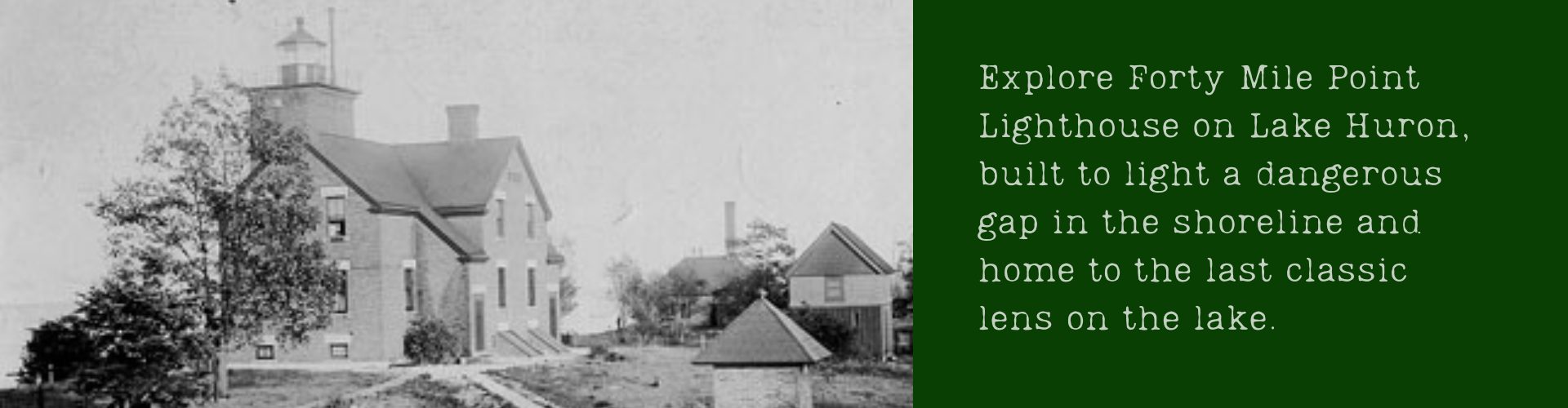
Tucked along the western shore of Lake Huron near Hammond Bay, Forty Mile Point Lighthouse quietly tells a story of necessity, persistence, and Great Lakes resilience. Unlike many lighthouses built to guard busy harbors or river mouths, this light exists for a different reason. It ensures mariners were never left navigating the Lake Huron shoreline in complete darkness.
Why Forty Mile Point Was Built
By the late 1800s, most of the Presque Isle Peninsula was already illuminated. New Presque Isle Light to the south and Spectacle Reef Lighthouse offshore cast long beams across Lake Huron. However, an 8.7-mile stretch of coastline between them remained dangerously dark. For ships traveling between Mackinaw Point and the St. Clair River, this unlit gap posed a serious risk.
In 1890, the Lighthouse Board formally recommended funding for a new light at Forty Mile Point. It was named for its location exactly 40 miles by water from Old Mackinaw Point. Congress, however, was slow to act. It took five years before the project was finally approved. Construction began in the mid-1890s, following a design nearly identical to 14 Mile Point and Big Bay Point lighthouses on Lake Superior.
Design and Living Quarters
The lighthouse was built on wooden pilings with a substantial red brick structure measuring 35 by 57 feet. Its walls were engineered with three courses of brick and a two-inch dead air space. Additionally, it had an extra brick course, an early nod to insulation against harsh Great Lakes weather. The integrated square tower rises 52 feet above the ground.
Inside, the building housed two identical apartments: one for the head keeper and one for the assistant keeper. This practical layout reflects the era when lighthouses were not just aids to navigation. They were also full-time homes for the families who maintained them.
Lighting the Lake
Although construction was completed in November 1896, the light was not first illuminated until April 1, 1897. This was when shipping resumed after winter. The original light was a fourth-order Fresnel lens manufactured by Sautter & Co. of Paris. Featuring six bull’s-eye panels and a clockwork rotation system, it produced a white flash every ten seconds.
That original lens was relocated in 1919 to the Sand Hills Lighthouse near Eagle River on Lake Superior. The lens currently in place is especially notable. It is a composite lens made from parts of at least three different lenses. This includes one panel crafted by Henry-Lepaute of Paris in 1872. It remains the last working classic lens on Lake Huron, now flashing with a three-seconds-on, three-seconds-off characteristic.
The station was automated in 1969 and continues to operate today, marked by its white exterior and black lantern.
The Graveyard of Ships
Forty Mile Point is also tied to one of Lake Huron’s most infamous chapters. During the “Big Blow” of 1905, a massive storm claimed 27 wooden vessels. One of them, the steamer Joseph S. Fay, ran aground near the lighthouse. A portion of its hull still rests on the beach roughly 200 feet north of the tower.
A Michigan Historical Marker on site commemorates the area known as the “Graveyard of Ships.” It notes that Lake Huron—called La Mer Douce by early French explorers—has claimed more than 1,200 recorded shipwrecks. Additional losses came during the Great Storm of 1913, which sank many newer, steel-hulled ships.
Visiting Forty Mile Point Today
Today, Forty Mile Point Lighthouse is part of a well-marked Presque Isle County park. It is located about six miles north of Rogers City along U.S. 23. The lighthouse anchors the northern end of the seven-mile Huron Sunrise Trail. This is a scenic bike path that runs past Hoeft State Park and into Rogers City.
The lighthouse itself is owned by Presque Isle County. The museum and gift shop are operated by the Forty Mile Point Lighthouse Society. Together, they help preserve this important piece of Great Lakes maritime history. They also welcome visitors to explore, learn, and linger along the Lake Huron shoreline.
Explore our full collection of Northern Michigan lighthouse stories here
Start planning your trip today and explore the legacy of Michigan’s maritime history!
📍 Explore the Map Below