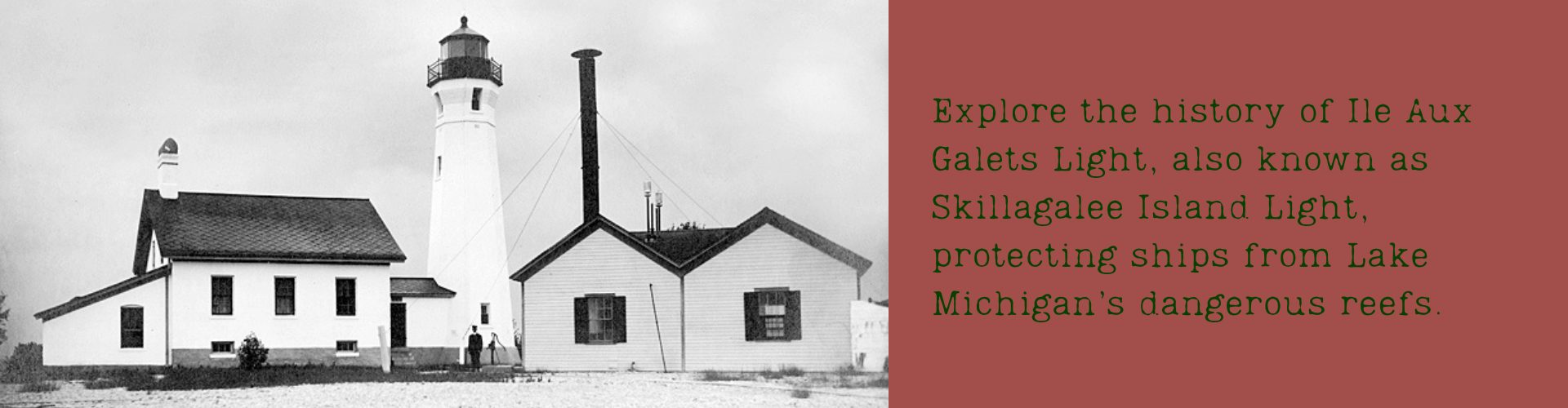
Northern Michigan’s Rugged Lake Guardian
Nestled in the northeast waters of Lake Michigan, between Beaver Island and the mainland, lies Ile Aux Galets, more commonly known as Skillagalee Island. This low, gravelly island—roughly seven miles northwest of Cross Village in Emmet County—is home to a lighthouse. It has protected mariners from the treacherous shoals of Waugoshance Point for over a century. Along with nearby Grays Reef, Waugoshance, and White Shoal Lights, Ile Aux Galets Light stands as a vital warning beacon for ships navigating these perilous waters.
A Name with History
The island’s French name, Ile Aux Galets, translates to “Isle of Pebbles,” a nod to its rocky terrain. Early French explorers christened it so, but English speakers struggled with the pronunciation. Over time, “Ile Aux Galets” because it was misheard the name transformed into Skillagalee, a name that stuck in official U.S. Lighthouse Board records by 1889. By the early 20th century, the original French name regained official use. It is the name recognized by the U.S. Coast Guard today. The island also hosts a large colony of ring-billed gulls, making it a small but lively natural habitat.
From Tragedy to a Lighthouse
Skillagalee Island has a long history of shipwrecks. One of the most notable was the A.D. Patchin, a wood sidewheeler built in 1846. On September 27, 1850, the Patchin’s course into Grays Reef Passage was thrown off by strong currents and left stranded on the island’s shore. Though the crew survived, it destroyed the ship. This highlighted the urgent need for a lighthouse. Congress responded in 1851, authorizing construction of the first light. The harsh conditions caused rapid deterioration, leading to a replacement in 1868.
The Lighthouse That Stands Today
The current lighthouse, built in 1888 stands 48 feet tall. It features a fourth-order Fresnel lens considered state-of-the-art at the time. A unique design that is only with Port Sanilac Light on Lake Huron. In 1890, the station upgraded its fog signals from a steam siren to 10-inch steam whistles. It required 26 tons of coal to operate in a year. Maintenance was a full-time job, and keepers lived in challenging conditions while ensuring the light and fog signals operated flawlessly.
Automation and Preservation
The lighthouse remained staffed until 1969. The Coast Guard removed all the associated buildings, including the keeper’s house, fog signal building, and boathouse. This left only the tower. Equipped with an automated 12-inch ML-300 Tideland Signal lens and powered by solar panels and batteries. Declared excess to the Coast Guard’s needs in 2011, it is available to eligible organizations under the National Historic Lighthouse Preservation Act. Today, the light is listed on the National Register of Historic Places (Reference #84001389).
Visiting Skillagalee Island Light
Approaching Skillagalee Island is extremely hazardous due to shallow waters, unpredictable weather, and dangerous reefs. Access is limited to small boats or sea kayaks because there is not landing facilities. The tower is closed to the public, but visitors can admire the lighthouse from a distance. Despite these challenges, the lighthouse remains a striking reminder of Lake Michigan’s maritime history. It shows the dangers faced by early sailors.
A Beacon of Northern Michigan History
Ile Aux Galets Light stands as a testament to the persistence and ingenuity of lighthouse keepers and engineers. They safeguarded mariners navigating one of Lake Michigan’s most treacherous regions. Its story combines French exploration, maritime tragedy, and engineering achievement. This makes it an essential chapter in Northern Michigan’s rich nautical heritage.
Explore our full collection of Northern Michigan lighthouse stories here
Start planning your trip today and explore the legacy of Michigan’s maritime history!
📍 Explore the Map Below