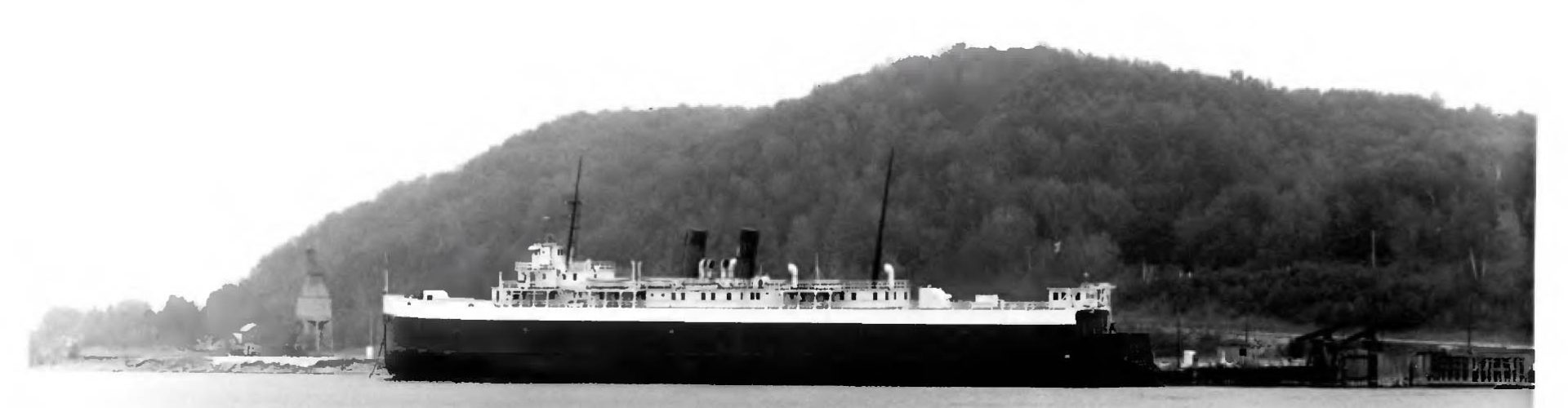
Along the waterfront of Manistee Lake rests a remarkable survivor, a steel giant built during the golden era of Great Lakes transportation. The S.S. City of Milwaukee, launched in 1931, is more than a museum ship. She’s the final unmodified traditional railroad car ferry still afloat, the last link to a time when rail cars sailed across Lake Michigan instead of circled around it.
Today she is a National Historic Landmark, meticulously preserved by the Society for the Preservation of the S.S. City of Milwaukee. But her story begins long before she settled into retirement along the Manistee shoreline.
A Ship Built in the Wake of Disaster
The City of Milwaukee owes her existence to tragedy. In October 1929, the original SS Milwaukee sank in a fierce gale, taking its entire crew and cargo with it. The loss left a critical gap in the Grand Trunk Railroad’s fleet, prompting the construction of a new vessel built stronger, safer, and more efficient.
In 1930, the Manitowoc Shipbuilding Company of Wisconsin laid her keel. By 1931, she slid into the water, a 360-foot steel-hulled powerhouse designed to carry heavy rail cars across Lake Michigan in all seasons.
She would become the last of six sister ships built during the late 1920s and early 1930s, a group that once formed the backbone of cross-lake railroad transportation.
Engineering Power: Built for the Toughest Waters
The City of Milwaukee was engineered to push through the harshest wind, waves, and winter ice Lake Michigan could throw at her.
Technical Highlights
- Length: 360 ft
- Carrying capacity: 28–32 fully loaded rail cars
- Valves & Layout: Eight watertight compartments from bow to stern
- Propulsion:
- Four Scotch marine boilers producing 185 psi
- Two triple-expansion steam engines, each 1,350 hp
- Combined 2,700 hp driving twin 12-ft, 10,000-lb propellers
- Fuel: Coal until 1947; converted to Bunker C fuel oil thereafter
Her shallow draft allowed rail cars to load easily, while her reinforced hull enabled her to plow through ice during winter crossings.
The car deck featured four pairs of rails with additional anchor rails securing rail cars with heavy chains. Above the car deck sat the engineering spaces, crew quarters, mess areas, galley, and passenger staterooms. The texas deck housed officers’ quarters, topped by the pilot house, the command center of the ship.
She was designed for utility but built with craftsmanship. Many of her original wood panels, brass fixtures, and mechanical systems remain untouched today.
The Golden Era of Great Lakes Car Ferries
Railroad car ferries were once a defining feature of Great Lakes commerce. Introduced in 1892, these ships allowed railroads to bypass Chicago’s congested traffic and avoid the slow, sometimes impassable overland winter routes.
At the system’s peak, 14 ferries operated on Lake Michigan, carrying up to 34 rail cars per trip.
For railroads, these ferries were floating shortcuts, saving time, avoiding bottlenecks, and ensuring reliable delivery regardless of season.
For crew members, life onboard meant long shifts, harsh weather, and a unique sense of camaraderie forged on the water.
The City of Milwaukee sailed during the final decades of this era.
Service Life: Crossing Lake Michigan
From her launch in 1931 until 1978, the City of Milwaukee sailed for the Grand Trunk Railroad, primarily operating between:
- Muskegon, Michigan
- Milwaukee, Wisconsin
She transported rail cars, goods, and passengers across the lake year-round. Her reliability made her one of the most trusted ships in the fleet.
By the late 1970s, however, the decline of ferry-based rail transport had begun. Roads improved, trucking expanded, and the economics of ferry operations shifted.
In 1978, she became the last Grand Trunk ferry still in service. She was then chartered to the Ann Arbor Railroad, serving until her final retirement in 1982.
Her engines went quiet but her story was far from over.
Preservation and Landmark Status
After retirement, the ship was acquired by the Society for the Preservation of the S.S. City of Milwaukee, a nonprofit dedicated to saving the last surviving car ferry of her era.
Decades of work went into restoring her interiors, maintaining her steelwork, and preserving her original machinery. Because she was never converted to diesel or modernized structurally, the City of Milwaukee is a rarity—an untouched example of early 20th-century maritime engineering.
In 1990, she was officially designated a National Historic Landmark, cementing her importance as a piece of American and Great Lakes history.
Life as a Museum Ship
The City of Milwaukee is now moored on Manistee Lake, where she serves as:
- A guided tour museum
- A hands-on educational experience
- A preserved example of Great Lakes maritime engineering
- A venue for community events
- A seasonal bed and breakfast
Visitors can walk through the spaces where engineers shoveled coal, officers kept watch, cooks prepared meals, and passengers stared out across stormy waters.
The engine and boiler rooms remain among the most impressive features, massive steel spaces filled with pipes, valves, and towering machinery that powered decades of cross-lake commerce.
Her pilot house offers a panoramic view of Manistee Lake, making it easy to imagine navigating through fog, ice, or night crossings.
Manistee’s Ghost Ship: A New Chapter
In the early 2000s, volunteers began transforming sections of the ship into a haunted attraction each October. The event quickly grew into one of Michigan’s most acclaimed seasonal experiences.
The annual Ghost Ship is not only entertainment, it has become a major fundraiser for the City of Milwaukee’s preservation efforts, drawing thousands of visitors and providing essential support for ongoing restoration work.
Each year new sets, props, and paths are built, an impressive feat inside the confines of a historic vessel. This blending of history and creativity has helped keep the ship relevant, visited, and cherished by the community.
Why Her Preservation Matters
The S.S. City of Milwaukee represents:
- A vanished era of rail and maritime history
- A testament to early 20th-century engineering
- A symbol of the Great Lakes’ economic past
- One of the last surviving car ferries of her type in the world
Her survival is remarkable. Her continued preservation ensures future generations can understand how railroads and maritime travel shaped the region.
Ships like her were once common on the lakes. Now, she is the sole unmodified representative of that history.
Visiting Today
A visit to the City of Milwaukee is more than a tour, it’s an immersion into Michigan’s industrial and maritime heritage.
Whether you explore the decks, attend an event, or stay overnight, you are stepping into a story nearly a century long. The hum of the engines may be gone, but the echo of her voyages remains in every corridor and riveted steel panel.
Floating Monument
The S.S. City of Milwaukee stands today as a floating monument to the Great Lakes’ past, beautifully preserved, deeply significant, and lovingly cared for. Her story is one of resilience, innovation, and transformation. As both museum and landmark, she keeps the memory of a vibrant era alive for all who come aboard.
If you’re fascinated by maritime history, industrial engineering, or Michigan’s historic identity, this remarkable ship is a must-see. She is the last of her kind, and she continues to tell her story from the shores of Manistee.
While there make sure to visit the USCGC Acacia that was decommissioned on June 7, 2006, after 62 years of continuous service, the longest of any vessel in her class.
After an unsuccessful attempt to establish a museum in Chicago, Acacia steamed under her own power to Manistee in October 2009. She was formally dedicated as a museum ship in August 2011 and is now preserved alongside the SS City of Milwaukee National Historic Landmark.