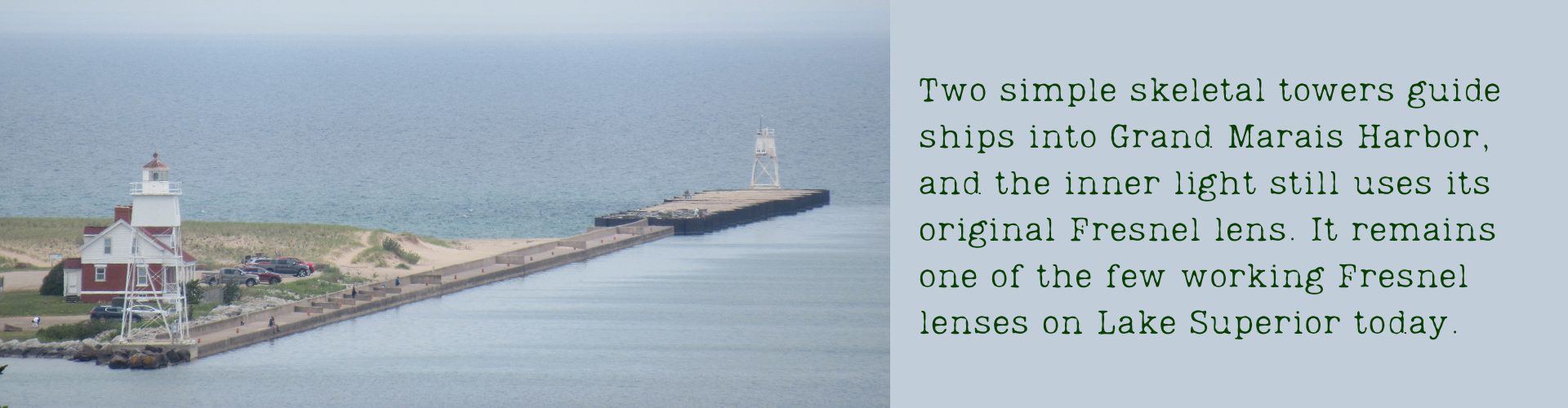
On the southern shore of Lake Superior, the small harbor at Grand Marais tells a story shaped by wind, water, and the steady movement of ships. Today, two slender white towers stand along the west pier, guiding vessels just as they have for more than a century. Known as the Grand Marais Harbor of Refuge Inner and Outer Lights, these paired beacons reflect both the ambitions of Great Lakes commerce and the practical challenges of navigating one of the world’s most powerful inland seas.
Building a Harbor of Refuge
In the late nineteenth century, shipping traffic on Lake Superior increased dramatically. Steam powered vessels carried iron ore, timber, and other cargo across long and often dangerous stretches of open water. Between Whitefish Bay and Grand Island, mariners found few safe places to seek shelter during sudden storms.
Recognizing this gap, the United States Army Corps of Engineers began improving the harbor at Grand Marais in 1881. Over the next decade, crews dredged the harbor basin and built a timber pile breakwater that stretched nearly a mile across the entrance. A shipping channel was cut into the harbor, and two timber crib piers, each about seven hundred feet long, were constructed on either side of the channel. These piers were extended gradually, section by section, as work continued.
The First Light on the Pier
As the harbor neared completion, officials understood that improved navigation aids would be essential. In 1892, the Lighthouse Board requested funding to place a light and fog signal at the head of the western pier. Congress approved the project in 1895.
Plans moved forward quickly. A prefabricated skeletal tower was built and installed by November of that year. To reduce costs, a fog signal that had previously served at Point Iroquois was relocated to Grand Marais. No permanent keeper’s quarters were included in the initial construction. Instead, the keeper lived in what was described as a temporary shanty, a modest arrangement that reflected both the remote setting and the tight budget.
Adding a Range Light
Mariners soon recognized that a second light would greatly improve navigation into the harbor. Range lights work together by forming a visual line that guides vessels safely through narrow channels. When the two lights appear aligned from a ship’s deck, the vessel is on the correct course.
The Lighthouse Board requested that unused project funds be redirected to construct a rear range light. Congress agreed in 1897, and by the following year a second prefabricated tower stood farther inland along the pier. Together, the two lights created a clear and dependable guide into Grand Marais Harbor.
Changes Along the Pier
In 1905, the west pier was extended more than six hundred feet. The following year, the outer range light was moved to the new pierhead to maintain its position at the harbor entrance. A permanent keeper’s dwelling was finally built in 1908, replacing the earlier temporary shelter.
As vessel size increased across the Great Lakes, the strategic importance of Grand Marais Harbor gradually declined. By the 1940s, the Army Corps of Engineers stopped maintaining the timber breakwater. Without regular repairs, the structure deteriorated, allowing sand to accumulate and slowly fill portions of the harbor.
During this same period, responsibility for the lights passed to the United States Coast Guard. In the 1960s and 1970s, sections of the pier were reinforced with concrete. The west pier was extended again by more than eight hundred feet through the addition of a cellular sheet pile structure. Keepers continued to live in the nearby house until 1982. Two years later, the Grand Marais Historical Society received the building and restored it for public use.
Technology and Preservation
Both range lights remain active today. The outer light has been fitted with a modern acrylic lens, a change that reflects evolving lighthouse technology. The inner light, however, still uses its original Fresnel lens. These precision crafted lenses once revolutionized lighthouse illumination and are now increasingly rare in active service.
The keeper’s house now operates as a museum, offering visitors a chance to explore the daily life and responsibilities that once defined lighthouse work along Lake Superior’s rugged shore.
A Pair of Working Beacons
Standing more than half a mile apart, the Grand Marais Harbor lights share a distinctive appearance. Each tower is a prefabricated skeletal structure made of iron or steel, painted white and bolted securely to the pier. The outer light rises thirty four feet above the deck, while the inner light stands fifty five feet tall.
Though modest in scale, these towers continue to fulfill the role they were designed for more than a century ago. They guide vessels safely toward shelter, just as they did when steamships first crowded the waters of Lake Superior.
Their story is one of adaptation and endurance. In a place where storms can rise without warning, the steady glow of these lights remains a quiet promise of safe passage.
Explore our full collection of Northern Michigan lighthouse stories here
Start planning your trip today and explore the legacy of Michigan’s maritime history!
📍 Explore the Map Below