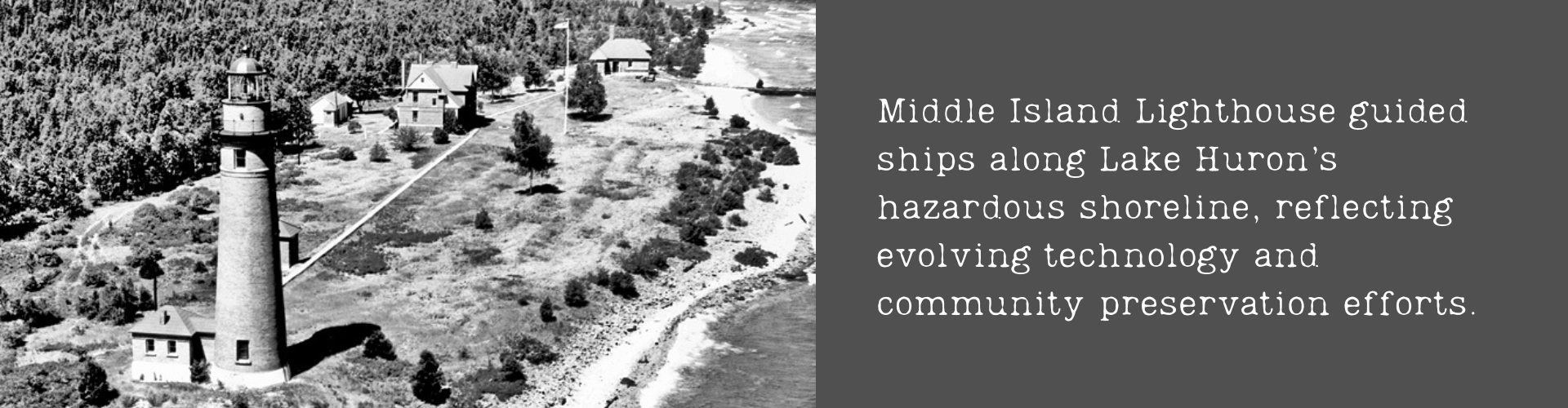
Rising from the waters of Lake Huron about ten miles north of Alpena, Middle Island Lighthouse marks a place that long held importance for mariners navigating the Michigan shoreline. Positioned midway between Thunder Bay and Presque Isle, the island offered both refuge and risk. Its sheltered harbor provided protection during storms. Yet, surrounding shoals made approach difficult and dangerous.
Recognizing a Hazard on the Lake
By the late nineteenth century, the hazards near Middle Island were well known. In 1881, the United States Life Saving Service established a station on the island to assist vessels in distress. As shipping traffic continued to increase along this stretch of Lake Huron, calls for a permanent lighthouse grew stronger.
The United States Lighthouse Board requested funding in 1896, though the proposal did not move forward for several years. Finally, in 1902, Congress appropriated funds for the construction of a lighthouse and fog signal. As a result, the project would become one of the final links in a chain of navigation aids guiding ships along Michigan’s Lake Huron coast.
Building the Light
Preparations began in 1903, with construction contracts awarded the following year. Work started during the summer of 1904 and continued through the shipping season. After winter delays, crews returned in 1905 to complete the project. The light was first illuminated on June 1, 1905.
The original lighting system relied on an oil burning lamp paired with a red fourth order Fresnel lens. This combination provided a distinctive signal visible across the open waters. They added an oil storage shed in 1906 to support daily operations at the station.
Growth and Technological Change
Advancements in lighthouse technology brought updates over time. In 1928, the oil fueled system was replaced with an electrically powered third order Fresnel lens. This lens displayed a green light. Improvements were also made to the fog signal. These updates reflected ongoing efforts to enhance safety in periods of low visibility.
In 1939, the tower was repainted white with a horizontal band to improve its daytime visibility. The color of this band was later changed, marking another chapter in the lighthouse’s evolving appearance.
Automation arrived in 1961, ending the era of resident keepers. Without regular supervision, the site experienced extensive vandalism during the following decade. Attempts at restoration began in the 1980s, though progress was limited.
Community Preservation Efforts
A turning point came in 1989, when Marvin Theut purchased the keeper’s house and fog signal building. His efforts led to the formation of the Middle Island Lighthouse Keepers Association. This group began work to stabilize and restore the property.
By 2001, owners had adapted the fog signal building for use as a bed and breakfast. This adaptation offered visitors a unique connection to the island’s maritime history. In 2010, the government declared the lighthouse surplus. hey transferred ownership to the preservation group two years later. The group soon formed the Middle Island Lighthouse Preservation Society to continue restoration work.
A Distinctive Station Complex
The Middle Island Light station includes three primary structures arranged along cement walkways. The conical brick tower stands several hundred feet from the double keeper’s house. Meanwhile, the fog signal building sits on the opposite side of the residence.
Constructed of brick on stone foundations, the tower rises seventy feet to the center of the lantern. It reaches eighty feet at its highest point. Its tapered design narrows from a broad base to a smaller diameter near the top. In this way, it gains a strong yet graceful profile.
The keeper’s house is a two story red brick structure divided into two apartments. Each apartment contains six rooms. Nearby, the fog signal building features a hip roof and an additional section. This section was added to house hoisting equipment used during its operational years.
Guiding Ships on Lake Huron
Today, Middle Island Lighthouse remains an important reminder of the region’s maritime past. Its presence reflects both the dangers faced by early mariners and the determination of communities dedicated to preserving these historic landmarks.
Standing between open water and sheltered harbor, the lighthouse continues to symbolize the enduring relationship between Michigan’s shoreline and the ships that once depended on its guiding light.
Explore our full collection of Northern Michigan lighthouse stories here
Start planning your trip today and explore the legacy of Michigan’s maritime history!
📍 Explore the Map Below