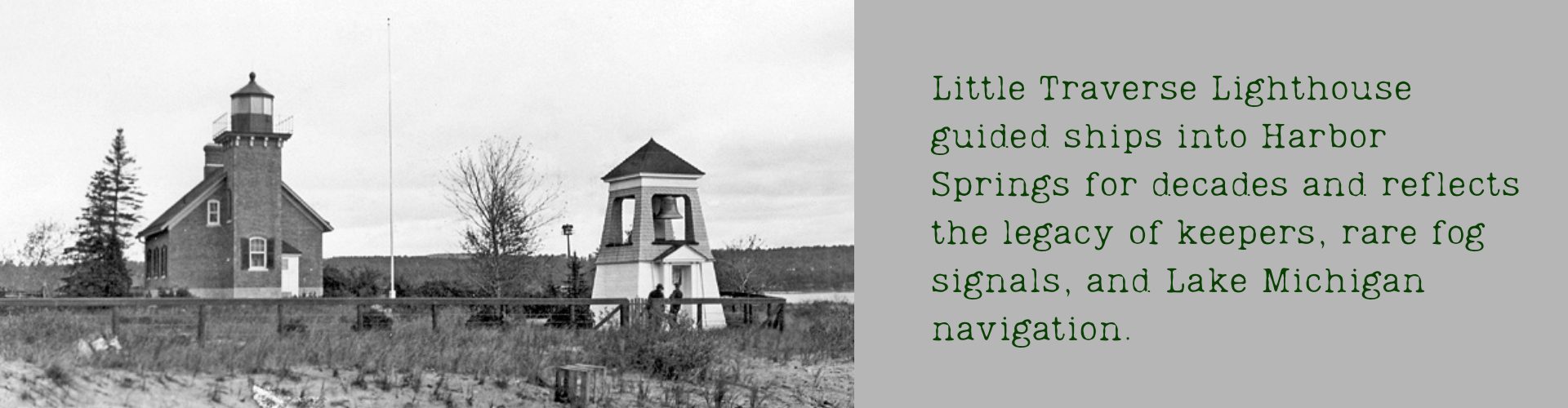
On the north side of Little Traverse Bay, a graceful lighthouse stands at Harbor Point near Harbor Springs. Known as the Little Traverse Light, it has long marked the entrance to one of Lake Michigan’s most sheltered harbors. Though now surrounded by private homes, its history reflects both the growth of regional navigation. It also reflects the lives of those who kept its beam shining.
A Needed Beacon on the Bay
By the early 1870s, increasing vessel traffic along the Lake Michigan shoreline highlighted the need for reliable navigation aids at Little Traverse Bay. Engineer Orlando Metcalfe Poe recommended the construction of a lighthouse in 1871. He recognized the importance of guiding ships safely into Harbor Springs.
Financial constraints delayed the project for more than a decade. Finally, the site was purchased in 1883. Construction of the lighthouse was completed the following year under the direction of the United States Lighthouse Service.
Design and Construction
The Little Traverse Light was built as a compact but elegant station. Its tower rises from an attached keeper’s dwelling. Both were constructed to withstand the region’s demanding weather. At the top, a decagonal lantern room painted white and capped with a red roof houses the original fourth order Fresnel lens.
Manufactured in Paris by the firm of L. Sautter, Lemonnie and Company in 1881, the lens reflects the international craftsmanship often found in American lighthouse construction during the nineteenth century.
Supporting buildings once included a brick paint locker, a summer kitchen, a wooden boat shed, and later an automobile garage. Together, these structures formed a working complex that sustained daily operations on the point.
The Fog Bell Tower
In 1896, a distinctive fog signal structure was added near the lighthouse. This square pyramidal tower housed a striking mechanism that sounded a bell during periods of low visibility. The design is considered rare among Great Lakes fog signals, and the original mechanism remains in place today.
Keepers and Daily Life
For nearly eighty years, lighthouse keepers maintained the station and ensured that its light remained dependable. Among them was Elizabeth Whitney Williams, one of the earliest female lighthouse keepers on the Great Lakes. Her memoir offers a rare personal account of life at the station. She describes both the responsibilities and the quiet rhythms of work along the bay.
Automation and Change
In 1963, a modern skeletal tower was constructed east of the original lighthouse. This replacement structure rises sixty two feet with a focal plane of seventy two feet. It displays a green flash every six seconds. With its installation, the historic lighthouse was deactivated and no longer required a resident keeper.
Today, the original building remains privately owned and is not open to the public. Located within a gated community, it can only be viewed from a distance or by boat on the bay. Despite this limited access, the lighthouse continues to inspire artists and historians drawn to its distinctive setting.
A Quiet Presence on Little Traverse Bay
Though no longer active, Little Traverse Lighthouse remains an enduring symbol of Harbor Springs’ maritime heritage. Its elegant form, rare fog bell tower, and connections to notable keepers reflect a time when careful navigation was vital. They also reflect a time when dedicated service shaped life along Lake Michigan’s shore.
Standing on Harbor Point, it still marks the entrance to the harbor. It quietly recalls the vessels that once depended on its steady light.
Explore our full collection of Northern Michigan lighthouse stories here
Start planning your trip today and explore the legacy of Michigan’s maritime history!
📍 Explore the Map Below