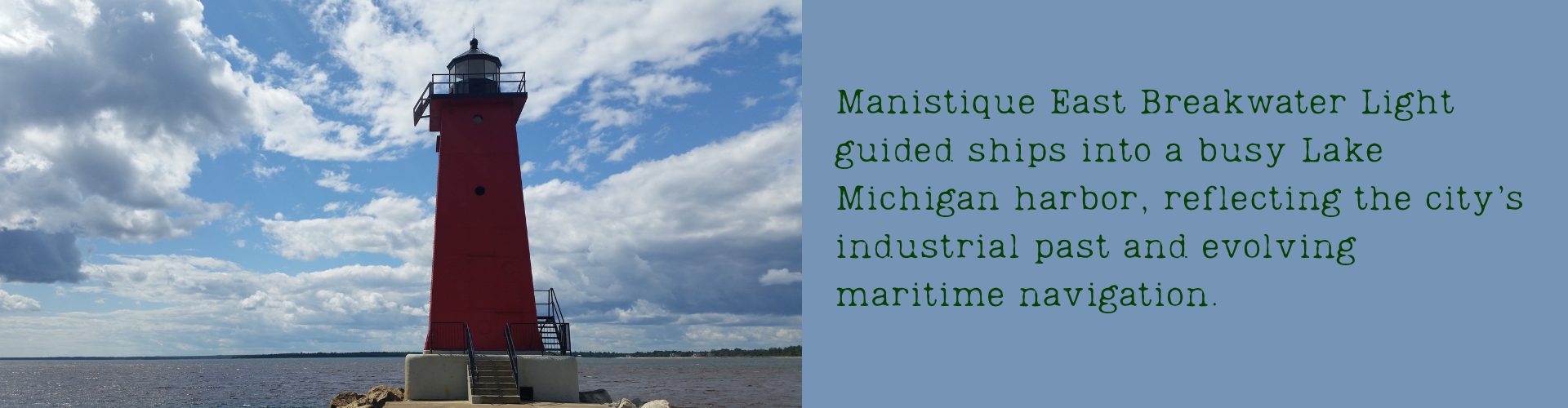
At the edge of Manistique’s harbor, a compact steel tower stands as a reminder of the city’s once thriving maritime past. Officials built the Manistique East Breakwater Light during a period when the harbor bustled with activity, serving as a gateway for timber, pig iron, and other cargo moving across Lake Michigan
A Harbor in Need of Protection
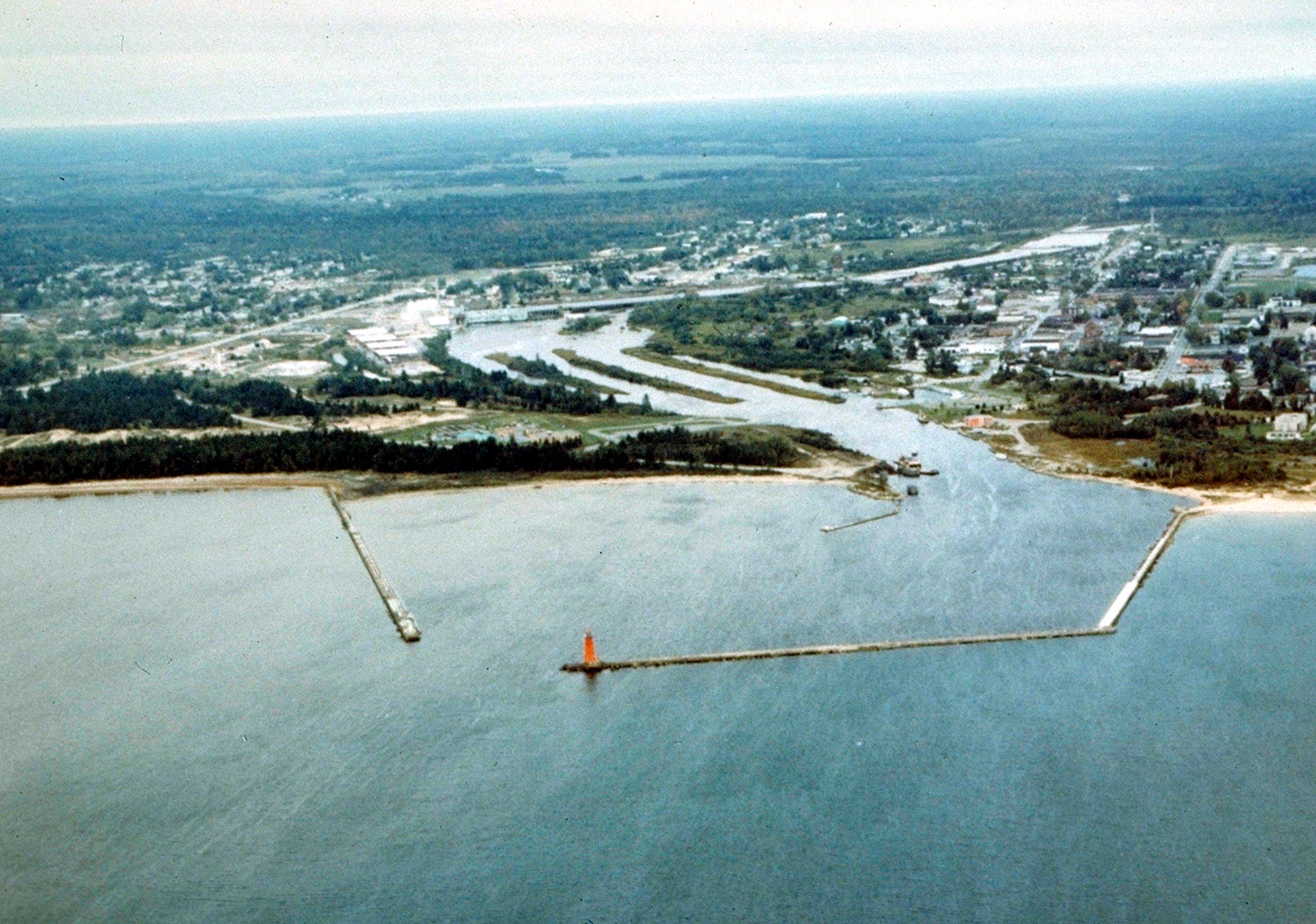
During the late nineteenth century, timber crib piers protected Manistique’s harbor. These early structures, constructed in the 1870s, provided limited shelter from storms that could quickly turn dangerous. As shipping increased, local leaders recognized the need for stronger harbor defenses.
By 1910, their efforts had drawn federal attention. An Army Corps of Engineers expert arrived to develop plans for a more durable concrete breakwater system. They awarded construction contracts to the Greiling Brothers Company, and work began that same year. These improvements marked an important step in securing the harbor’s role as a regional shipping center.
Planning for Navigation
At the same time harbor construction was underway, George Putnam, then Commissioner of Lighthouses, recommended installing navigation lights along the new breakwaters. In 1912, the U.S. Lighthouse Service placed temporary range lights on one of the piers to guide vessels safely into the harbor
Congress approved funding for permanent structures in 1913. By the following year, they had completed lights on the west breakwater. Work on the east breakwater continued until 1915, after which construction began on a new light tower and a station keeper’s house near the base of the pier.
The Manistique East Breakwater Light was completed in August 1916. Its beacon was first illuminated on August 17 of that year, marking a new era of improved navigation for ships entering the harbor.
 Design and Construction
The lighthouse reflects the practical engineering approach of the early twentieth century. Built on a cast concrete foundation, the square tower rises approximately thirty eight feet above the breakwater. Its structure consists of prefabricated steel plates bolted together and securely fastened to the base.
At the top, a square gallery supports a decagonal cast iron lantern. Originally, the lantern housed a fourth order Fresnel lens, whose distinctive red light helped mariners distinguish the harbor entrance from other shoreline features.
Changing Times on the Waterfront
As the twentieth century progressed, Manistique’s prominence as a shipping port gradually declined. Advances in transportation and shifting trade patterns reduced the volume of cargo moving through the harbor. Reflecting these changes, the lighthouse was automated in 1969. The original Fresnel lens was replaced with a modern acrylic optic, simplifying maintenance while preserving its navigational function.
In 2000, the Army Corps of Engineers replaced portions of the aging concrete breakwater with rip rap, further adapting the harbor to changing conditions.
Preservation and Ownership
Efforts to transfer the lighthouse under the National Historic Lighthouse Preservation Act began in 2012. When no qualifying organization assumed stewardship, the structure was offered for sale through a federal auction process. It was purchased by a private individual in 2013.
The Manistique East Breakwater Light had already been recognized for its historical significance, earning a place on the National Register of Historic Places in 2005.
A Small Tower with a Lasting Role
Though modest in size, the lighthouse continues to represent an important chapter in Manistique’s maritime story. Its steel tower reflects the era when industrial shipping shaped the region’s economy, while its steady light still marks the harbor entrance for modern vessels.
Standing against the open waters of Lake Michigan, it remains a quiet reminder of the city’s connection to the rhythms of Great Lakes commerce.
Explore our full collection of Northern Michigan lighthouse stories here
Start planning your trip today and explore the legacy of Michigan’s maritime history!
📍 Explore the Map Below