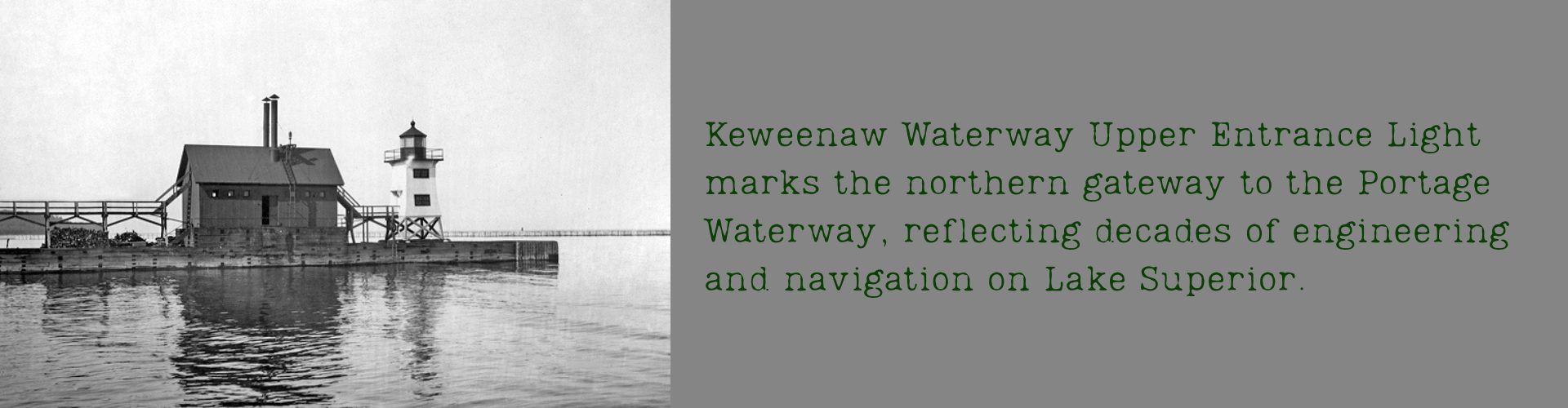
At the northern end of the Portage Waterway, where the canal meets the open waters of Lake Superior, the Keweenaw Waterway Upper Entrance Light stands within what is now McLain State Park. This lighthouse reflects decades of engineering work. Over time, this work transformed the Portage River into a vital passage across Michigan’s Keweenaw Peninsula.
Early Navigation Improvements
The Portage River was first dredged in 1860, creating a navigable shortcut that allowed vessels to cross the peninsula rather than sail around its exposed northern coast. As traffic increased, the need for reliable navigation aids at the waterway’s entrance became clear.
Congress appropriated funds in 1873 for a lighthouse, and the first structure was completed the following year atop a nearby bluff. As harbor improvements continued, protective piers were constructed at the canal’s mouth. A wooden tower was placed on one of these piers in 1879, and a steam powered fog signal was added in 1887.
Expanding the Waterway
Federal ownership of the canal began in 1891, leading to a sustained program of improvements under the direction of the United States Army Corps of Engineers. The pierhead light was upgraded in the mid 1890s, and additional breakwaters were built by the early twentieth century. As a result, pyramidal tower lights marked the ends of these structures, guiding ships safely into the canal.
In the 1930s, a major widening project reshaped the waterway. The original 1874 lighthouse was demolished during this work and replaced with a new tower in 1937. Further modifications to the breakwaters in the late 1940s required removing earlier lights. Therefore, this led to the construction of the present pierhead lighthouse in 1950.
Architecture and Engineering
The Keweenaw Waterway Upper Entrance Light reflects mid twentieth century lighthouse design and engineering. Its foundation consists of a large circular caisson formed from interlocking steel sheet piling and filled with rock for stability. This base supports a reinforced concrete deck elevated above the lake’s surface.
Atop the deck sits a single story fog signal building with clipped corners and a clean geometric profile. Painted white, the structure exemplifies aspects of the Streamlined Moderne style that influenced industrial architecture during the period.
Rising from the center of this building is a five story steel light tower. Its tapered form and curved surfaces create a distinctive silhouette against the horizon. In addition, port style windows punctuate the upper levels, while the flat roof supports the modern marine beacon that continues to serve mariners today.
Automation and Modern Operation
The lighthouse was automated during the 1970s, ending the need for resident keepers. Advances in navigation technology have allowed the light to operate reliably with minimal maintenance. Still, its role remains essential for vessels entering the canal from Lake Superior.
Recognized for its architectural and historical significance, the Keweenaw Waterway Upper Entrance Light was added to the National Register of Historic Places in 2014. Its preservation reflects the broader importance of the Portage Waterway in regional maritime history.
A Gateway Between Waters
Together with its counterpart at the lower entrance, the Upper Entrance Light continues to mark a crucial passage through the Keweenaw Peninsula. Its presence reflects the ongoing relationship between engineering innovation and the demands of Great Lakes navigation.
Standing at the edge of Lake Superior, the lighthouse remains both a functional aid to navigation and a lasting symbol of the region’s maritime heritage.
Explore our full collection of Northern Michigan lighthouse stories here
Start planning your trip today and explore the legacy of Michigan’s maritime history!
📍 Explore the Map Below