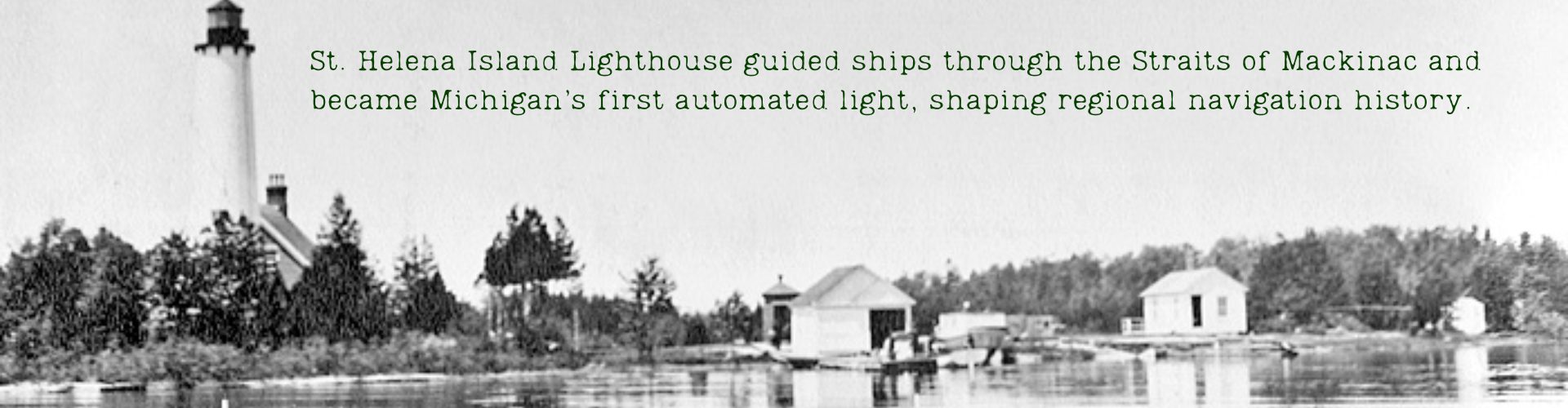
St. Helena Island Lighthouse rises from the southeastern point of a remote island in the Lake Michigan approach to the Straits of Mackinac. Built in the early 1870s, the light became part of a coordinated effort to guide vessels safely through one of the most heavily traveled and hazardous passages in the Great Lakes.
A Strategic Island in the Straits
Located about ten miles west of Mackinac Island, St. Helena Island covers roughly two hundred forty acres. Its natural harbor on the north shore has long provided shelter from strong southwesterly storms that sweep across the length of Lake Michigan. For generations, Native Americans and voyageurs used the island as a refuge during sudden weather changes.
During the Civil War era, growing maritime traffic revealed the dangers posed by a shoal extending from the island. To improve navigation safety, Congress appropriated funds in 1872 for the construction of a lighthouse built of limestone and brick. The new beacon, fitted with a third and one half order Fresnel lens, was first illuminated in September 1873.
Part of a Larger System
St. Helena Island Light became one of a series of fourteen reef lights designed to mark hazardous shoals and channels throughout the Straits of Mackinac. These lights worked together to create a safer corridor for vessels carrying cargo between the upper and lower Great Lakes.
A small support complex grew around the lighthouse. The keepers constructed dwellings, a boat dock, and a boathouse to sustain operations on the isolated island. From its opening until 1922, one or two keepers staffed the station, maintaining the light and ensuring its reliability through changing seasons.
A Pioneer in Automation
In 1922, St. Helena Island Lighthouse became the first in Michigan to lose its resident keeper. Advances in technology made this transition possible. The tower was equipped with an acetylene gas system and a sun valve, an innovative device developed by engineer Gustav Dalén.
This mechanism allowed the light to operate automatically. As evening temperatures dropped, the valve released gas that ignited against a pilot flame. With sunrise, the valve closed, conserving fuel. The success of this system led to its adoption at many other Michigan lighthouses in the years that followed.
Decline and Restoration
After automation, the island’s once active fishing station gradually became deserted. Buildings deteriorated as years passed, and vandalism and neglect caused further damage. In 1980, the United States Coast Guard considered demolishing the remaining structures due to safety concerns, though the plan was never carried out.
In the mid 1980s, restoration efforts began under the leadership of the Great Lakes Lighthouse Keepers Association. Volunteers, including members of a Boy Scouts troop from Ann Arbor, helped clear extensive debris and stabilize the surviving buildings. These efforts marked the beginning of a long term commitment to preserving the site’s historic character.
Ownership of the lighthouse complex was formally transferred to the association in 1997, with the condition that the Coast Guard would continue to operate the navigation light. The surrounding portions of St. Helena Island were later protected through acquisition by the Little Traverse Conservancy.
The Light Today
The lighthouse remains an active aid to navigation and serves as a center for maritime heritage education. Though the original Fresnel lens has been lost, a modern acrylic optic continues to guide vessels passing through the Straits.
Today, St. Helena Island Lighthouse stands as the sole surviving reminder of a once active settlement. Its weathered stone walls and restored buildings reflect both the resilience of Great Lakes maritime history and the dedication of those who continue to preserve it.
Explore our full collection of Northern Michigan lighthouse stories here
Start planning your trip today and explore the legacy of Michigan’s maritime history!
📍 Explore the Map Below