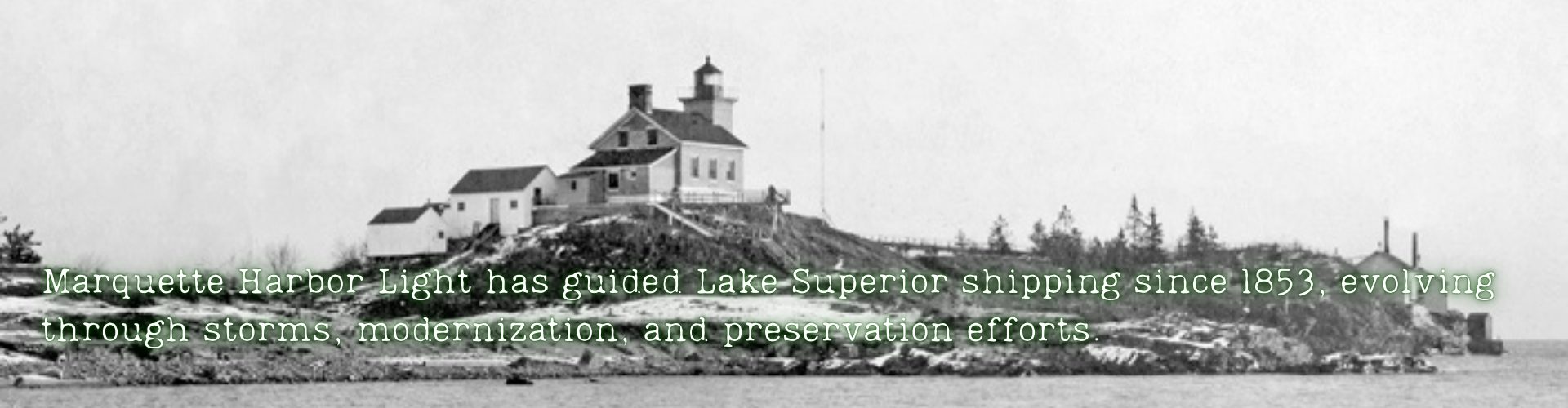
Standing at the edge of Lake Superior’s rugged shoreline, Marquette Harbor Light has long served as a vital beacon for vessels navigating the busy ore shipping routes of Michigan’s Upper Peninsula. Over more than a century and a half, the lighthouse has evolved through storms, technological change, and shifting maritime needs while remaining an active aid to navigation.
Establishing a Harbor Light
As iron ore mining expanded in the mid-nineteenth century, the need for safe navigation into Marquette Harbor became increasingly clear. Congress appropriated funds for a lighthouse in 1850, and construction began two years later. The light was first exhibited in June 1853, providing essential guidance to ships approaching the region’s growing ore docks.
The original structure, however, quickly succumbed to the harsh conditions of Lake Superior. Recognizing the need for a more durable station, Congress approved funds in 1865 for a replacement tower and dwelling.
Improvements and Reconstruction
Engineering work in the harbor continued throughout the late nineteenth century. In 1875, the U.S. Army Corps of Engineers constructed a two-thousand-foot breakwater to reduce the impact of storms and waves. Despite these improvements, a powerful storm destroyed the earlier lighthouse in 1889.
They subsequently established the current Marquette Harbor Light on a concrete crib at the southern end of the breakwater. The attached keeper’s residence, designed in a schoolhouse style, shares architectural similarities with other Upper Peninsula lights such as Granite Island, Gull Rock, and Huron Island. A second story was added to the dwelling in 1910 to accommodate expanded operations.
Optics and Technological Change
Early illumination consisted of multiple Lewis lamps, but a major system upgrade followed the creation of the United States Lighthouse Board in 1853. In 1856, the station received a sixth-order French Fresnel lens capable of projecting light up to ten nautical miles.
The lighthouse was electrified in July 1899, reflecting broader modernization across the Great Lakes. Over time, the original fourth-order Fresnel lens was transferred to another local station, and the present light uses a DCB-36 Aerobeacon optic. This mid-twentieth-century technology represents a later phase in lighthouse innovation, bridging the transition from traditional lenses to modern automated systems.
Fog Signals and Daily Operations
Dense fog frequently blankets Lake Superior’s shoreline, making audible signals an essential part of maritime safety. The Marquette station once operated three distinct fog signals—one in a dedicated fog signal building and one on each breakwater—each with its own tone to help mariners identify their position.
Life at the station could be challenging. Staffing proved difficult, and by 1882 ten different keepers had served in less than three decades. The demanding conditions underscored the isolated and often strenuous nature of lighthouse service.
A Coast Guard Presence
In 1891, a U.S. Life-Saving Service station was established on the lighthouse grounds. When the Life-Saving Service merged with the Revenue Cutter Service in 1915, and later when the Lighthouse Service was incorporated into the Coast Guard in 1939, the entire complex came under unified federal control.
During World War II, the site functioned as a Coast Guard training station, housing hundreds of recruits. Today, a Coast Guard facility continues to operate nearby, maintaining a longstanding maritime presence at Marquette Harbor.
Preservation and Public Access
The lighthouse was listed on the National Register of Historic Places in 1984, recognizing its historical and architectural significance. In 2002, the Marquette Maritime Museum secured a long-term lease, allowing for preservation work and guided public tours.
On the lighthouse’s 150th anniversary in 2016, ownership was transferred from the Coast Guard to the City of Marquette. The light remains an active navigational aid while also serving as a focal point for maritime heritage education.
Through decades of change, Marquette Harbor Light has continued to illuminate the path for vessels on Lake Superior, symbolizing the enduring importance of navigation aids in one of the Great Lakes’ most demanding environments.
Explore our full collection of Northern Michigan lighthouse stories here
Start planning your trip today and explore the legacy of Michigan’s maritime history!
📍 Explore the Map Below