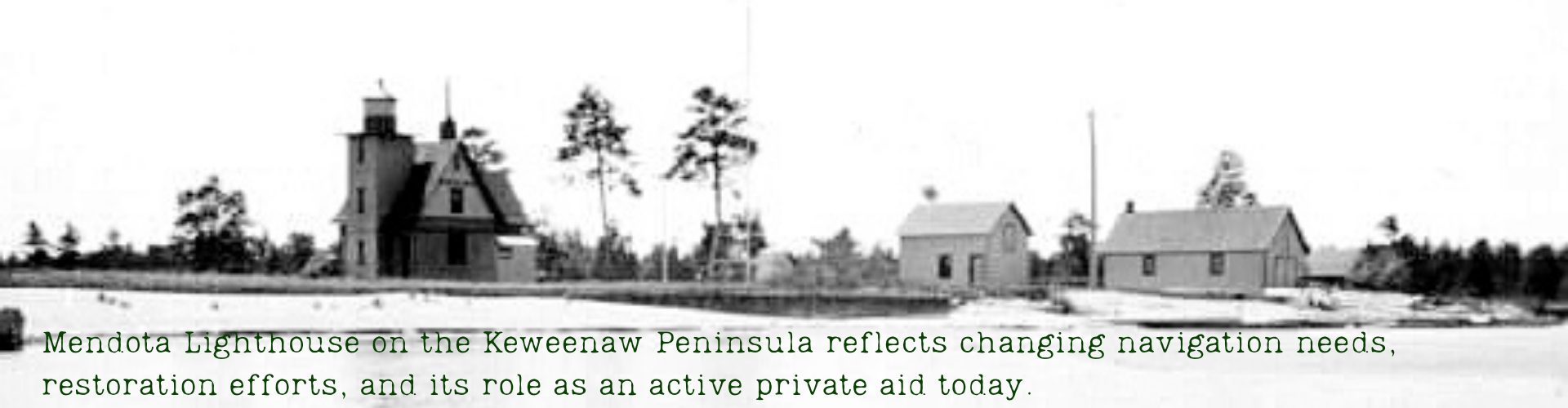
Along the rugged shoreline of the Keweenaw Peninsula, the Mendota Lighthouse stands as a reminder of both ambition and adaptation in Great Lakes navigation. Also known as the Bete Grise Light, it was originally built to support travel between Lake Superior and Lac La Belle, an inland lake connected by a constructed canal.
An Early Navigation Experiment
Plans for the lighthouse were first developed in 1867, at a time when improving inland water routes was seen as a way to strengthen regional commerce. The light was constructed in 1869 near the canal entrance, intended to guide vessels between the lake and the sheltered waters of Lac La Belle.
Despite these intentions, navigators soon found the route offered little advantage. Commercial traffic did not develop as expected, and the light was decommissioned after only a year of service. The tower itself was removed and transported to Marquette, leaving the keeper’s dwelling behind on the isolated shoreline.
Renewed Interest in a Harbor of Refuge
More than two decades later, the value of the location was reconsidered. In 1892, ships sought shelter in the bay during a severe storm. Observing the abandoned keeper’s house, mariners suggested that a functioning lighthouse would make the harbor easier to locate in dangerous conditions.
Funding was secured in the mid-1890s to restore the light. By that time, however, the original structure had deteriorated beyond repair. A new lighthouse was constructed on the existing foundations, marking a renewed commitment to navigation safety in the area.
Automation and Decline
Technological advances gradually reduced the need for full-time lighthouse staffing. The Mendota Light was automated in 1933, allowing it to operate without a resident keeper. It continued to serve mariners for several more decades before being decommissioned in 1956.
Following its closure, the lighthouse passed into private ownership and was used as a residence for many years. Its remote setting, accessible only by boat, contributed both to its preservation and to its relative obscurity.
Restoration and Modern Use
In the late twentieth century, new efforts emerged to restore the lighthouse’s historic function. After being offered for sale in 1996, the property was acquired by an owner committed to conservation. The original fourth order Fresnel lens was located, restored, and relit in 1998.
Today, the Mendota Lighthouse operates as an active private aid to navigation. Its beam once again serves vessels traveling along the Keweenaw Peninsula, linking the site’s early ambitions with modern preservation efforts.
A Quiet Landmark on the Peninsula
Visitors can view the lighthouse from the end of the road at the Mendota Ship Canal near Bete Grise. From there, a short walk offers a glimpse across the water to the station’s boathouse and the light itself, standing quietly along the shoreline.
Though its history includes periods of abandonment and renewal, the Mendota Lighthouse remains a symbol of the changing needs and enduring challenges of Great Lakes navigation.
Explore our full collection of Northern Michigan lighthouse stories here
Start planning your trip today and explore the legacy of Michigan’s maritime history!
📍 Explore the Map Below