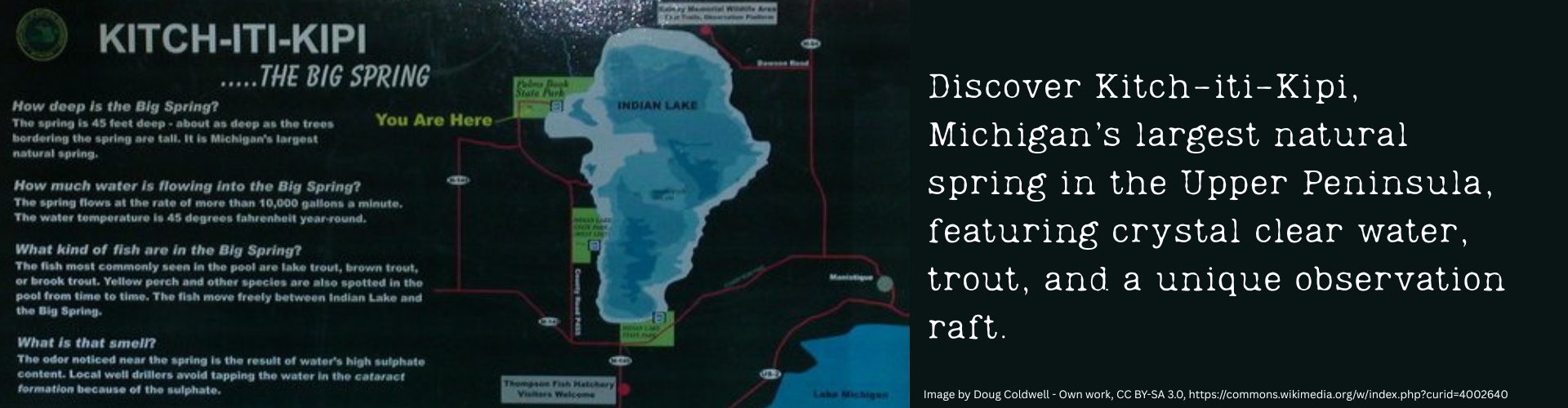
Deep in the forests of Michigan’s Upper Peninsula sits one of the most remarkable natural wonders in the Great Lakes region. Crystal clear water rises endlessly from the earth below. Ancient tree trunks rest at the bottom like forgotten relics. Sand quietly shifts beneath the surface as thousands of gallons of water surge upward every minute.
Today, visitors know it as Kitch-iti-Kipi, the “Big Spring.”
For generations, however, this place was far more than a tourist attraction.
Long before roads, observation rafts, and state park signs appeared, the Spring was already part of the homeland and traditions of the Anishinaabe people who lived throughout the Great Lakes region. The Spring’s clear water, steady temperature, and quiet beauty made it a place tied to fishing, reflection, and spiritual meaning.
The name itself is often translated as “The Big Cold Spring” or “The Great Cold Water.” Even now, the water remains around 45 degrees year-round, no matter the season.
Standing beside the Spring today, it is easy to understand why earlier generations viewed it with awe.
A Hidden Spring in the Wilderness
Although many modern accounts describe the Spring as being “discovered” in the 1920s, that is not entirely accurate.
Anishinaabe communities had known about the Spring for centuries before white settlers arrived in the region. What changed during the early twentieth century was that the Spring became known to the outside world.
By the 1920s, much of the surrounding Upper Peninsula had already been heavily logged. Lumber companies stripped enormous stretches of pine, cedar, and hardwood forests throughout the late 1800s and early 1900s. Areas around the Spring became cluttered with fallen timber, brush, and logging debris.
According to local history, Manistique businessman John I. Bellaire encountered the Spring during this period. Bellaire owned a Five and Dime store and reportedly became fascinated by the hidden oasis buried within the wilderness.
At the time, the area surrounding the Spring was rough and largely inaccessible. Loggers even used nearby sections as dumping grounds.
Bellaire believed the Spring deserved protection.
Rather than purchasing the property himself, he approached the Palms Book Land Company and convinced them to sell roughly 90 acres surrounding the Spring to the State of Michigan for just $10. The agreement required the land to remain a public park and required the park to carry the company’s name.
In 1926, the state officially acquired the property that became Palms Book State Park.
Over time, additional surrounding land was added to the park, which now encompasses more than 300 acres.
The Civilian Conservation Corps and the Early Park
During the Great Depression, workers from the Civilian Conservation Corps helped transform many Michigan parks into public recreation areas.
Palms Book State Park was no exception.
CCC crews helped build early visitor facilities that made the Spring accessible while still preserving its natural atmosphere. Improvements included docks, ranger quarters, and one of the park’s most memorable features, the observation raft.
For decades, visitors have slowly pulled the raft across the Spring using a large hand wheel while peering down into the water below.
The experience has become a tradition for generations of families visiting the Upper Peninsula.
A Place Surrounded by Mystery
Part of Kitch-iti-Kipi’s enduring appeal comes from the legends connected to it.
Over the years, numerous stories have circulated about the Spring. Some may have roots in older oral traditions while others may have been created or embellished later to promote tourism around the park.
Either way, the stories became part of the mystique surrounding the Spring.
One of the most well-known legends tells of a young chieftain who fell deeply in love with a maiden from his village. To prove his devotion, she challenged him to paddle his canoe into the icy spring where she promised to leap from a tree branch into his arms.
As he searched for her across the dark water, his canoe overturned and he drowned. According to the story, the young woman had never intended to meet him and instead laughed at his misfortune back at the village.
The Spring was supposedly named in his memory.
Another tale speaks of forbidden lovers separated by a powerful chieftain. In that version, the young man was drowned in the Spring, and the grieving woman later joined him beneath the water.
Some visitors still claim they can see the outlines of the two lovers deep below the surface.
Other legends describe healing powers within the Spring, magical tamarack bark that transformed into gold, and young parents listening to the rippling water for names for their newborn children.
Whether fact, folklore, or later storytelling, these tales helped turn Kitch-iti-Kipi into something larger than a geological wonder.
It became a place of imagination.
The Big Spring Today
Even after decades of tourism, Kitch-iti-Kipi still feels surprisingly untouched.
The Spring measures roughly 200 feet across and reaches depths of around 40 feet. More than 10,000 gallons of water flow upward every minute through limestone fissures beneath the surface.
The remarkable clarity allows visitors to see ancient tree trunks, fish drifting through the water, and the rolling sand constantly shifting below.
In many ways, the Spring feels suspended in time.
Visitors arrive from around the world now, especially during the busy summer and fall seasons. Yet despite its popularity, the place still carries an unusual quietness once the raft glides away from shore.
The trees close in around the water. The surface reflects the sky. The cold spring water continues its endless movement upward from the earth below.
And for a moment, it becomes easy to imagine what this place looked like long before roads and tourists arrived in the Upper Peninsula.
Some places feel historic because of the events that happened there.
Kitch-iti-Kipi feels historic because of the feeling it leaves behind.