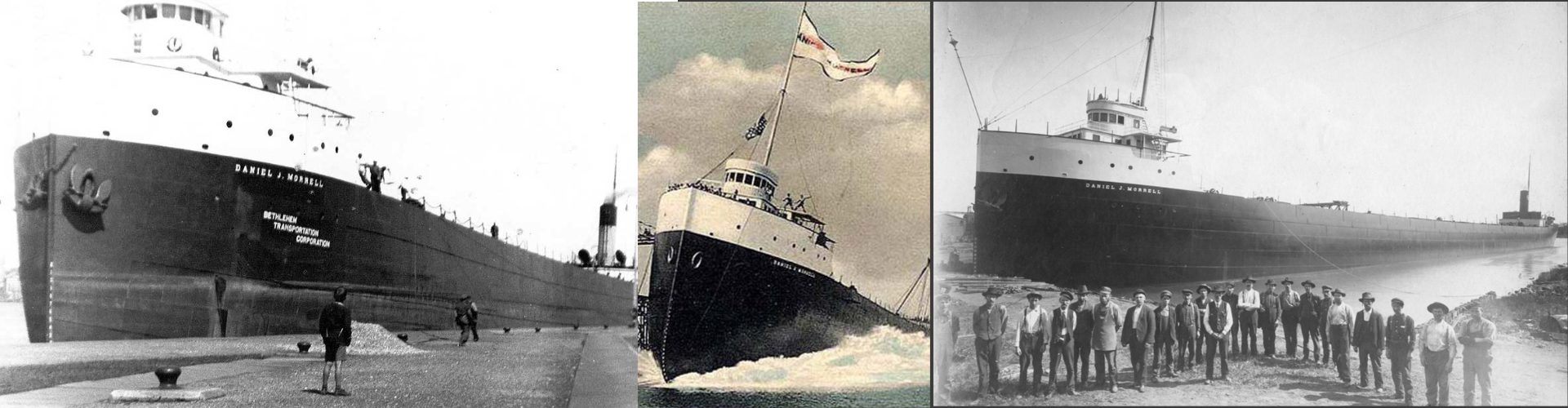
When people think of Great Lakes shipwrecks, they often picture wooden schooners from the 1800s or famous disasters like the Edmund Fitzgerald. Yet one of the most shocking sinkings happened much later, in 1966, just beyond what many consider the northern boundary of Michigan’s Lower Peninsula.
The wreck of the Daniel J. Morrell occurred off Pointe Aux Barques in Lake Huron, only a short distance south of the 44th parallel. While it technically rests just outside the region many call Northern Michigan, its story has become part of the area’s rich maritime history. Few Great Lakes disasters are as dramatic, heartbreaking, or unforgettable.
Click to Enlarge
The Queen of the Lakes
When the Daniel J. Morrell entered service in 1906, she was a marvel of engineering. At more than 600 feet long, she was the largest vessel sailing the Great Lakes and proudly carried the title Queen of the Lakes.
Named after Daniel Johnson Morrell of the Cambria Iron Company, the freighter spent decades hauling iron ore between Lake Superior and the steel mills farther south. She was dependable, hardworking, and familiar to generations of sailors.
By 1966, however, the Morrell was showing her age.
Although she had been modernized over the years, the ship’s steel had endured six decades of pounding waves, twisting hull stresses, and brutal winters. Engineers later discovered that steel manufactured before the late 1940s could become dangerously brittle in extremely cold temperatures. Few people realized just how serious that weakness could become.
The Last Voyage
Late in November 1966, the Daniel J. Morrell was making what was expected to be her final run of the season. Unlike most of her trips, she carried only ballast rather than a full cargo of iron ore.
She was traveling with her sister ship, the Edward Y. Townsend, as a powerful November storm swept across Lake Huron.
The winds climbed past 70 miles per hour. Waves reached heights of 20 to 25 feet, towering over the ship’s deck. Snow, freezing temperatures, and darkness made conditions even worse.
Recognizing the danger, the captain of the Edward Y. Townsend decided to seek shelter in the St. Clair River. The Morrell continued north toward Thunder Bay, hoping to outrun the storm.
She never made it.
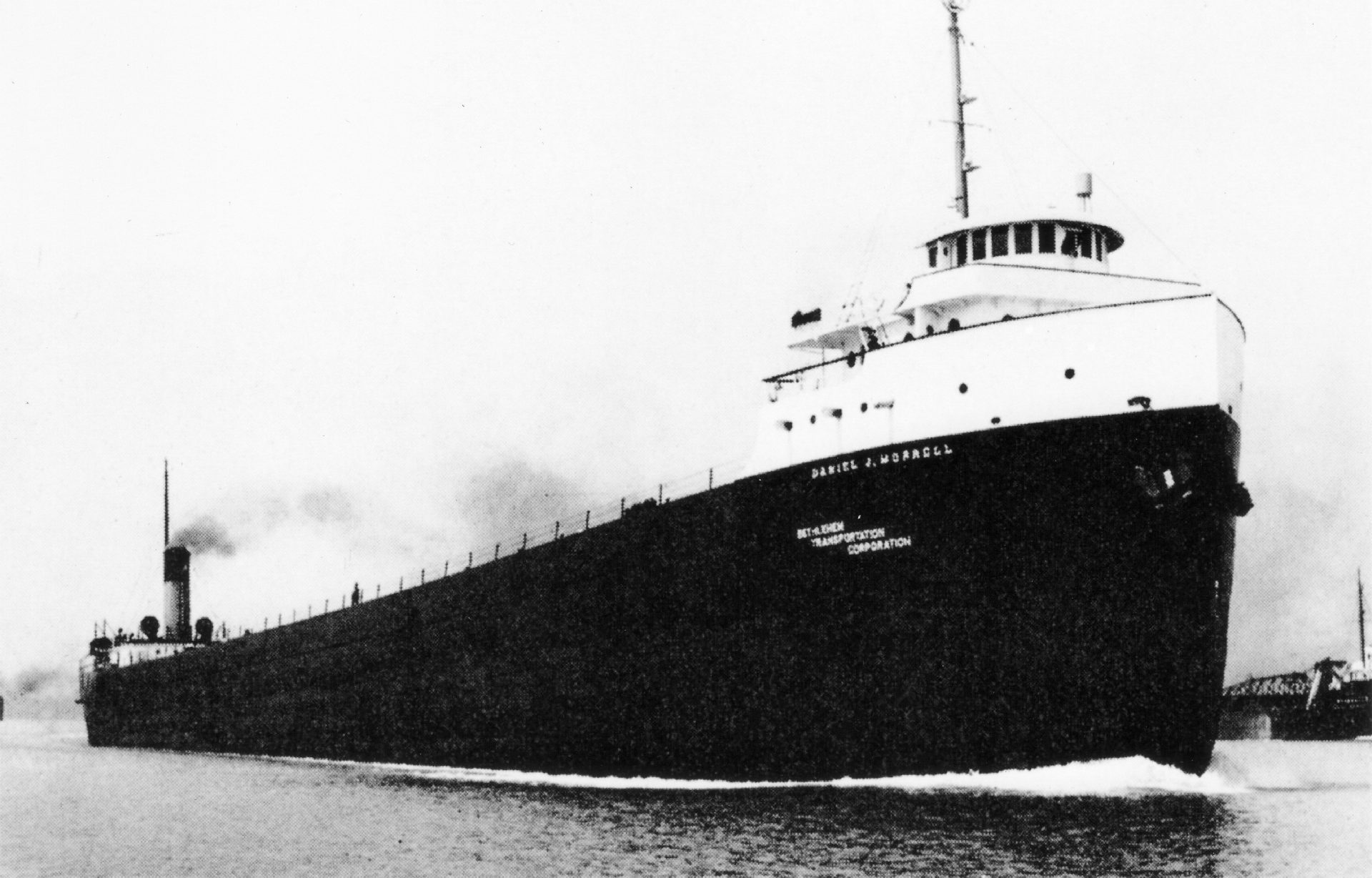
The steamer Daniel J. Morrell shortly before her loss
A Ship Torn Apart
Around two o’clock on the morning of November 29, crew members were jolted awake by what survivor Dennis Hale later described as sounding like a cannon blast.
Books flew from shelves. The lights went out.
The ship’s alarm echoed through the darkness as crew members rushed onto the deck. Captain Arthur Crawley believed the ship had buckled and ordered the crew to prepare for the worst.
There was no time to send a distress call. Power to the bow had been lost, making radio communication impossible.
Just minutes later, the unimaginable happened.
The Daniel J. Morrell split in half.
The bow disappeared beneath the icy waters almost immediately, taking much of the crew with it. Men who had gathered near the front of the ship were thrown into the freezing lake as their life raft struggled against enormous waves.
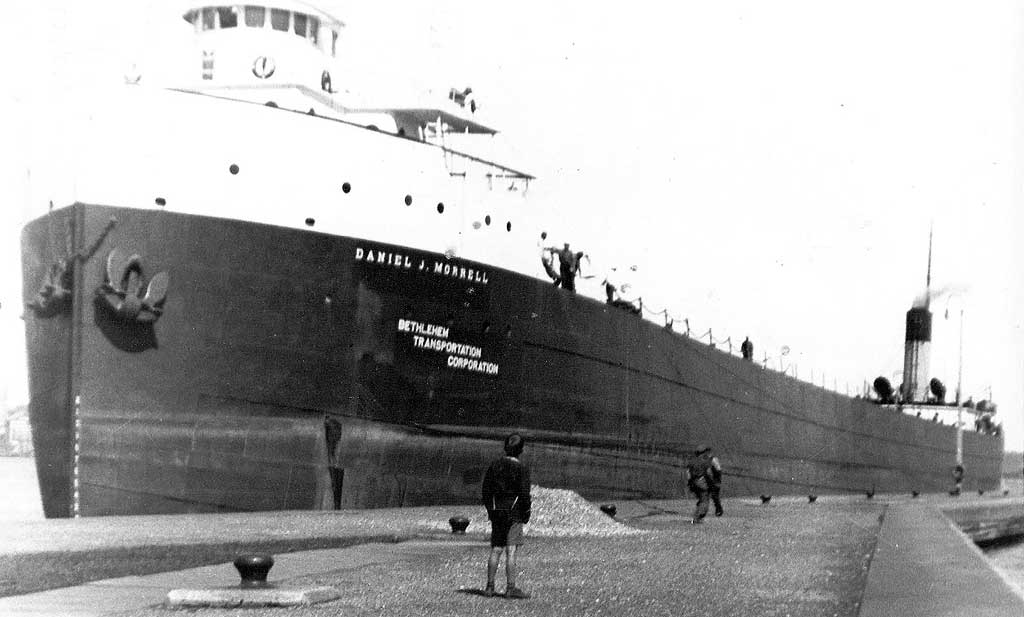
The steamer Daniel J. Morrell in the Soo Locks in 1936
Only four managed to climb aboard.
Then came one of the most chilling moments in Great Lakes history.
Someone shouted that another ship was approaching.
Hope spread through the raft. Rescue had arrived.
But as the lights grew closer, the men realized they were looking at the stern of their own ship.
The engines were still running.
Separated from the bow, the stern continued steaming through the storm under its own power. It slowly disappeared into the darkness, carrying the engine room crew with it.
Writer William Ratigan later described the sight as a wounded beast wandering into the night.
Nearly an hour and a half later, the stern also slipped beneath Lake Huron.
The two halves eventually came to rest about five miles apart.
Thirty Eight Hours Alone
The freezing water quickly claimed the lives of the other men aboard the raft.
Only Dennis Hale survived.
His story was almost as remarkable as the sinking itself.
When the ship’s alarm sounded, Hale had barely enough time to grab his life jacket and return to his cabin. In the darkness he could find only his pea coat before racing back on deck.
He entered the water wearing little more than boxer shorts, a life jacket, and the heavy coat.
For nearly thirty eight hours he drifted through one of the coldest environments imaginable. One by one, the three other men aboard the raft died from exposure.
Hale remained alive beside them until a United States Coast Guard helicopter finally spotted the raft late on November 30.
Rescuers found the twenty six year old watchman suffering from severe hypothermia and dehydration. He endured numerous surgeries during his recovery and carried both the physical and emotional scars for the rest of his life.
For decades, he found it too painful to talk about what had happened.
Eventually, he shared his experiences in the book Shipwrecked: Reflections of the Sole Survivor, dedicating it to the twenty eight friends and shipmates who never came home.
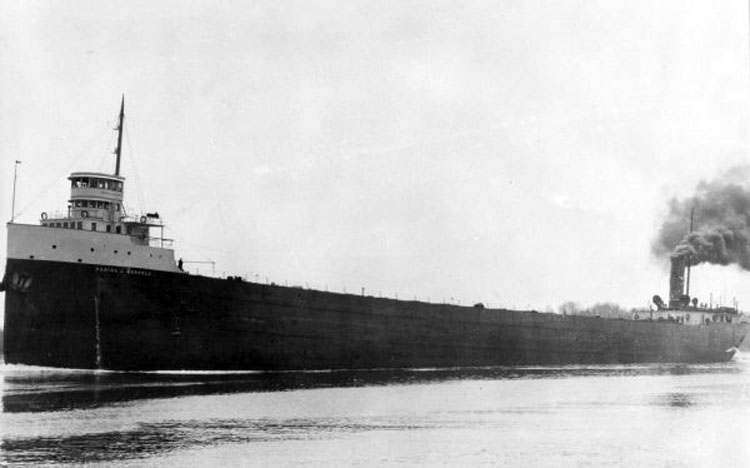
A postcard of the Morrell with a double-high pilothouse.
Lessons Written in Steel
The Coast Guard investigation concluded that the storm alone did not destroy the Daniel J. Morrell.
The real culprit was the aging steel.
Repeated years of stress, combined with freezing temperatures, caused the hull to become brittle enough that it fractured under the relentless pounding of Lake Huron.
The tragedy led to renewed attention on the condition of older Great Lakes freighters. Inspection standards improved, and engineers gained a much better understanding of how cold weather affected aging steel.
The Morrell’s loss also reminded mariners of another harsh reality. Traditional lifeboats offered little protection in the towering seas of a Great Lakes November storm. Hypothermia remained the greatest danger once sailors entered the water.
Where the Morrell Rests Today
Today, the Daniel J. Morrell rests upright on the bottom of Lake Huron within the Thumb Underwater Preserve.
The bow lies just north of the 44th parallel. The stern rests roughly five miles farther to the south, marking the final path it traveled after the ship broke apart.
Both sections sit in about 200 feet of water, making them destinations for experienced technical divers. The wreck remains remarkably intact. Divers can still see the massive anchors, lifeboats, wheelhouse, machinery, and even dishes left behind when the crew abandoned ship.
Together, the two halves serve as an underwater memorial to the twenty eight men who lost their lives.
A Story That Still Echoes
More than half a century later, the Daniel J. Morrell remains one of the Great Lakes’ most haunting shipwrecks.
It reminds us that modern steel ships were never immune to the power of November storms. Experience, technology, and size could improve the odds, but they could never guarantee safety.
The Great Lakes have claimed thousands of vessels over the centuries.
The Daniel J. Morrell stands apart because it happened in an era when many believed such disasters belonged to the past.
Instead, Lake Huron delivered one final reminder that she still commanded respect, and that even the mightiest ships could disappear beneath her November waves.
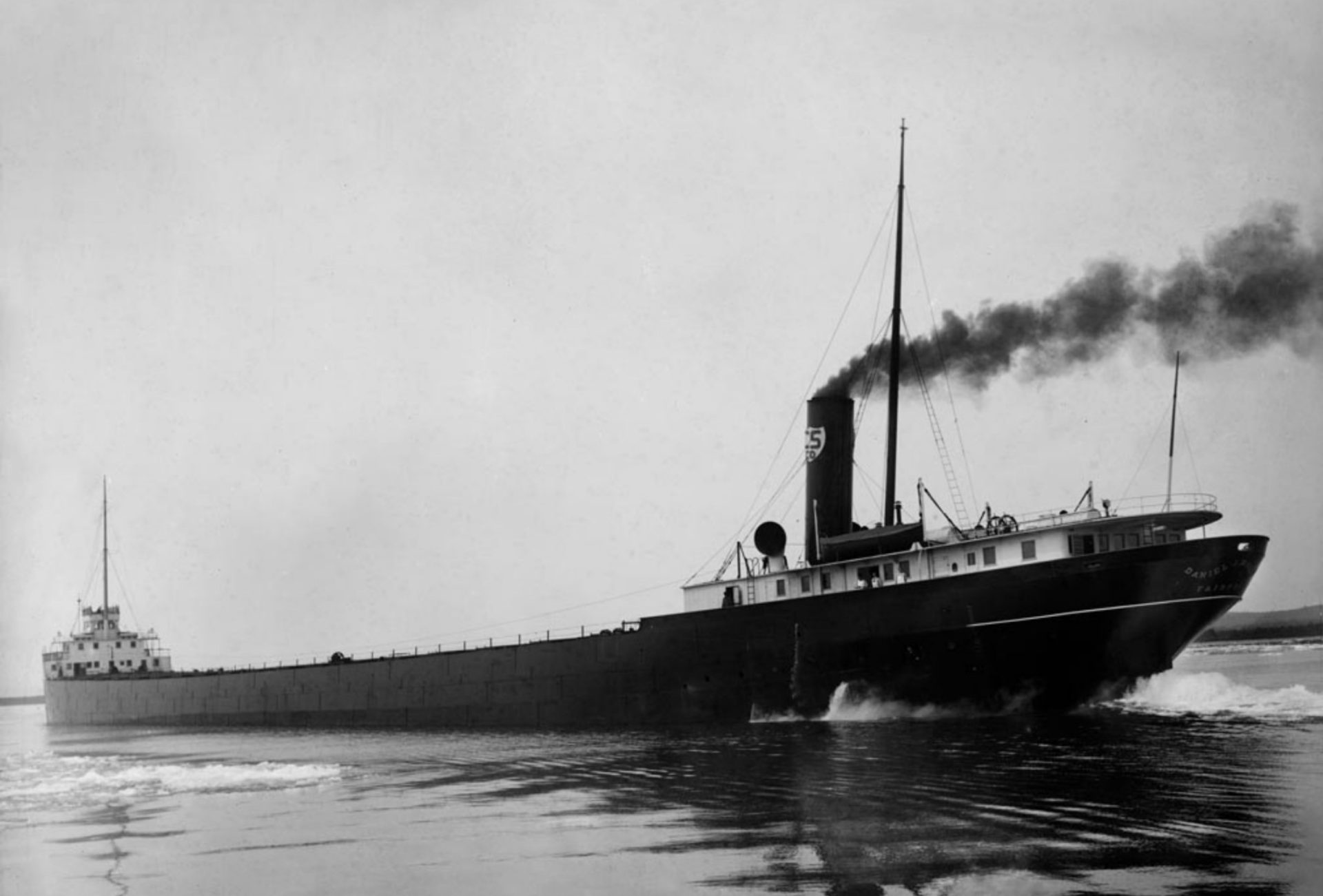
The Daniel J. Morrell showing her Cambria Steamship Company smokestack
History has a way of hiding in unexpected places.
Sometimes it stands in the form of an old lighthouse. Sometimes it survives in a century old photograph or a weathered cemetery. And sometimes it rests more than 200 feet beneath the surface of Lake Huron.
The Daniel J. Morrell may have sunk just beyond what many people consider Northern Michigan, but its story belongs to the history of this region. It reminds us that the Great Lakes shaped our communities, our economy, and the lives of countless families who depended on these waters.
The next time you find yourself looking across Lake Huron, take a moment to appreciate both its beauty and its power. Beneath those waves are stories that deserve to be remembered.
Why This Story Matters
The wreck of the Daniel J. Morrell reminds us that history is not always distant. This tragedy unfolded within living memory, during an era when many believed modern ships had conquered the dangers of the Great Lakes. Instead, Lake Huron proved that experience, technology, and steel could never fully tame the power of November.
Today, the wreck rests quietly beneath the waves, but its story continues to remind us that every name on a crew list represented a family waiting for someone to come home.
Another Great Lakes Story
The Daniel J. Morrell is one of the Great Lakes’ most haunting shipwrecks, but it is far from the only one. If stories of courage, tragedy, and the power of the Great Lakes fascinate you, you’ll also enjoy the story of the City of Bangor, a freighter carrying hundreds of brand new automobiles when a November storm changed everything.
Read next: The City of Bangor Shipwreck
Every Place Tells a Story
At Northern Michigan History, we believe every place tells a story. Sometimes those stories are found in a weathered lighthouse, a quiet cemetery, an abandoned village, or the streets of a small town. Other times, they rest beneath the waters of the Great Lakes.
Our mission is to uncover those stories, preserve them, and share them with everyone who loves this remarkable corner of Michigan. Every story adds another layer to the places we explore and reminds us that history is all around us.
The next time you stand along the shore in Tawas, or gaze across the blue waters of Lake Huron, remember that one of the Great Lakes’ most haunting shipwrecks rests quietly beneath the surface. Knowing its story changes the way you see the lake, and that is what discovering history is all about.