Guiding Ships Along the St. Marys River
Tucked along the St. Marys River, the Winter Point Range Lights quietly played a critical role in guiding vessels through one of the most important shipping corridors in the Great Lakes. Unlike a single lighthouse standing alone, range lights work as a pair, front and rear. They help mariners line up safely within a channel. Winter Point’s story is one of adaptation and engineering ingenuity. In addition, the demands of river traffic drive this story of steady improvements.
Building a Permanent Navigational Aid
Plans for a permanent range station at Winter Point took shape in the early 1890s. This was part of a broader effort to improve navigation along the St. Marys River. Construction began in the spring of 1892, with materials shipped in from the Detroit lighthouse depot. Crews erected a skeleton iron tower on shore for the rear range. They also constructed a landing wharf and lantern house for the front range light. A raised walk connected the two. This allowed keepers to move between them even across marshy ground.
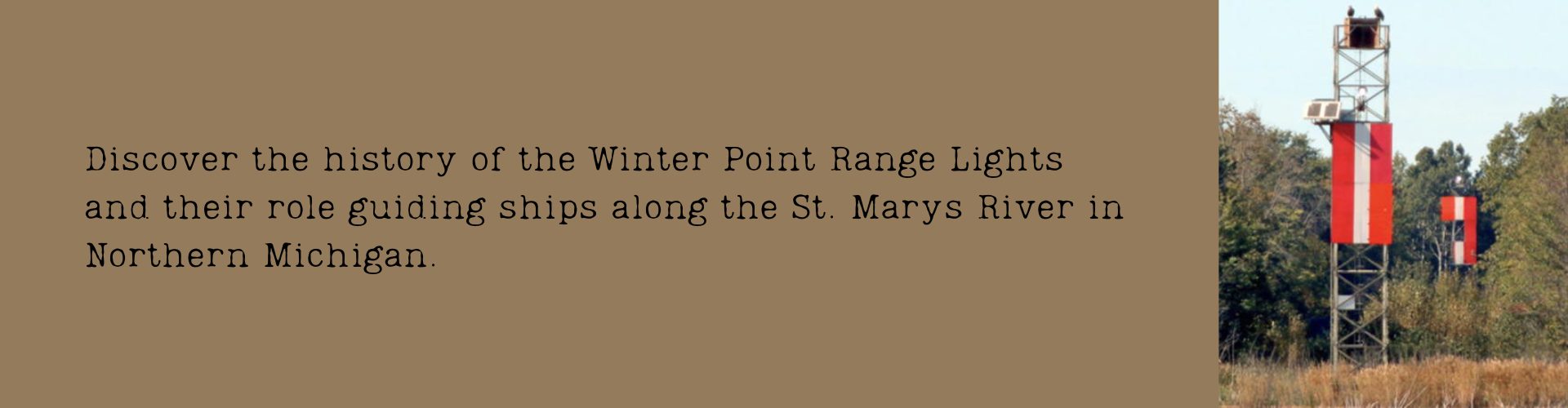
The rear tower was an impressive example of late-19th-century lighthouse engineering, triangular in design. It was built of star iron with lateral bracing, and it rose roughly 60 feet from base to focal plane. A modest frame dwelling and oil house completed the station. By early June of that year, fixed white lights were shining for the first time. This marked Winter Point as an active and essential navigational aid.
Adapting to a Changing Shoreline
Nature and navigation rarely stand still, and Winter Point was no exception. By the mid-1890s, shifting conditions made it necessary to relocate parts of the station. The rear range tower was carefully moved hundreds of feet across the peninsula to improve alignment. As a result, the distance between the front and rear lights increased. Elevated footwalks on cedar posts were added to keep access reliable. Additionally, the oil house and dwelling received new foundations and repairs.
Further improvements followed, including a long landing that extended into deeper water. Additional brick piers were added to stabilize the rear range. These changes reflected the growing importance of the St. Marys River as commercial traffic increased.
Rebuilding and Modernization
By the early 1900s, age and wear prompted additional upgrades. Wooden walks were replaced by earthen embankments across marshy areas, and surveys were conducted to clearly define station boundaries. Dredging improved the channel, ensuring the range remained effective as vessel traffic evolved.
A major reconstruction came in 1907. Recognizing the importance of the nearly nine-mile range, officials rebuilt the front beacon with a new skeleton frame tower. They also installed a powerful locomotive headlight. When the new lights were exhibited that summer, Winter Point once again reflected the latest in navigational technology.
From Oil to Gas and an Unwatched Future
The final chapter of Winter Point’s active service involved modernization rather than expansion. By the 1910s, preparations were underway to update oil houses and convert the lights from traditional oil to oil gas. This change significantly increased brightness, up to roughly 6,000 candlepower—and allowed the range to operate as an unwatched station.
By 1914, the rear tower’s color scheme was updated for better daytime visibility. The Winter Point Range Lights continued their quiet duty. They guided ships safely through the St. Marys River without the need for a resident keeper.
A Quiet but Essential Legacy
While Winter Point may not be as well-known as some of Michigan’s dramatic coastal lighthouses, its role was no less important. For decades, these range lights provided precise guidance through a busy river channel. They adapted to changing technology and conditions along the way. Today, Winter Point stands as a reminder that even the most understated lights played a vital role in Northern Michigan’s maritime history.
Explore our full collection of Northern Michigan lighthouse stories here
Start planning your trip today and explore the legacy of Michigan’s maritime history!
📍 Explore the Map Below