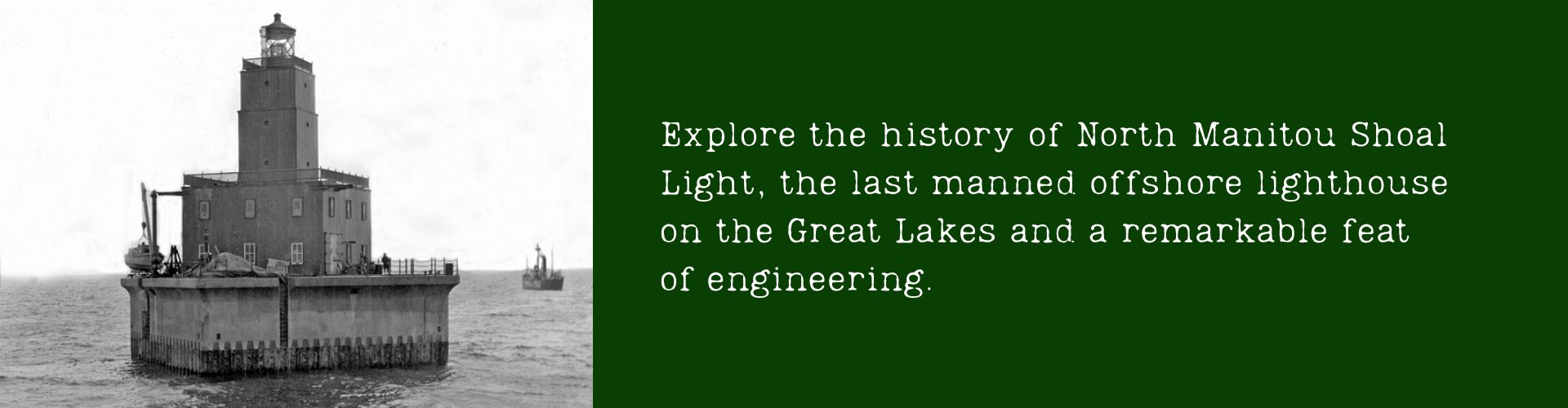
The Last Staffed Offshore Lighthouse on the Great Lakes
Far out in the waters of Lake Michigan, southeast of North Manitou Island, stands one of the most distinctive lighthouses ever built on the Great Lakes.
Known officially as North Manitou Shoal Light Station and affectionately called “The Crib” by many mariners, the structure looks more like an offshore platform than a traditional lighthouse. Rising from a massive concrete foundation in open water, it represents a fascinating chapter in the evolution of Great Lakes navigation.
More importantly, it holds a unique place in maritime history. When it was automated in 1980, North Manitou Shoal Light became the last staffed offshore lighthouse on the Great Lakes.
Marking a Critical Shipping Route
For generations, the waters around the Manitou Islands served as one of the primary shipping routes connecting Lake Michigan with the Straits of Mackinac.
Thousands of vessels carrying lumber, coal, grain, iron ore, and manufactured goods passed through the area. However, the North Manitou Shoal presented a significant hazard to navigation.
The shallow waters could be difficult to spot, especially at night or during storms, making a reliable warning system essential.
The Lighthouse Board first addressed the danger in 1907 by recommending that a lightship be stationed on the shoal. Unlike a permanent lighthouse, a lightship was essentially a floating lighthouse anchored in position to warn passing vessels.
In 1910, Lightship No. 56 took up station at the shoal and began marking the hazard.
The Era of the Lightships
For the next twenty-five years, a succession of lightships guarded North Manitou Shoal.
Lightship No. 56 served until 1927, when it was replaced by Lightship No. 89. In 1934, Lightship No. 103 arrived and continued the service.
Although effective, lightships had limitations.
Storms could damage them, maintenance was costly, and crews faced difficult and often dangerous working conditions. Like many other locations on the Great Lakes, North Manitou Shoal eventually became a candidate for a permanent lighthouse structure.
The Lighthouse Board first proposed building a fixed station in 1923, but funding was not immediately available.
It would take another decade before the project finally moved forward.
Building “The Crib”
The breakthrough came during the Great Depression.
In 1933, funding became available through the Public Works Administration, one of the federal government’s major infrastructure programs.
Construction of the permanent station began shortly afterward, and by 1935 the lighthouse was complete.
Engineers built the structure atop a massive concrete crib foundation positioned in 26 feet of water. The foundation measures 65 feet on each side and supports a substantial steel superstructure that rises twenty feet above the lake surface.
Atop this platform sits a two-story steel building containing living quarters and diesel generators. Rising above the building is a three-story steel tower housing the light itself.
The completed structure reaches a height of 63 feet above the platform, with the light positioned 79 feet above the water.
Unlike the brick and stone lighthouses that came before it, North Manitou Shoal Light reflected a new generation of engineering designed specifically for offshore conditions.
Life at an Offshore Station
The station was originally staffed by a crew of three men.
Life aboard North Manitou Shoal Light was very different from life at a traditional shoreline lighthouse.
The keepers lived surrounded by water, often isolated for days or weeks during periods of rough weather. Supplies had to be delivered by boat, and every aspect of daily life revolved around maintaining the station and ensuring the light remained operational.
Diesel generators provided power, while the steel structure offered protection from Lake Michigan’s storms.
Although technology had advanced considerably since the era of oil lamps and hand tended Fresnel lenses, the keepers still faced the challenges of working in one of the Great Lakes’ most remote environments.
For decades, the station faithfully served mariners traveling through the busy waters around the Manitou Islands.
Automation and the End of an Era
By the late twentieth century, lighthouse automation had become increasingly common.
Advances in technology allowed lights to operate reliably without the need for resident keepers. In 1980, North Manitou Shoal Light was automated, and the station was officially abandoned.
The original Westinghouse Airway Beacon was eventually replaced by newer lighting systems. Today, the station uses a solar powered and battery powered LED beacon to continue its navigational mission.
The automation marked the end of an important chapter in Great Lakes history.
With the departure of its final crew, North Manitou Shoal Light became the last staffed offshore lighthouse on the Great Lakes.
Preservation and Restoration
Like many automated offshore stations, the lighthouse faced an uncertain future after its keepers left.
Despite being listed on the National Register of Historic Places in 2005, maintaining a structure located miles from shore presented significant challenges.
A major turning point came in 2016 when the General Services Administration offered the lighthouse for public auction.
Rather than see the historic station fall into neglect, the nonprofit organization North Manitou Light Keepers, Inc. successfully purchased the property and began an ambitious restoration effort.
Their work continues today, helping preserve one of the most unique and historically important navigational structures on the Great Lakes.
A Lighthouse Unlike Any Other
North Manitou Shoal Light occupies a special place in Michigan’s maritime history.
It bridged two eras of navigation. It replaced the lightships that once guarded dangerous shoals, and it remained active long enough to witness the transition to modern automated navigation systems.
Its steel tower, concrete crib foundation, and offshore setting make it unlike most traditional lighthouses. Yet its purpose has always been the same as every lighthouse that came before it: helping mariners travel safely across the Great Lakes.
Standing alone in the waters of Lake Michigan, “The Crib” remains a powerful reminder of the ingenuity, determination, and engineering skill that shaped Great Lakes navigation.
Explore our full collection of Northern Michigan lighthouse stories here
Start planning your trip today and explore the legacy of Michigan’s maritime history!
📍 Explore the Map Below