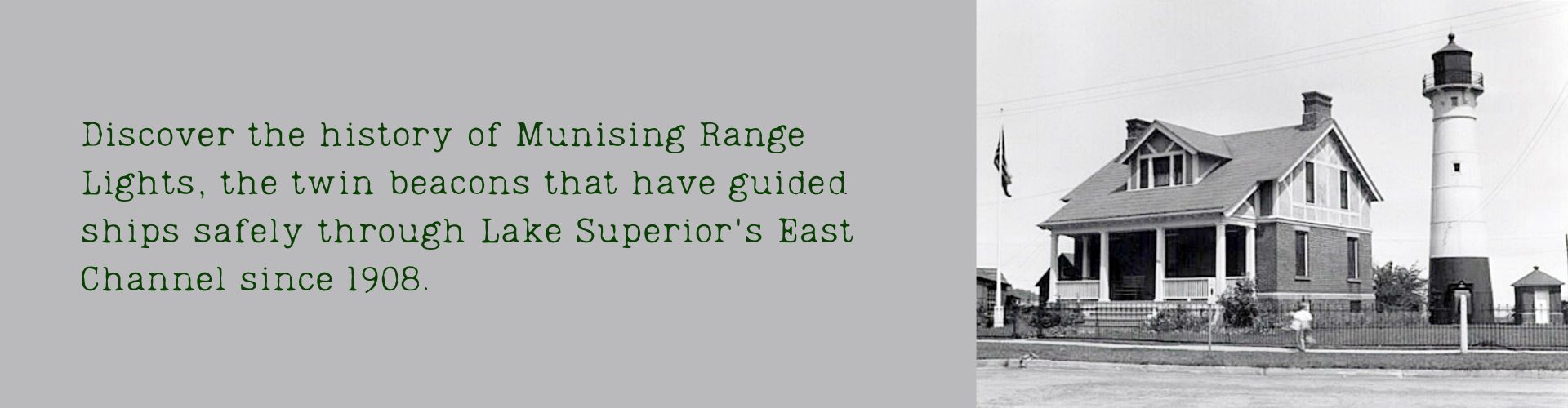
Guiding Mariners Through the East Channel
For more than a century, a pair of lighthouses overlooking Munising Bay have helped mariners safely navigate one of Lake Superior’s most important harbor entrances.
Known as the Munising Front Range Light and the Munising Rear Range Light, these towers work together to guide vessels through the East Channel between Grand Island and the mainland. While neither lighthouse is particularly large, their combined role has made them essential to safe navigation in the area since the early twentieth century.
Their story is also one of changing technology, dedicated lighthouse keepers, and the continuing effort to make travel on Lake Superior safer.
When One Lighthouse Was Not Enough
Long before the range lights were built, mariners entering Munising Harbor relied on the Grand Island Harbor Lighthouse.
Constructed in 1868 on the southeastern tip of Grand Island’s eastern lobe, known as the Thumb, the wooden lighthouse stood near the entrance to the East Channel. At the time, it helped guide vessels traveling between Lake Superior and the growing harbor at Munising.
Over the years, however, shipping traffic increased and navigational needs changed. By 1905, the Lighthouse Board determined that the Grand Island Harbor Lighthouse was no longer serving its intended purpose. Mariners approaching through the East Channel often could not see the light until they were dangerously close to it.
The aging wooden structure was also becoming expensive to maintain.
Rather than continue investing in an increasingly ineffective lighthouse, the Lighthouse Board proposed a new solution. A pair of range lights positioned in Munising would provide a much more visible navigational system and allow vessels to line up safely with the channel long before reaching the harbor entrance.
Congress approved funding for the project in 1907, setting the stage for a new chapter in Munising’s maritime history.
Building the New Range Lights
A contract for the steel towers was awarded to the Champion Iron Company of Kenton, Ohio.
Construction began in 1908 on property purchased near the western edge of Munising. Along with the towers, a substantial keeper’s dwelling was built for the station’s resident light keeper.
The handsome red brick dwelling was designed with comfort in mind. Steam radiators heated each of its seven rooms, an important feature during Upper Peninsula winters. The building was nearly identical to keeper’s dwellings constructed the same year at Grand Marais and Pointe aux Barques.
The front range tower was built approximately fifty feet behind the dwelling. Standing fifty five feet tall, the steel structure tapered from twelve feet wide at its base to eight feet wide at the lantern room. A spiral staircase carried visitors and keepers upward to the lantern gallery.
The rear range tower was placed roughly 1,150 feet southwest of the front light on higher ground. Though only thirty one feet tall, its elevated location gave it a focal plane of more than one hundred feet above the water.
Together, the lights formed a navigational alignment that could safely guide vessels through the East Channel.
A New Light for Munising Harbor
On October 29, 1908, Keeper George Prior displayed the light at Grand Island Harbor Lighthouse for the final time.
The next day, he crossed the water to Munising and performed the first lighting of the new range lights.
For mariners entering the harbor, the new system offered a significant improvement. When the front and rear lights lined up visually, captains knew they were following the correct course through the channel.
Both towers originally displayed fixed red lights produced by Adams and Westlake reflector lanterns. A nearby brick oil house stored the fuel necessary to keep the lights operating throughout the navigation season.
The system proved successful and remained an important navigational aid for vessels entering Munising Harbor.
The Keepers Who Tended the Lights
Like many Great Lakes lighthouses, the Munising Range Lights owe much of their success to the men who maintained them.
One of the most notable was Keeper Alf Evensen. His career on Lake Superior began in 1902 at Whitefish Point before he moved to Marquette Lighthouse and later Grand Island North Lighthouse.
Evensen spent the final fifteen years of his distinguished career caring for the Munising Range Lights. By the time he retired in 1940, he had accumulated thirty eight years of service on Lake Superior.
His family’s connection to lighthouse service continued through his son Harold, who worked aboard the lighthouse tender Amaranth.
After Evensen’s retirement, veteran lighthouse keeper Fred W. Hawkins arrived from Au Sable Point Lighthouse to assume responsibility for the station. Hawkins served until 1947, continuing the tradition of dedicated stewardship.
Another experienced keeper, Floyd W. Miller, later supervised not only the Munising Range Lights but also Grand Island Harbor Range and Grand Island Lighthouse. His career included assignments at Lansing Shoal, Split Rock, and Poverty Island lighthouses before arriving in Munising.
When Miller retired in 1961, the era of resident lighthouse keepers in Munising effectively came to an end.
Modernization and Preservation
Technology steadily changed life at the station.
In 1941, the range lights were electrified, eliminating much of the labor associated with maintaining fuel based lighting systems. Electrification made the lights more reliable while reducing the daily workload of the keepers.
Responsibility for the lights eventually shifted to the United States Coast Guard, whose crews balanced maintenance of navigational aids with search and rescue duties.
A new chapter began in July 2002 when the Munising Range Lights were transferred to the National Park Service as part of Pictured Rocks National Lakeshore under the National Historic Lighthouse Preservation Act.
Today, the front range light is managed by the National Park Service. The grounds are open to visitors, although the tower itself is not open for climbing. The rear range light remains on the hillside south of Hemlock Street, continuing to display its red light as it has for generations.
During the winter of 2008 and 2009, both towers underwent significant restoration work. Crews sandblasted the metal structures, repaired areas damaged by corrosion, applied protective coatings, and repainted the towers to ensure their preservation for future generations.
The former keeper’s dwelling now serves as offices for employees of Pictured Rocks National Lakeshore’s Science and Natural Resources Division.
Still Showing the Way
More than a century after their first illumination, the Munising Range Lights continue to serve the purpose for which they were built.
Visitors often notice the white towers as landmarks overlooking Munising, but for generations of mariners they represented something far more important. Working together, the lights provided a safe path through the East Channel and into the protected waters of Munising Harbor.
Their story reflects the evolution of Great Lakes navigation, from oil lamps and resident keepers to modern automated systems. Yet despite all those changes, the lights remain faithful guides along the Lake Superior shoreline, continuing a tradition that began on an autumn evening in 1908.
Explore our full collection of Northern Michigan lighthouse stories here
Start planning your trip today and explore the legacy of Michigan’s maritime history!
📍 Explore the Map Below