Guiding Ships Through Lake Superior’s Narrow Passage
Far from the mainland, near the rugged northeastern corner of Isle Royale, Passage Island Lighthouse stands watch over one of the most important shipping routes on Lake Superior.
For generations of mariners, the narrow channel between Passage Island and Isle Royale was both a shortcut and a challenge. Ships traveling between Sault Ste. Marie and Thunder Bay often relied on this route, carefully navigating a passage only a few miles wide. In the days before modern navigation technology, a dependable lighthouse was essential.
Since 1882, Passage Island Lighthouse has filled that role, helping countless vessels safely thread their way through one of Lake Superior’s most remote and beautiful waterways.
A Growing Need for Navigation
During the nineteenth century, shipping on Lake Superior expanded rapidly.
Mining operations throughout Michigan’s Upper Peninsula were booming, and the discovery of rich silver deposits at Silver Islet in Ontario brought even more traffic to the lake. Ore, supplies, passengers, and commercial goods moved through the region in increasing numbers.
As ships traveled between ports on both sides of the international border, the waters around Isle Royale became an important transportation corridor.
The passage between Passage Island and Isle Royale’s Blake Point was particularly significant. Mariners often described navigating the route as having to “thread the needle,” a fitting description for a channel only about three and a quarter miles wide.
Recognizing the growing importance of the route, the United States Lighthouse Board began requesting funds for a lighthouse as early as the 1870s.
Politics Delay a Lighthouse
Although the need for a lighthouse was clear, construction did not begin immediately.
Congress appropriated $18,000 for the project in 1875, but the funding came with an unusual condition. The money would not be released until Canada agreed to construct a lighthouse on Colchester Reef in Lake Erie.
The arrangement reflected an effort by the United States government to encourage Canada to improve navigation on shared waterways.
As a result, the Passage Island project sat in limbo for several years.
Finally, by 1880, Canadian progress on the Colchester Reef Light allowed the federal government to move forward. Construction on Passage Island began in 1881.
The keystone was laid that year, and the lighthouse entered service on July 1, 1882.
Building a Lighthouse for Lake Superior
The station was built to withstand one of the harshest environments on the Great Lakes.
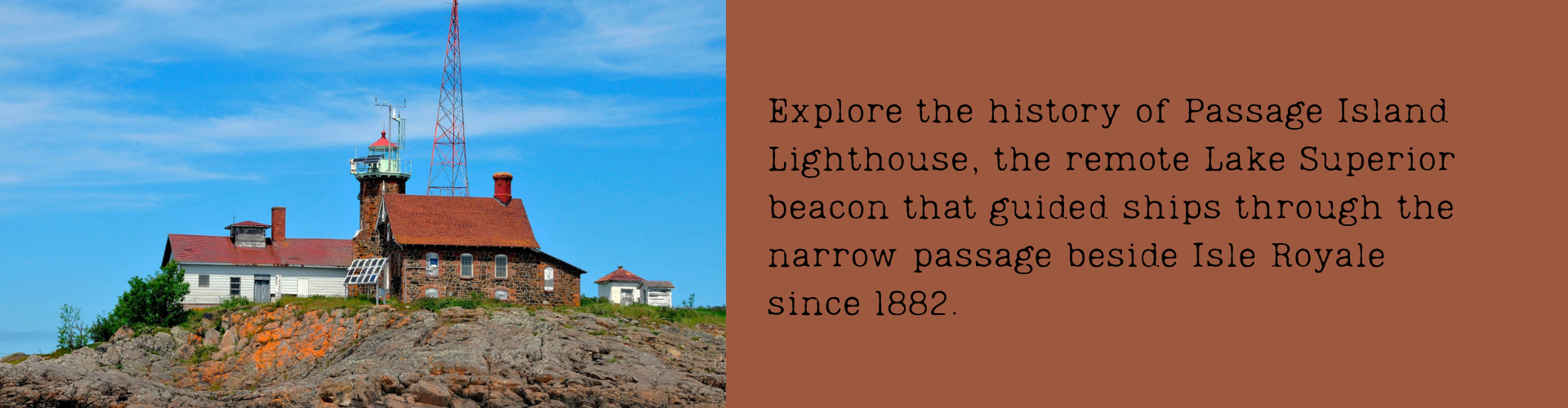
The lighthouse tower rises 44 feet above the island and was constructed from locally gathered fieldstone. The lower portion of the tower is square, while the upper section transitions into an octagonal shape before reaching the lantern room.
At the top sits a ten-sided cast iron lantern accessed by a spiral staircase winding through the tower.
Attached directly to the lighthouse is a substantial two-story keeper’s dwelling measuring approximately 26 by 30 feet. Together, the tower and residence formed a durable and practical station capable of supporting keepers stationed in this remote location.
The stone construction helped the buildings endure the powerful storms, heavy snowfall, and harsh winters that are common on Lake Superior.
Evolving Technology
Like many Great Lakes lighthouses, Passage Island continuously adapted to new technology.
When the station first opened, it displayed a fixed red light produced by a fourth order Fresnel lens and an oil burning wick lamp.
A mechanical fog bell was originally used to warn vessels during periods of reduced visibility. In 1884, that system was replaced by a much more effective ten-inch steam powered fog whistle.
Technological improvements continued throughout the station’s history.
In 1894, a new flashing white lens manufactured by the renowned French company Barbier, Benard & Turenne was installed. The brighter and more distinctive signal made the lighthouse even more effective for mariners navigating the passage.
In 1913, the light’s intensity increased dramatically when the station converted from a traditional oil wick system to an incandescent oil vapor lamp. The improvement boosted the light to approximately 50,000 candlepower.
Electricity arrived in 1928, bringing another major advancement in lighthouse operation.
Marking the Passage
Passage Island Lighthouse did not work alone.
In 1912, a steel light tower was erected at nearby Blake Point on Isle Royale. Together, the two lights helped define the narrow channel between the island and the mainland.
The system provided mariners with a clear visual guide through one of Lake Superior’s most important shipping lanes.
Canadian vessels traveling between Thunder Bay and Sault Ste. Marie depended heavily on these navigational aids. Even experienced captains needed precise guidance when crossing the often-unpredictable waters of northwestern Lake Superior.
The lighthouse became one of Isle Royale’s most important maritime landmarks.
Life on a Remote Island
Serving as a keeper at Passage Island required commitment and resilience.
The station’s isolated location meant that supplies arrived by boat and communication with the mainland was limited for much of its history.
Keepers maintained the light, operated the fog signal, monitored weather conditions, and cared for the station’s buildings throughout the navigation season.
Storms could isolate the island for extended periods, while winter brought ice, snow, and fierce winds.
Despite these challenges, generations of keepers ensured that the light remained operational for mariners crossing Lake Superior.
The station remained staffed well into the twentieth century and continued to have resident keepers as recently as 1957.
Automation and Preservation
The era of resident lighthouse keepers finally came to an end in 1978.
On December 20 of that year, Passage Island Lighthouse was fully automated.
A decade later, in 1989, the historic Fresnel lens was replaced with a modern acrylic optic. Although the original lens was retired, the station continued its navigational mission using newer technology.
Recognition of the lighthouse’s historical significance followed in the years ahead.
In 2006, Passage Island Lighthouse was added to the National Register of Historic Places, ensuring that its role in Great Lakes history would be formally recognized and preserved.
A Sentinel of Isle Royale
Today, Passage Island Lighthouse remains one of the most remote and picturesque lighthouse stations on the Great Lakes.
Its stone tower, sturdy keeper’s house, and dramatic setting capture an era when navigation depended on the dedication of lighthouse keepers and the reliability of a beacon shining through darkness, fog, and storms.
For more than 140 years, the lighthouse has helped vessels safely navigate the narrow waters between Passage Island and Isle Royale.
Standing on the edge of Lake Superior, it continues to tell the story of the ships, keepers, and mariners who depended on its light while crossing one of the largest freshwater lakes in the world.
Explore our full collection of Northern Michigan lighthouse stories here
Start planning your trip today and explore the legacy of Michigan’s maritime history!
📍 Explore the Map Below