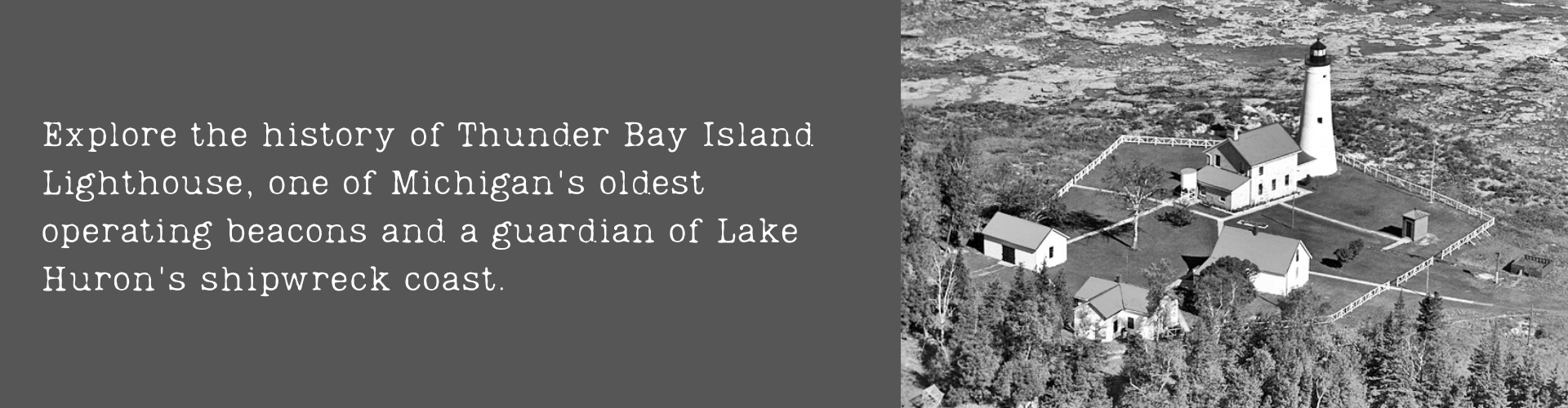
A Beacon Among Shipwrecks
Rising above the waters of northern Lake Huron, Thunder Bay Island Lighthouse has guided mariners for nearly two centuries. Located on the southeastern tip of Thunder Bay Island, the lighthouse stands at the entrance to one of the Great Lakes’ most historically significant maritime regions.
Today, the lighthouse is known not only for its long service to navigation but also for its connection to the many shipwrecks that rest beneath the waters of Thunder Bay. Together, they tell the story of the challenges, dangers, and importance of Great Lakes shipping.
Few Michigan lighthouses can claim a history that reaches back as far as Thunder Bay Island Light.
A Lighthouse for a Dangerous Bay
Thunder Bay has long been recognized as both a refuge and a hazard.
The bay offered mariners protection from storms sweeping across Lake Huron, making it a valuable shelter for vessels traveling between the lower and upper Great Lakes. However, the same waters were filled with hidden dangers. Reefs, shoals, and islands surrounded the bay’s entrance, creating obstacles that claimed countless ships over the years.
As maritime traffic increased during the early nineteenth century, the federal government recognized the need for a lighthouse to help vessels safely navigate the area.
In 1831, builders constructed one of the earliest lighthouses on Lake Huron on Thunder Bay Island. It was only the third operating United States lighthouse on the lake.
Unfortunately, the original structure proved inadequate and began to deteriorate almost immediately.
Building a More Lasting Lighthouse
In 1832, masons constructed a replacement lighthouse using local limestone.
The sturdy stone tower stood 40 feet tall and provided a much more durable solution for the harsh conditions of Lake Huron. For the next quarter century, the lighthouse helped guide vessels into and around Thunder Bay.
As shipping traffic continued to grow, improvements became necessary.
In 1857, workers raised the tower by an additional ten feet and sheathed it with brick, increasing its height to 50 feet. During the same renovation, a fourth order Fresnel lens was installed, dramatically improving the lighthouse’s effectiveness.
Additional modifications over the years eventually brought the tower to its current height of approximately 63 feet.
Though altered, the lighthouse that stands today remains rooted in the structure first built in 1832, making it one of Michigan’s oldest continuously operating lighthouse towers.
Expanding the Station
As navigation technology evolved, so did the facilities on Thunder Bay Island.
In 1858, workers installed a fog bell to assist mariners during periods of reduced visibility. Thick fog frequently blankets Lake Huron, making audible signals just as important as the lighthouse beam itself.
In 1868, workers rebuilt the keeper’s dwelling, providing improved living conditions for the families responsible for maintaining the station.
A steam powered foghorn followed in 1871, offering an even more effective warning system for vessels navigating through poor weather. In 1892, workers constructed a dedicated fog signal building to house the equipment.
Together, these improvements transformed Thunder Bay Island Light from a simple lighthouse into a fully equipped navigation station capable of assisting mariners under a wide variety of conditions.
Life on a Remote Island
For more than 150 years, lighthouse keepers and their families called Thunder Bay Island home during the navigation season.
Life on the island required dedication and self-reliance. Keepers were responsible for maintaining the light, operating fog signals, caring for station buildings, and monitoring weather conditions.
Supplies often arrived by boat, and severe storms could isolate the island for extended periods.
Despite the challenges, generations of keepers faithfully maintained the station, ensuring that vessels traveling Lake Huron could rely on its light.
That long tradition finally came to an end in 1983 when the Coast Guard automated the lighthouse.
Automation eliminated the need for resident keepers, ending one of the longest continuous periods of lighthouse staffing in Michigan history.
The Shipwreck Coast
The waters surrounding Thunder Bay Island have earned a reputation as one of the most important maritime archaeological regions in North America.
While the lighthouse helped countless vessels navigate safely, many ships still fell victim to storms, collisions, and navigational errors.
In recognition of this remarkable underwater heritage, the federal government established the Thunder Bay National Marine Sanctuary in 2000.
The sanctuary protects one of the nation’s most significant collections of historic shipwrecks. The wrecks range from early wooden sailing vessels and side wheel steamers to large twentieth century freighters, providing a unique record of Great Lakes commerce and transportation.
These shipwrecks help tell the story of why navigational aids such as Thunder Bay Island Lighthouse were so important.
Preservation and Restoration
Like many automated lighthouses, Thunder Bay Island Light entered a period of decline after resident keepers left the station.
Although the National Register of Historic Places listed the lighthouse in 1984, the buildings and infrastructure gradually deteriorated during the following years.
Concerned, preservationists stepped forward to change that.
In 1997, the United States Coast Guard leased the lighthouse to the Thunder Bay Island Preservation Society. The organization launched an ambitious effort to stabilize, restore, and preserve the historic station.
Their work has drawn attention from lighthouse enthusiasts throughout the Great Lakes region and beyond.
In fact, in 2004, preservation advocates further promoted the lighthouse’s history through the publication of a book dedicated to Thunder Bay Island’s heritage, with proceeds helping support ongoing restoration efforts.
A Light That Still Shines
Nearly two hundred years after builders built the first lighthouse on Thunder Bay Island, the beacon continues to serve mariners on Lake Huron.
Its stone tower has survived changing technology, shifting shipping patterns, and generations of storms. It has watched over one of the most shipwreck prone regions of the Great Lakes and remains an enduring symbol of Michigan’s maritime past.
For visitors exploring the history of Thunder Bay, the lighthouse offers a powerful reminder that every shipwreck story begins with sailors attempting to navigate safely home.
And for nearly two centuries, Thunder Bay Island Lighthouse has been there to help show them the way.
Explore our full collection of Northern Michigan lighthouse stories here
Start planning your trip today and explore the legacy of Michigan’s maritime history!
📍 Explore the Map Below