The Lonely Sentinel of Isle Royale
Far out in the waters of northwestern Lake Superior, a narrow reef known as Rock of Ages posed a serious threat to ships for generations. Hidden beneath the surface, it was battered by some of the most powerful storms on the Great Lakes. As a result, the rocky outcropping earned a reputation among mariners as one of the most dangerous navigational hazards in the region.
Today, Rock of Ages Lighthouse rises from that reef like a stone fortress, standing watch over the shipping lanes west of Isle Royale. Moreover, it was built in one of the most remote locations on the Great Lakes. It remains one of Michigan’s most impressive engineering achievements and one of the most isolated lighthouse stations ever constructed.
A Hazard on Lake Superior
The waters surrounding Isle Royale have long been a challenge for mariners.
As shipping traffic increased throughout the nineteenth century, vessels carrying iron ore, copper, timber, coal, and manufactured goods regularly crossed Lake Superior. The route west of Isle Royale was especially important for ships traveling between Duluth and Thunder Bay. Furthermore, the route was vital for ships traveling between Thunder Bay and the Soo Locks.
Unfortunately, the Rock of Ages reef sat directly in the path of this traffic.
Several shipwrecks occurred on the reef. Consequently, federal officials were convinced that a permanent lighthouse was needed to protect vessels navigating the area.
By the early twentieth century, the United States Lighthouse Board had gained extensive experience building lighthouses on remote reefs and shoals. For example, Spectacle Reef, Stannard Rock, and other offshore stations had proven that such projects were possible. However, they were never easy.
Rock of Ages would become one of the final and most ambitious examples of that effort.
Building a Lighthouse on Bare Rock
Construction began in 1908.
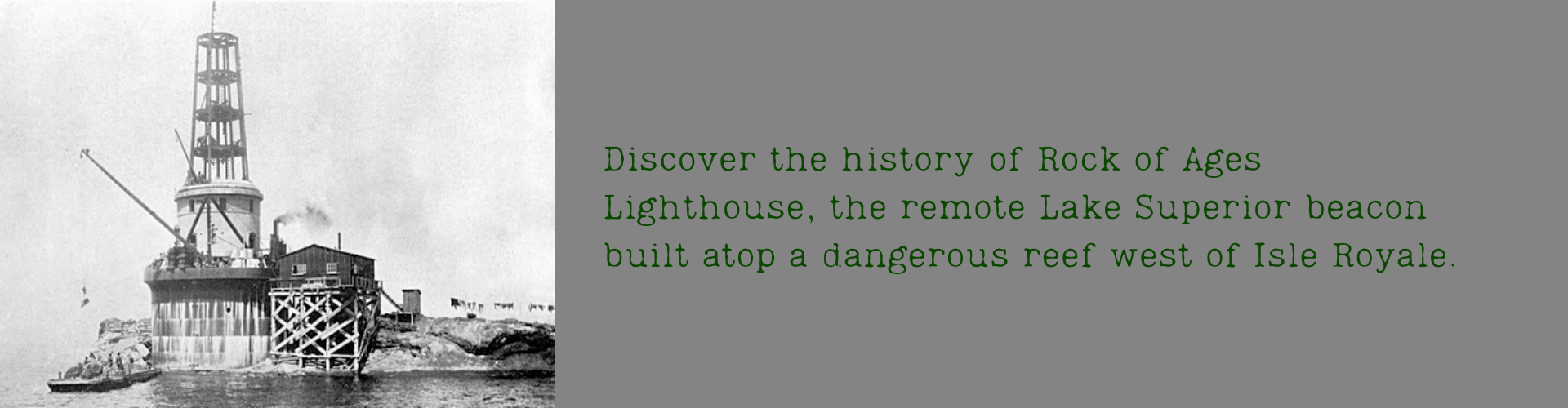
The project site offered little more than a small rock outcropping measuring roughly fifty by two hundred feet. There was no natural harbor and almost no protection from Lake Superior’s waves.
Workers established a construction base at Washington Harbor on Isle Royale. In addition, they relied on the lighthouse tender Amaranth to transport men, equipment, and building materials to the reef.
Before construction could begin, part of the rock had to be blasted away to create a level foundation.
Engineers then erected a massive circular steel wall and filled it with concrete, creating a pier fifty feet in diameter and twenty-five feet high. Accordingly, this enormous foundation would support the lighthouse above the relentless pounding of Lake Superior.
Once the base was complete, workers assembled the steel framework that formed the lighthouse’s core. Brick walls were built around the framework, concrete floors were added and cast iron spiral staircases connected the levels.
Temporary bunkhouses, a galley, and a mess hall were constructed on timber platforms attached to the reef. This allowed workers to live on site throughout the project.
A temporary light was exhibited in 1908 while construction continued.
A Tower Built to Endure
The completed lighthouse was unlike most Great Lakes lighthouses.
At its center is a massive steel core extending from the bedrock foundation through the entire structure. This design provided extraordinary strength and helped the tower withstand the harsh conditions of Lake Superior.
The lighthouse’s caisson foundation contains a two-story cellar, while the tower itself rises high above the lake.
Many historians have noted similarities between Rock of Ages Lighthouse and Chicago Harbor Lighthouse. Still, the Isle Royale station was built on a much more exposed and challenging site.
Its appearance also reflects the final generation of major offshore lighthouse construction on the Great Lakes.
The Power of the Fresnel Lens
One of the station’s most impressive features arrived in 1910.
That year, a massive second order Fresnel lens manufactured by Barbier, Benard & Turenne of Paris was installed in the lantern room.
The lens stood more than six feet tall and weighed approximately 3,530 pounds. It floated in a bath of mercury, allowing it to rotate smoothly despite its enormous size.
Compared to smaller lighthouse lenses, the second order Fresnel was extraordinarily powerful. Its beam could be seen up to twenty nautical miles away under favorable conditions. This helped mariners safely avoid the dangerous reef.
The lens represented the pinnacle of lighthouse technology during the early twentieth century. Furthermore, it remains one of the most remarkable optical devices ever used on the Great Lakes.
Life on an Isolated Reef
Serving at Rock of Ages was not for everyone.
Each spring, a crew of lighthouse keepers was transported to the station, where they remained until the end of the navigation season. During those months, they lived surrounded by water. In addition, they were isolated from the mainland and often from other people.
Provisioning the station was difficult and sometimes dangerous. Supplies had to be carefully planned because storms could prevent delivery for extended periods.
On one occasion, the keepers’ food supply dwindled to a single can of tomatoes before relief finally arrived.
Stories like that highlight just how challenging life could be at one of the Great Lakes’ most remote lighthouse stations.
Despite the hardships, generations of keepers faithfully maintained the light and fog signals. This ensured that vessels crossing Lake Superior could depend upon the station.
Automation Arrives
By the late twentieth century, advances in technology made automation increasingly practical.
In 1978, Rock of Ages Lighthouse was automated, ending sixty-eight years of service by resident lighthouse keepers.
The station’s famous Fresnel lens continued operating for a time. However, in 1985 it was replaced as part of a modernization project powered by solar energy.
Today, the original lens is preserved at Isle Royale National Park, where visitors can view one of the largest and most impressive Fresnel lenses ever installed on the Great Lakes.
A Lasting Symbol of Great Lakes Engineering
Rock of Ages Lighthouse represents the culmination of decades of offshore lighthouse construction on the Great Lakes.
Engineers who built the station drew upon lessons learned at Spectacle Reef, Stannard Rock, and other difficult locations. The result was a structure capable of surviving powerful storms, winter ice, and the isolation of Lake Superior’s open waters.
More than a century after its construction, the lighthouse continues to serve mariners as an active aid to navigation.
Standing alone on a rocky outcropping west of Isle Royale, it remains one of the most dramatic and impressive lighthouses in Michigan.
For those who encounter it, Rock of Ages is a reminder of a time when engineering skill, determination, and courage combined to place a beacon in one of the most unforgiving places on the Great Lakes.
Explore our full collection of Northern Michigan lighthouse stories here
Start planning your trip today and explore the legacy of Michigan’s maritime history!
📍 Explore the Map Below