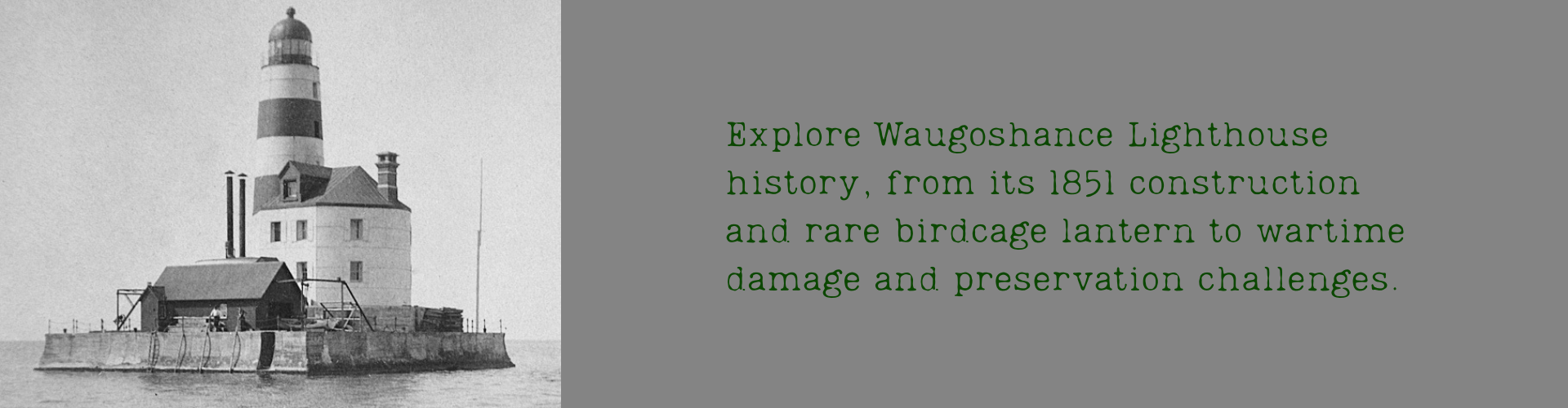
ouseA Weathered Landmark in the Straits of Mackinac
About fifteen miles west of Mackinaw City, the remains of Waugoshance Lighthouse stand in the shallow waters of northern Lake Michigan. Once an important navigational landmark for ships approaching the Straits of Mackinac, the lighthouse is now one of Michigan’s most endangered historic maritime structures.
Its location was no accident.
A Lighthouse Surrounded by Dangerous Waters
During the nineteenth century, vessels traveling north from Chicago and other Lake Michigan ports had to navigate a complicated stretch of water before entering the Straits of Mackinac. Shallow shoals, shifting weather, and limited visibility made the journey particularly hazardous.
Waugoshance Point extended into Lake Michigan, creating a broad area of shallow water that ships needed to avoid. In some places, the depth was less than twelve feet, making the passage especially dangerous for larger vessels.
For mariners approaching the Straits, the lighthouse marked an important turning point between the eastern shore of Lake Michigan and the Beaver Island archipelago.
Today, the ruined structure remains a reminder of the challenges faced by the people who navigated these waters and those who maintained the lights that helped guide them.
The First Lightship on the Great Lakes
The history of Waugoshance Lighthouse began nearly two decades before the permanent structure was built.
In 1832, the federal government established a lightship at Waugoshance Shoal to warn vessels of the dangerous waters.
The wooden vessel, named Lois McLain, became the first lightship stationed on the Great Lakes.
A lightship served much the same purpose as a lighthouse, but instead of standing on a permanent foundation, it remained anchored near a navigational hazard.
This arrangement was particularly useful in locations where constructing a traditional lighthouse was difficult or impractical.
Waugoshance was one of those places.
The surrounding shoals extended far from shore, and the waters were exposed to the powerful storms that frequently crossed northern Lake Michigan.
Although the lightship provided an important warning to passing vessels, a permanent lighthouse offered the possibility of a more dependable navigational station.
In 1851, the Lois McLain was replaced by Waugoshance Lighthouse.
Building a Lighthouse in Open Water
Constructing Waugoshance Lighthouse presented challenges unlike those encountered at many earlier Great Lakes stations.
Rather than building on an island or along the shoreline, workers had to establish a permanent foundation in shallow, exposed water.
Waugoshance became one of the earliest Great Lakes lighthouses built entirely surrounded by water.
The station rested on a substantial crib foundation, an engineering approach that helped support the structure in an area exposed to heavy waves and seasonal ice.
The location was particularly vulnerable to storms approaching from the southwest.
Winds traveling across the long expanse of Lake Michigan could generate powerful waves that grew more dangerous as they reached the shallow shoals surrounding the lighthouse.
These conditions complicated both the original construction and the ongoing maintenance of the station.
The lighthouse itself was built with unusually thick masonry walls. At the base, the walls measured approximately five and a half feet thick.
The exterior was originally painted with four broad horizontal red and white stripes, creating a distinctive daytime landmark that mariners could recognize even when the light was not visible.
Over time, the structure would undergo substantial changes as engineers worked to protect it from the lake.
The Unusual Birdcage Lantern
One of Waugoshance Lighthouse’s most distinctive architectural features was its birdcage lantern.
The lantern’s unusual framework gave it an appearance resembling a birdcage, a design rarely seen among Great Lakes lighthouses.
Waugoshance was one of only three Great Lakes lighthouses constructed with this style of lantern.
Inside the lantern was a fourth order Fresnel lens, reportedly the first of its order installed on the Great Lakes.
Fresnel lenses represented an important improvement in lighthouse technology. Their arrangement of carefully shaped glass prisms concentrated light into a beam that could be seen from greater distances than a conventional lamp.
For vessels navigating northern Lake Michigan, the light provided a recognizable reference point near the dangerous shoals.
The combination of the distinctive tower, striped exterior, and lantern made Waugoshance an important landmark both day and night.
Rebuilding the Foundation
Maintaining a lighthouse in open water required constant attention.
The same waves and ice that threatened passing ships also battered the station’s foundation.
By 1870, the original pier required substantial reconstruction.
The project was a major undertaking, made more difficult by the limited construction season on northern Lake Michigan.
Although the lighthouse operated through much of the shipping season, the period of weather suitable for major construction was considerably shorter.
Workers had to transport materials to the station, carry out repairs, and complete the project while conditions allowed.
The lighthouse also received protective metalwork as its masonry deteriorated.
Steel boilerplate was installed around the exterior walls to help protect the structure from the effects of weather and water.
A similar approach was later used at Big Sable Point Lighthouse, where the original brick tower also required metal protection.
These improvements extended the working life of Waugoshance Lighthouse, but the station remained exposed to some of Lake Michigan’s most difficult conditions.
The Smoke of October 1871
One of the most unusual episodes in Waugoshance Lighthouse history occurred during the devastating fires of October 1871.
Beginning around October 8, enormous fires swept through communities and forests across the Great Lakes region.
The Great Chicago Fire and the Peshtigo Fire became two of the best known disasters, but widespread fires also burned through parts of Michigan, including areas near Manistee, Holland, and the Thumb.
Smoke from the fires spread across Lake Michigan, creating exceptionally poor visibility for vessels traveling the lake.
For lighthouse keepers, the conditions presented a serious problem.
Even a properly maintained lighthouse could provide little assistance when dense smoke prevented mariners from seeing its beam.
At Waugoshance, keepers reportedly rang bells for days in an effort to warn approaching vessels away from the shoals.
The bells provided an audible warning when the light itself could not be seen.
Despite their efforts, numerous vessels were lost in the difficult conditions.
The episode illustrates an important part of lighthouse history that is sometimes overlooked. Keepers were responsible for much more than lighting a lamp at sunset.
They had to respond to changing conditions, maintain warning equipment, and do whatever they could to help mariners navigate safely.
At an isolated station such as Waugoshance, that responsibility could become especially demanding.
Changes in Great Lakes Navigation
For much of the nineteenth century, Waugoshance Lighthouse marked an important passage for vessels traveling between Lake Michigan and the Straits of Mackinac.
But Great Lakes shipping changed considerably during the decades that followed.
As commercial vessels grew larger and required deeper water, the shallow passage near Waugoshance became less practical.
Ships increasingly used the deeper Gray’s Reef passage farther west.
The construction of additional navigational lights also reduced the importance of the older station.
White Shoal Lighthouse, completed in 1910, provided a powerful new light north of Waugoshance. The development of navigational aids along the deeper shipping routes further reduced the need for the original station.
Waugoshance Lighthouse was deactivated in 1912.
After sixty one years of service, its light was extinguished, and the station remained under federal ownership.
The lighthouse had fulfilled its original purpose, but its most difficult years were still ahead.
World War II and the Destruction of the Lighthouse
After its deactivation, Waugoshance Lighthouse stood abandoned in northern Lake Michigan.
Without resident keepers to maintain the building, the effects of weather and neglect gradually became more apparent.
During World War II, the United States Navy used the abandoned lighthouse for bombing practice.
The military exercises caused extensive damage to the historic structure.
The keeper’s dwelling and the wooden framing within the lighthouse burned, leaving much of the building exposed.
Over time, the protective metal shell also began to deteriorate and fall away.
The lighthouse that had once displayed broad red and white stripes gradually became the gray, weathered ruin visible today.
Although the stone and masonry portions of the structure survived, the damage left the building increasingly vulnerable to Lake Michigan’s waves, ice, and storms.
Efforts to Save Waugoshance Lighthouse
As the lighthouse continued to deteriorate, preservation advocates began working to protect what remained.
The Waugoshance Lighthouse Preservation Society was formed in 2000, with Chris West among those leading the effort.
The organization sought to stabilize the building and eventually restore portions of the historic station.
Preserving Waugoshance presented substantial challenges.
Unlike a lighthouse accessible by road, Waugoshance required workers and materials to be transported across open water. The surrounding shoals complicated access, while the damaged structure made repair work difficult.
The society obtained an extended lease from the United States Coast Guard and undertook intermittent repairs.
Fundraising focused on stabilizing the building, an essential first step before more extensive restoration could be considered.
In 2009, the lighthouse was declared excess federal property and made available through the National Historic Lighthouse Preservation Act.
The program allowed eligible public agencies, nonprofit organizations, and educational institutions to apply for historic lighthouses at no cost, provided they met preservation requirements.
Despite continued interest in Waugoshance, the scale of the necessary repairs remained a serious obstacle.
An Endangered Great Lakes Landmark
By 2019 and 2020, rising Lake Michigan water levels and continued deterioration had placed additional stress on Waugoshance Lighthouse.
The foundation was particularly vulnerable.
Preservation estimates indicated that stabilizing the foundation alone could cost approximately $300,000.
That figure did not include the additional work necessary to restore the damaged building.
In January 2021, the Waugoshance Lighthouse Preservation Society announced that the costs of long term preservation had become prohibitive.
The organization planned to dissolve and donate its remaining preservation funds to local organizations with similar missions.
The lighthouse was returned to federal control.
Supporters also sought permission to remove and preserve the unusual birdcage lantern cap, recognizing its historical and architectural importance.
That request was denied.
Waugoshance has appeared on Lighthouse Digest’s Doomsday List, which identifies historic lighthouses facing serious threats to their survival.
The designation reflects the difficult reality facing a structure that has endured more than a century and a half of Lake Michigan weather, wartime damage, and prolonged deterioration.
Waugoshance Lighthouse Today
Today, Waugoshance Lighthouse remains a ruined landmark in the waters west of Mackinaw City.
Its once colorful exterior has largely disappeared, and the surviving structure is exposed to the elements.
The lighthouse is closed to the public.
Although it can be viewed from the water, reaching the area requires navigating open Lake Michigan and the shallow shoals that made the lighthouse necessary in the first place.
Those waters remain hazardous, particularly when winds and waves increase.
The deteriorated building is also unsafe for visitors, and there is no public access to the structure itself.
For those interested in seeing Waugoshance, viewing it from a safe distance by boat is the appropriate approach.
The lighthouse’s future remains uncertain. Continued erosion, wave action, and deterioration threaten what remains of the historic station.
A Reminder of Michigan’s Maritime Past
Waugoshance Lighthouse tells a story that extends well beyond its years as an active navigational aid.
It represents an early chapter in Great Lakes lighthouse engineering, when builders were learning how to establish permanent stations in exposed offshore locations.
The lighthouse recalls the keepers who maintained the light through storms, ice, and the extraordinary smoke that covered Lake Michigan during the fires of 1871.
It also reflects the changing needs of Great Lakes shipping, as larger vessels and improved navigational systems gradually made older lighthouse stations unnecessary.
And its damaged condition offers a reminder of the difficulties involved in preserving historic structures surrounded by water.
For more than sixty years, Waugoshance Lighthouse helped guide mariners through one of northern Lake Michigan’s most dangerous passages.
Today, its surviving walls and distinctive lantern stand as reminders of the people, vessels, and maritime history connected to the Straits of Mackinac.
Whatever the future holds for the structure, Waugoshance Lighthouse remains an important part of Northern Michigan’s history.
Explore our full collection of Northern Michigan lighthouse stories here
Start planning your trip today and explore the legacy of Michigan’s maritime history!
📍 Explore the Map Below