Survivor of Fire and Change
Where the Au Sable River meets Lake Huron, a lighthouse once stood watch over one of Michigan’s most bustling lumber towns. The Au Sable Pierhead Lighthouse was established to guide vessels safely into the mouth of the Au Sable River at Oscoda. It served as a vital harbor along Michigan’s northeastern shore. Though the river winds gently for 138 miles through the state’s northern Lower Peninsula, its meeting with Lake Huron was anything but tranquil. This was especially true in the days of lumber, mills, and massive ships.
Lighting the Way for Lumber and Trade
The Lighthouse Board recognized early on that river mouths served as critical harbor entrances. On November 20, 1873, a light was established at the outer end of the north pier of the Au Sable River. This light joined a small but growing list of Michigan’s river entrance lights, alongside Alpena’s (1875) and Cheboygan’s (1880).
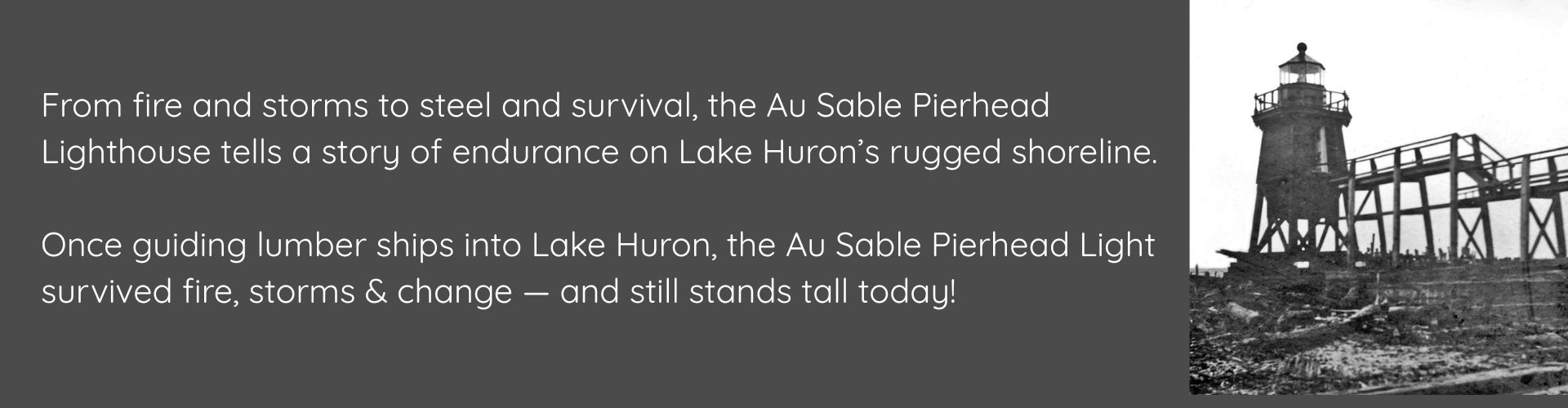
The first keeper, George H. Keating, earned $500 a year—no small sum for the time. However, he had to find his own lodging since no keeper’s dwelling was provided. The original wooden tower was twelve feet square at its base, tapering to eight feet near the lantern room. Standing just over 32 feet tall, it held a sixth-order Fresnel lens. This produced a fixed red light, later upgraded to a fifth-order lens from the French firm Sautter, Lemonnier, & Cie.
Though a fire damaged the light in 1885, it was quickly repaired. Keeper Tom Hendrickson eventually took over the station in 1883. He faithfully maintained the light for thirty years. This was a remarkable tenure considering the harsh conditions and frequent storms that battered the Lake Huron shoreline.
A Town and Its Lighthouse Tested by Fire
Life at Au Sable was never easy, but nothing compared to the inferno of July 11, 1911. That day, fierce winds drove flames from nearby forest fires straight into the towns of Oscoda and Au Sable. A newspaper headline captured the horror: “Fierce Rush of Flames Drives Many into Lake.”
The fire leveled both towns, with mills, homes, and businesses reduced to ash. Residents fled into Lake Huron for safety, and though many survived thanks to the quick aid of ships like the freighter Kongo, five lives were lost. The pierhead light miraculously survived. It stood as a small symbol of endurance amid the devastation.
A New Tower for a New Era
By the end of 1912, the wooden lighthouse was replaced by a pyramidal steel skeleton tower mounted on a concrete base. The new light featured an acetylene-powered flashing red beacon. It produced 130 candlepower, bright enough to pierce through the fog and mist that so often shrouded the river mouth.
The Annual Report of the Lake Carriers’ Association described it proudly:
“The new structure is a white pyramidal skeleton steel tower surmounting a white tank house on a square concrete base rising eight feet above the water… The illuminant has been changed from oil to acetylene.”
Keeper Hendrickson, now 58, wasn’t quite ready to hang up his lantern. He transferred to Munising, where he tended range lights for another decade before retiring.
Modernization and Preservation
Electricity reached the Au Sable light in 1940, changing its characteristic from flashing red to fixed red. Then in 1957, the skeletal tower was removed, replaced by modern towers on both the north and south piers.
But the story didn’t end there. The 1912 steel tower found an unlikely second life on the grounds of the Oscoda Yacht Club, where it stood for decades. In 2013, local business owner David Allen purchased the aging structure for $1,500. He was determined to keep this piece of maritime history close to home. Though rusted and weather-worn, the tower was lovingly restored and now stands proudly once again. It is proof that even when the lights go out, history can still shine through.
Explore our full collection of Northern Michigan lighthouse stories here
Start planning your trip today and explore the legacy of Michigan’s maritime history!
📍 Explore the Map Below