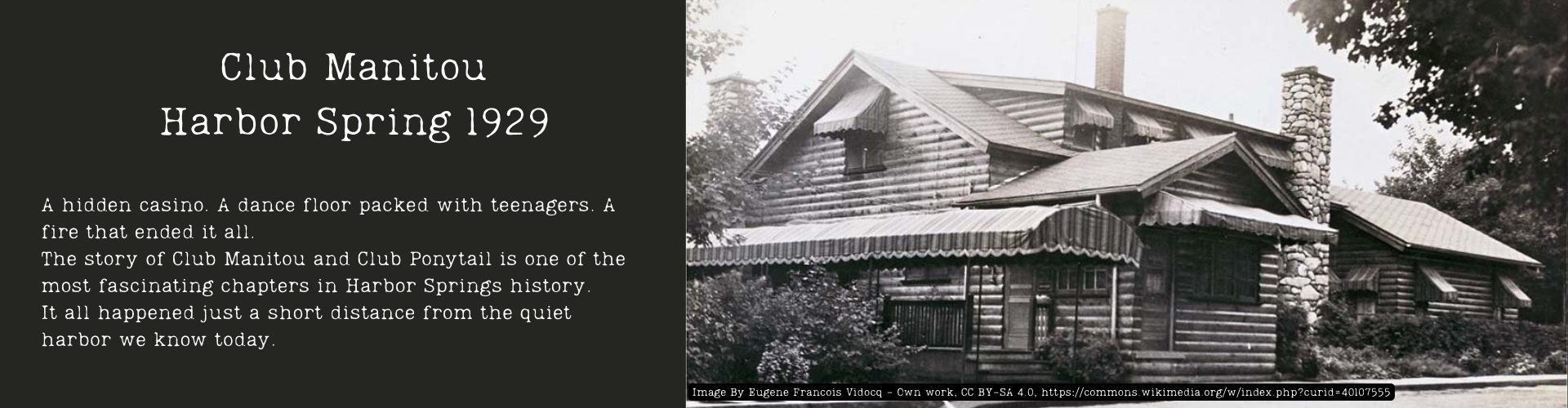
On the surface, Harbor Springs feels timeless.
Sailboats drift across Little Traverse Bay. Cottages sit quietly behind trees. Summer unfolds at an easy pace that has not changed much in generations.
But in the late 1920s, something very different was happening just beyond that calm surface.
For a few decades, one secluded club brought together wealth, music, and a shadow of organized crime. It became one of the most talked about places in Northern Michigan, even if few locals ever stepped inside.
A Resort Town with Quiet Appeal
By the early 1900s, Harbor Springs had already found its rhythm as a summer escape.
Families from Detroit, Chicago, and beyond came north by train and steamship, trading city heat for cool lake air. The bay offered relief, but it also offered something else, privacy.
That privacy would prove useful.
As Prohibition took hold in Michigan and across the country, demand for fine dining, liquor, and entertainment did not disappear. It simply moved out of sight.
The Arrival of Club Manitou
In 1929, just as another summer season began, a new club opened its doors.
Club Manitou was not advertised. It did not need to be. Word traveled quietly through the same circles that summered along the bay.
Behind the project was Purple Gang, a Detroit based group known for controlling the flow of illegal liquor during Prohibition. Their leader, Abe Bernstein, understood exactly what the summer crowd wanted.
Upstairs, the club offered refined dining that matched anything found in the cities. Downstairs, behind secured doors, was something else entirely. A hidden world of gambling, liquor, and late night entertainment.
It was carefully designed, and carefully protected.
Who Got In, and Who Didn’t
One detail stands out when you look back at Club Manitou.
Most locals were not welcome.
The club catered almost exclusively to wealthy summer visitors. It employed people from the area, but the experience itself was reserved for those who arrived with money and connections.
This separation helped the club operate in relative peace. Authorities often looked the other way, and the club became known more by reputation than by public presence.
For those inside, evenings were filled with music, dancing, and games of chance. For those outside, it remained something talked about, but rarely seen.
Competition and Control
Club Manitou was not entirely alone.
Nearby venues tried to capture the same audience, most notably a competing casino that briefly challenged its popularity. But the Manitou had an advantage. It offered an experience that felt polished, exclusive, and just a little bit forbidden.
That combination proved difficult to match.
Over time, control of the club shifted, but the atmosphere remained much the same. Music played late into the night. Summer visitors returned year after year. The club quietly became part of the seasonal rhythm of Harbor Springs.
The End of an Era
By the early 1950s, the climate had changed.
Pressure from state authorities increased, and the tolerance that once allowed places like Club Manitou to operate began to fade. Raids became more common, and eventually the club lost its license to serve alcohol.
Without it, the operation could not continue.
After the 1953 season, Club Manitou closed its doors.
For a time, the buildings sat still, holding onto years of stories that had never quite been told out loud.
A New Sound in the Same Space
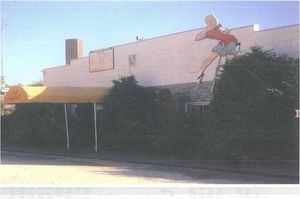
Club Ponytail Teen dance nightclub of harbor springs 1962-69 – By Eugene Francois Vidocq – Own work
Nearly a decade later, the property came back to life in a very different way.
In 1962, it reopened as Club Ponytail, a teen and collegiate nightclub that traded gambling tables for a dance floor. The mood shifted from quiet exclusivity to youthful energy.
Music took center stage.
National acts began making their way to this unlikely corner of Northern Michigan. For many young people, it became the place where summer memories were made. The kind of place where you might meet someone, hear a band you would never forget, or simply feel part of something bigger than a small town.
It was a different chapter, but the same location still drew people in.
An Abrupt Ending
That chapter, however, did not fade out slowly.
In March of 1969, a fire broke out at Club Ponytail. It is believed to have started with a gas heater explosion. The flames moved quickly, and the building was lost.
There were plans, at least at first, to rebuild. But the insurance money was not enough to bring it back. Just like that, the music stopped.
A few final performances were moved to nearby spaces, but the club itself was gone.
What Remains
The site, once home to hidden gambling rooms and later to packed dance floors, eventually became something far quieter, a private residence.
It is easy to drive past today without realizing what once stood there.
But for those who remember, or for those who have heard the stories, it was more than just a building. It was a place that reflected two very different eras in Northern Michigan history.
One shaped by secrecy and exclusivity.
The other by music, youth, and summer nights that seemed like they would never end.
For those who want to explore the story more deeply, guided tours are available through the Spirit of the Manitou, offering a closer look at this remarkable piece of Harbor Springs history.