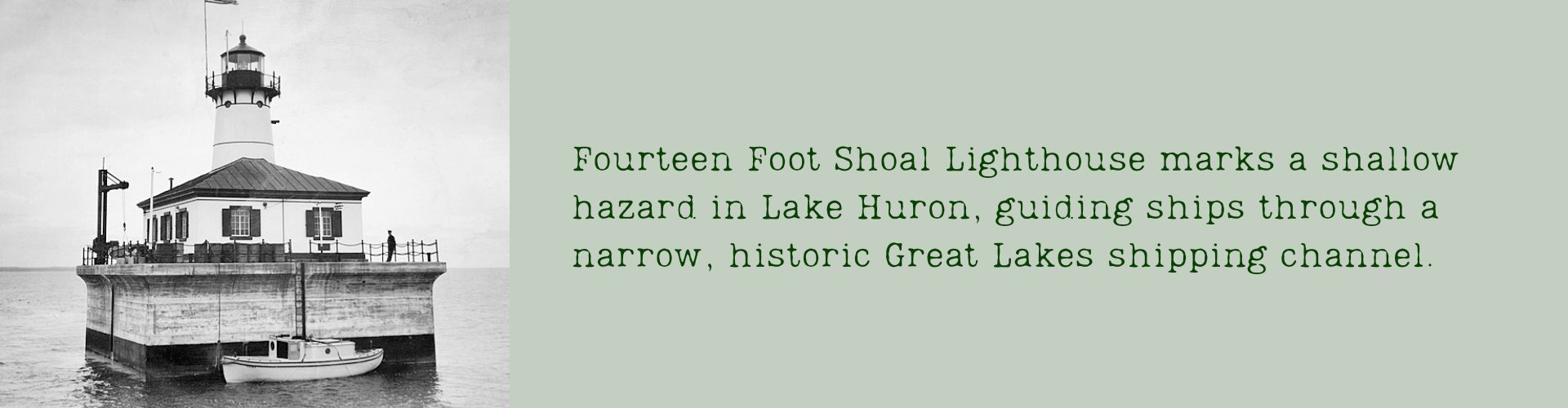
Guarding a Shallow Passage in Lake Huron
At the northern end of Lake Huron, where deep water gives way to hidden hazards, the Fourteen Foot Shoal Lighthouse quietly does its job. Named for the fact that the lake is only fourteen feet deep at this point, the lighthouse marks a dangerous shoal. This area has long challenged ships and mariners navigating these busy waters. While it’s not a lighthouse most people ever step inside, its role in Great Lakes navigation has been critical for nearly a century.
A Strategic Location on Lake Huron
Fourteen Foot Shoal Lighthouse stands in U.S. waters at the northern end of Lake Huron, near a narrow strait. Vessels bound for Chicago must pass through this area. Ships typically travel south of Bois Blanc Island to avoid shallow areas. This makes the channel one of the safest routes through the region. In this stretch of water, navigation depends on a pair of lights working together. Poe Reef Light marks the northern end of the safe channel. Meanwhile, Fourteen Foot Shoal Light defines the southern edge, helping vessels thread the needle between danger and deep water.
Designed for Automation from the Start
Unusual for its time, Fourteen Foot Shoal Lighthouse was designed from the beginning to operate without an on-site keeper and the home never lived in. The United States Lighthouse Service intended it to be automated and remotely controlled by radio from Poe Reef Light, located about 3.5 miles away. This was a forward-thinking design that reflected changing technology in lighthouse operations.
While plans for a permanent structure moved forward in 1025, a temporary acetylene buoy served to warn mariners. Construction of the lighthouse began in 1929, and the light officially went into service in 1930.
The Light and Its Technology
Originally equipped with a fourth-order Fresnel lens, a standard choice for offshore lights of its era. The focal plane of the light sits 56 feet above the water. Today, the lighthouse uses a 9.8-inch acrylic Fresnel-style optic which, when properly adjusted, is visible for up to nine nautical miles. A diaphone fog horn is also attached, providing an audible warning during fog and low-visibility conditions common on Lake Huron.
Still on Duty Today
Fourteen Foot Shoal Lighthouse remains an active aid to navigation under the care of the U.S. Coast Guard’s Ninth District. In 2002, the crew of the USCGC Mackinaw (WAGB-83) took on the task of painting and refurbishing the structure. This helped preserve both its function and appearance.
The lighthouse has been listed on the National Register of Historic Places in recognition of its historical and engineering significance. While it is not currently listed on the Michigan state registry, it has been determined eligible by the Michigan State Historic Preservation Office.
Visiting Fourteen Foot Shoal Lighthouse
Because of its offshore location, there is no easy way to visit Fourteen Foot Shoal Lighthouse by land. A private boat is the best way to see it up close. Even then, mariners must be mindful of the shallow water that gave the lighthouse its name. For most people, the lighthouse is best appreciated from a distance. It stands quietly watching over one of Lake Huron’s most important navigation routes.
Explore our full collection of Northern Michigan lighthouse stories here
Start planning your trip today and explore the legacy of Michigan’s maritime history!
📍 Explore the Map Below