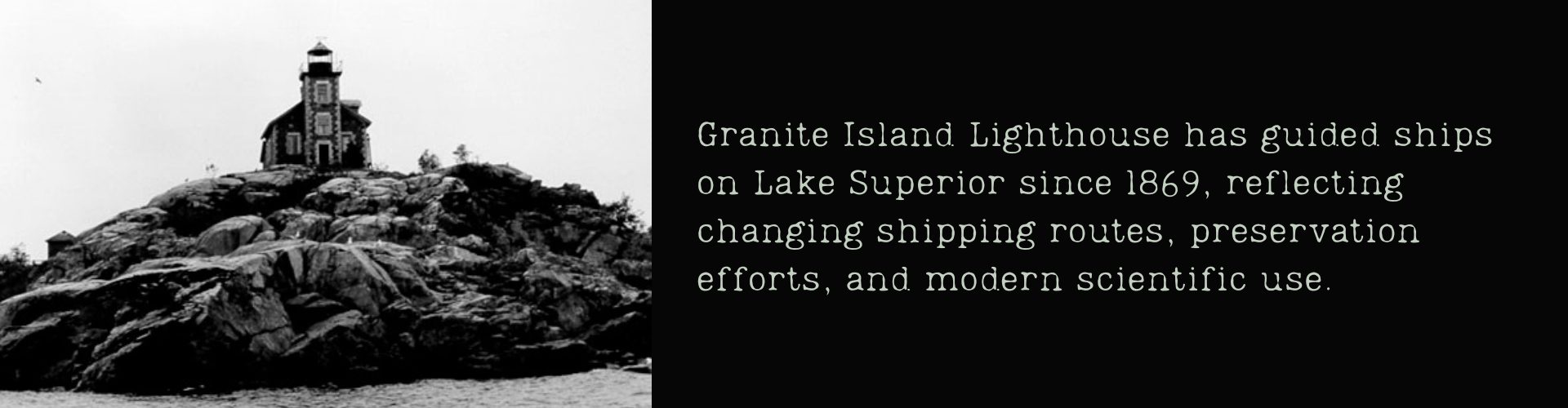
Rising from the open waters of Lake Superior, Granite Island Lighthouse has long stood as a quiet sentinel along one of the Great Lakes’ historic shipping routes. The island is remote and often surrounded by powerful winds and waves. The island’s light was once a critical guide for vessels traveling along the southern shore of the lake.
A Light for Busy Waters
By the middle of the nineteenth century, Lake Superior had become a major corridor for commercial shipping. Steamships and schooners carried iron ore, timber, and other cargo through waters that could turn treacherous with little warning. Positioned near these busy lanes, Granite Island was chosen as the site for a new lighthouse.
Construction began in 1868 under the direction of the United States Lighthouse Board. The light was officially commissioned the following year. Its design reflected both durability and regional style. Cut stone formed the keeper’s dwelling and attached square tower, while white limestone trimmed the corners and windows. Additionally, the one and one half story residence shared architectural similarities with other Upper Peninsula lights. These included those at Gull Rock, Huron Islands, and Marquette Harbor.
Life at the Station
For decades, lighthouse keepers and their assistants lived and worked on the island, maintaining the light through harsh winters and sudden summer storms. Their work ensured that mariners could safely navigate this exposed stretch of Lake Superior.
The station’s aids to navigation included a fourth order Fresnel lens, whose precise design concentrated light into a powerful beam visible far across the water. A fog bell tower provided an additional warning during periods of low visibility. The original fog signal structure was built in 1879. Later, it was replaced in 1910 by a steel bell tower. The bell itself had previously served at Thunder Bay Island before being installed here. It remained in use until 1939.
At one time, the lighthouse displayed a red flash every ninety seconds, marking its presence in the vast expanse of the lake. The focal height of the original light reached eighty nine feet above the water.
Changing Shipping Patterns
As maritime technology advanced, shipping lanes gradually shifted farther offshore. Larger vessels preferred deeper routes away from the island’s immediate vicinity. Because its role in navigation decreased, the Lighthouse Service automated the lighthouse in 1937. The last residents abandoned the living quarters, ending seventy years of continuous human presence.
In the late twentieth century, the Coast Guard considered the property surplus. Its eventual sale contributed to broader discussions about the future of historic lighthouses. These conversations helped lead to federal legislation that later encouraged transferring lighthouse properties to communities and preservation groups.
Restoration and Modern Uses
Scott and Martine Holman purchased Granite Island and its lighthouse in 1999. The team carefully restored the structures over the next three years, preserving their historic character while adapting them for new purposes. The lighthouse had already been recognized for its historical significance. In 1983, it was listed on the National Register of Historic Places.
Despite its remote setting, the island now supports a variety of modern activities. Northern Michigan University operates an internet relay station here, allowing real time educational connections with rural communities. A weather research station studies evaporation patterns that influence Great Lakes water levels. This data supports nearshore forecasting.
The restored keeper’s dwelling has also hosted creative writing retreats, offering a unique setting for reflection and study. A combination of solar panels, wind turbines, and backup propane systems generates power for the island. Operators remotely control these systems throughout the year.
A Working Aid to Navigation
Although privately owned and closed to the public, Granite Island continues to serve mariners. The United States Coast Guard maintains an automated navigation light on a gray steel tower. With a focal plane of ninety six feet and a range of ten nautical miles, it displays a white flash every six seconds.
The island’s exposed location has made it a place of remarkable weather extremes. One recorded wind gust reached one hundred forty three miles per hour in January of 2003. This is a reminder of the powerful forces that shape life on Lake Superior.
Today, Granite Island Lighthouse stands as both a historic landmark and a symbol of adaptation. Its stone walls and quiet presence recall a time when human vigilance was essential to safe passage. Even now, the light continues to fulfill its original purpose, guiding vessels across one of North America’s most formidable inland seas.
Explore our full collection of Northern Michigan lighthouse stories here
Start planning your trip today and explore the legacy of Michigan’s maritime history!
📍 Explore the Map Below