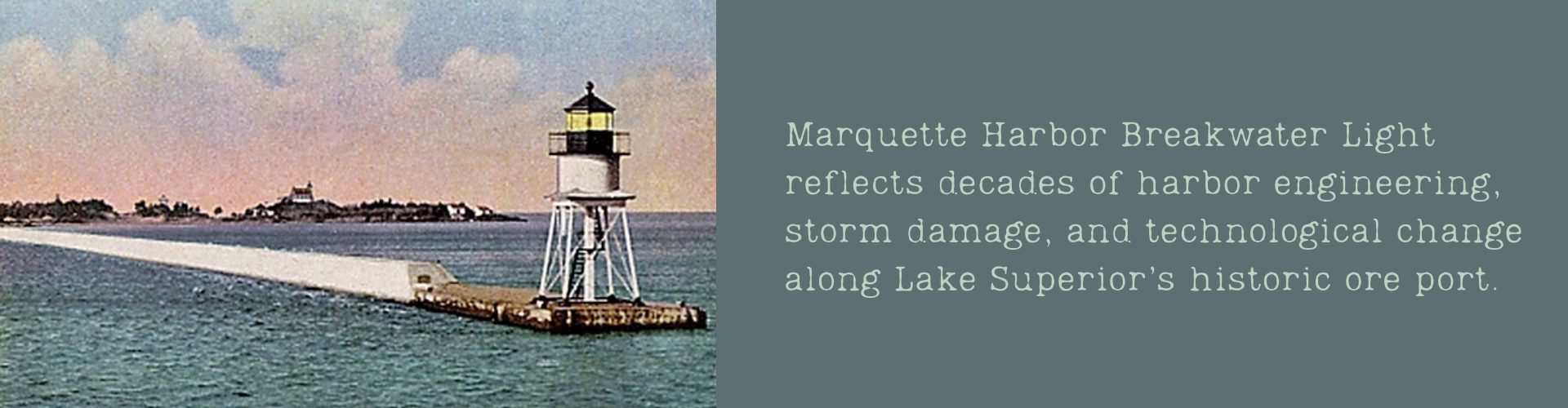
The lighthouse at the end of Marquette’s harbor breakwater reflects a long history of change along one of Lake Superior’s most important ore shipping ports. Though modest in size today, the light represents decades of engineering work, maritime growth, and the constant challenge of protecting vessels in exposed waters.
Early Harbor Improvements
Marquette Harbor first gained a lighthouse on the nearby point in 1853, serving ships involved in the growing iron ore trade. At the time, the harbor offered little natural protection. Storms sweeping in from the north and east could make docking difficult and dangerous.
To improve conditions, work began in 1867 on a timber and stone breakwater extending thousands of feet into the harbor. By 1875, once this structure was completed, a wooden tower was placed near the outer end to guide vessels. This early tower had previously served at Mendota before being relocated to Marquette.
Storms and Rebuilding
Life on the breakwater was often shaped by severe weather. In November 1886, a powerful storm swept away the tower and a large portion of the elevated walkway that connected it to shore. The structure was eventually recovered and returned to service.
Repeated damage followed. A severe gale in 1889 again carried off the tower, which was later retrieved but ultimately destroyed in another storm. Temporary lights were erected during these periods to maintain navigation safety.
In 1890, a stronger skeleton iron tower was installed. This structure included a lantern room and marked an effort to create a more durable aid to navigation. When the breakwater was extended in 1894, the tower was moved to the new outer end and placed on a foundation that housed equipment used to power the light.
Technological Advancements
The lighthouse saw early adoption of new technology. In 1899, electric wires were extended along the breakwater, making it one of the first Great Lakes lights to operate with electric power. When outages occurred, keepers returned to kerosene lighting, reflecting the transitional nature of maritime technology at the turn of the century.
The tower itself was repainted from brown to white in 1901 to improve visibility. In 1908, a new steel tower replaced the earlier iron structure. This thirty-six-foot tower featured a square watch room and octagonal lantern room. A fourth order Fresnel lens was installed, and a fog bell provided additional warning in low visibility.
Continued Expansion
Further improvements came as the breakwater was extended again during the 1910s. Construction created an angled section, or elbow, in the structure. The lighthouse was temporarily moved to accommodate the work and later repositioned at the new outer end. A diaphone fog signal and updated electrical systems were added in the late 1920s, ensuring the light remained effective for modern shipping.
Changing Harbor Activity
Marquette’s ore docks once transformed the harbor into a center of industrial activity. The introduction of gravity loading systems in the nineteenth century greatly reduced the time required to fill ships, allowing large freighters to move cargo more efficiently. Though shipping patterns changed over time, the harbor remained a vital link in the region’s economic story.
The current breakwater light was first illuminated in 1908, though the tower standing today dates from later changes. In 1985, the square steel tower was removed and replaced with a white cylindrical structure marked by a red band. The original Fresnel lens and lantern are now preserved at the Marquette Maritime Museum.
The Light Today
The modern tower stands thirty-six feet tall with a focal plane of thirty-six feet above the water. Its single flashing white light has a nominal range of twelve nautical miles and operates on a short repeating cycle. While access to the breakwater itself is limited, the surrounding grounds remain open to visitors who wish to experience the harbor’s maritime setting.
Today, the Marquette Harbor Breakwater Light continues to serve as a quiet guide along Lake Superior’s shoreline. Its long history of relocation, rebuilding, and technological change reflects both the power of the lake and the determination of those who worked to make navigation safer.
Explore our full collection of Northern Michigan lighthouse stories here
Start planning your trip today and explore the legacy of Michigan’s maritime history!
📍 Explore the Map Below