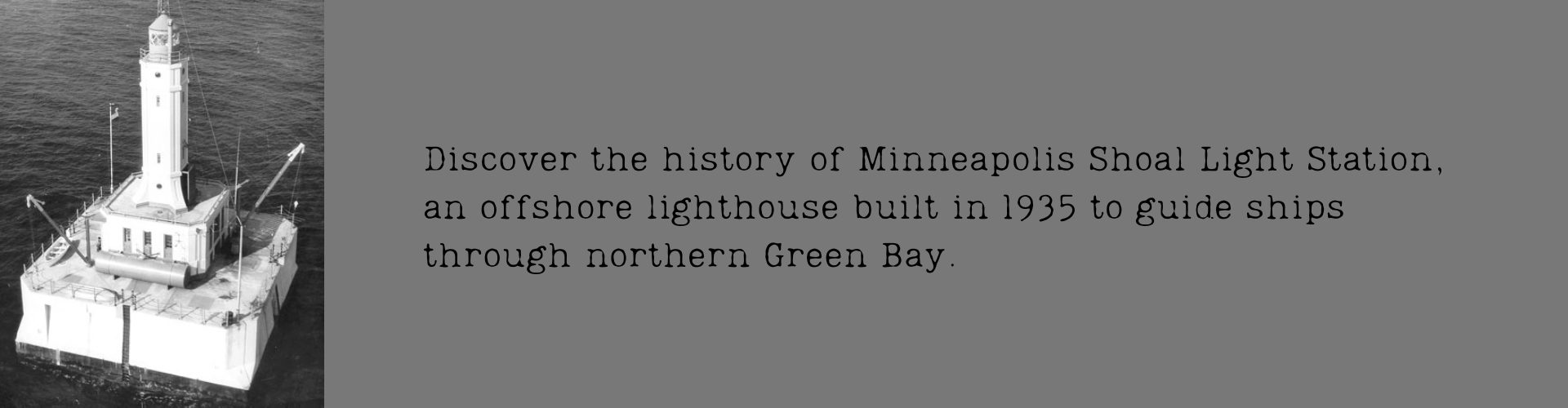
The Offshore Sentinel of Green Bay
Rising from the waters of northern Green Bay, the Minneapolis Shoal Light Station stands alone miles from shore, a reminder of an era when Great Lakes navigation depended on carefully placed beacons and the dedication of lighthouse keepers.
Located approximately 6.6 miles south of Peninsula Point near Big Bay de Noc, the lighthouse was built during a period of changing shipping patterns on Lake Michigan. While many of Michigan’s lighthouses trace their origins to the nineteenth century, Minneapolis Shoal represents a newer chapter in Great Lakes maritime history, one shaped by modern engineering and evolving commercial routes.
Today, the station remains an active aid to navigation and one of the most distinctive offshore lighthouses in Michigan waters.
Changing Shipping Routes Create a New Need
For much of the nineteenth century, ships traveling to and from Escanaba relied on the guidance of the Peninsula Point Lighthouse. Established in 1856, that lighthouse helped vessels navigate the waters near the entrance to Big Bay de Noc and the shipping channels serving the region.
As the decades passed, however, commercial shipping routes gradually changed. By the early 1930s, many vessels were traveling farther south of Peninsula Point than they had in earlier years. The existing lighthouse no longer provided the most effective guidance for the routes ships were using.
Recognizing the need for new navigational aid, federal funding was appropriated in 1932 for the construction of a lighthouse on Minneapolis Shoal, a hazardous area in northern Green Bay.
Construction moved quickly. The station was completed in 1934, and the light was first illuminated in 1935. From that moment forward, the offshore beacon became an important guide for vessels navigating the busy waters leading toward Escanaba and other Upper Peninsula ports.
Built to Withstand the Great Lakes
Unlike many earlier lighthouses that stood on shorelines or rocky points, Minneapolis Shoal Light Station was constructed directly in open water.
Engineers designed a substantial reinforced concrete foundation capable of enduring the powerful forces of waves, ice, and winter storms. The station rests on a square concrete pier that rises 30 feet above the water. Each side of the pier measures 64 feet, creating a stable platform for the structure above.
Atop the pier sits a two-story base measuring 30 feet on each side and standing 15 feet high.
The lower portions of the building housed the equipment needed to keep the station operating. Diesel generators provided electrical power, while boilers and compressors supplied heat and supported the operation of the light and fog signal. These systems allowed the station to function independently despite its isolated location far from shore.
The second floor served as living quarters for the keepers who maintained the light. Life at an offshore station required long periods of isolation, especially during rough weather when travel to and from the mainland could become difficult or impossible.
A Modern Lighthouse Design
The lighthouse itself rises from the center of the building’s roof.
Constructed of reinforced concrete and covered with steel plates, the cream-colored octagonal tower stands 17 feet tall. The tower tapers gracefully from 16 feet wide at its base to approximately 10 feet beneath the gallery.
The design reflected a new generation of lighthouse engineering. Rather than building a separate tower and keeper’s dwelling, engineers combined the functions into a single compact structure. This approach improved efficiency and reduced maintenance while providing a sturdy platform for offshore service.
The Minneapolis Shoal Light Station is often noted for its resemblance to the nearby Grays Reef Light Station. The two structures are considered twins and were constructed during the same era using similar plans.
Their design was based on modifications of earlier lighthouse plans developed by engineers F. P. Dillon and W. G. Will. Similar concepts had already been used successfully at lighthouse stations in Conneaut and Huron, Ohio.
The result was a durable and practical lighthouse capable of serving in some of the most challenging conditions found on the Great Lakes.
Life at the Station
For decades, keepers lived and worked at Minneapolis Shoal.
Maintaining an offshore lighthouse required constant attention. Equipment had to be monitored, generators serviced, buildings maintained, and the light kept in reliable working order. During periods of fog, the station’s signaling equipment played a vital role in helping mariners navigate safely through reduced visibility.
The isolation of offshore lighthouse life demanded self-reliance and patience. Keepers often spent extended periods surrounded by water, separated from family and community by weather and distance.
Although less romantic than many popular lighthouse stories, the daily work performed at stations like Minneapolis Shoal was essential to Great Lakes commerce and safety.
Automation and Preservation
Like many American lighthouses, Minneapolis Shoal eventually entered the age of automation.
In 1979, the station was automated, eliminating the need for resident keepers. Advances in technology made it possible for the light and its navigational systems to operate without continuous human presence.
Even after automation, the lighthouse continued serving mariners navigating Green Bay.
Recognition of the station’s historical and architectural significance came in 2006 when Minneapolis Shoal Light Station was listed on the National Register of Historic Places. The designation acknowledges both its role in Great Lakes navigation and its importance as an example of twentieth century lighthouse engineering.
A Lighthouse Built for a New Era
Many of Michigan’s best-known lighthouses were built during the age of sailing ships and lumber schooners. Minneapolis Shoal Light Station belongs to a different chapter of maritime history.
Constructed in response to changing shipping patterns during the twentieth century, it reflects the adaptability of Great Lakes navigation and the continuing effort to make commercial shipping safer and more efficient.
Standing alone in the waters of Green Bay, the lighthouse remains a quiet sentinel. Its concrete walls, steel clad tower, and offshore location tell the story of an era when modern engineering met the timeless challenge of guiding ships safely across the Great Lakes.
Explore our full collection of Northern Michigan lighthouse stories here
Start planning your trip today and explore the legacy of Michigan’s maritime history!
📍 Explore the Map Below