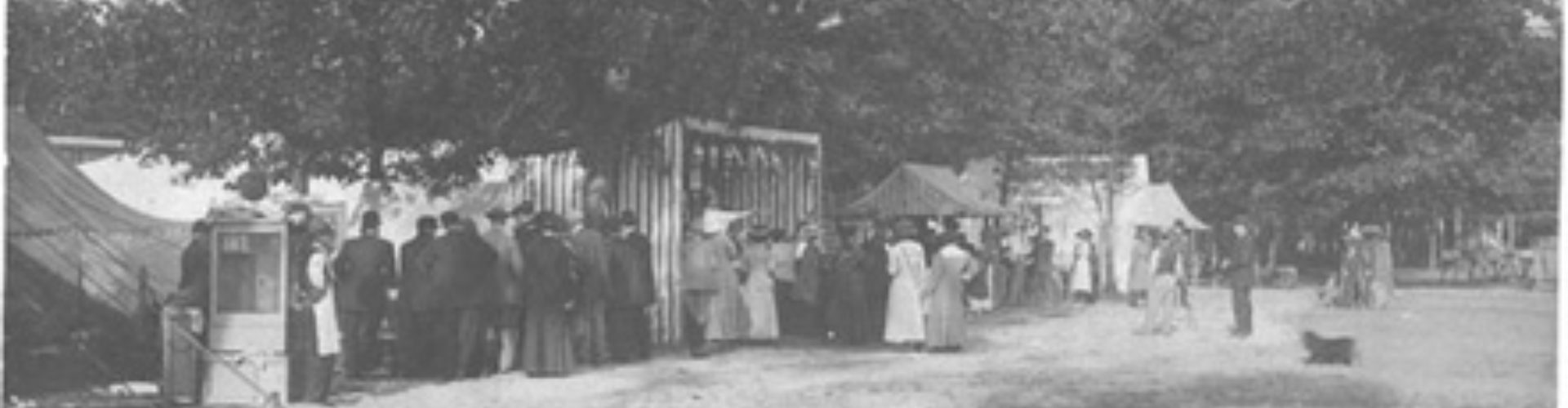
Going to the Fair, Going to the Fair, Going to the Northwest Michigan Fair
Every year, thousands flock to the Northwestern Michigan Fair to enjoy the sights, sounds, and tastes of Northern Michigan’s agricultural heritage. But how did this beloved event begin? On this day in history, September 29, 1908, the very first official Northwestern Michigan Fair opened its gates. This marked the start of a tradition that has lasted more than a century.
The inaugural fair ran from September 29 through October 2, 1908. Admission was priced at just twenty-five cents per day. The first annual premium book featured a striking photo of the Northern Michigan Asylum Herd of Holstein Cattle right on the front cover. The cover was a nod to the region’s deep agricultural roots. Though local fairs had popped up as early as 1873, it wasn’t until October 15, 1907, that the Grand Traverse Region Fair Association was officially created, laying the groundwork for what would become the Northwestern Michigan Fair.
From Circus Tents to the Civic Center
The fair’s original grounds have a fascinating history of their own. In 1882, Frank and Nellie Desmond purchased the fairgrounds, known today as the Civic Center. The property was held onto for 18 years. Ownership changed hands several times. The Traverse City Driving Park Association and later the Whiting family were all owners. In 1912 Grand Traverse County bought the grounds, securing a permanent home for the fair. Before this, the fair was famously held under tents on the Circus Grounds, now known as Thirlby Field.
For its first 16 years, the event operated under the Grand Traverse Region Fair Association name. Then in 1924, an official name change was made. The Northwestern Michigan Fair Association was born — a name it proudly carries today.
Finally Home
The fairgrounds moved to their current location on Blair Townhall Road in 1975. A long-range planning process and land purchase from Consumers Power made it possible. Since then, the fair has continued to evolve, embracing new features while keeping its agricultural roots intact. Notably, in 2006, a major capital improvement project transformed the grounds, including the removal of the Harness Racing Track and the addition of a state-licensed campground.
Despite all these changes, the core mission remains the same as it was in 1908: to promote Michigan agriculture, horticulture, education, mechanical arts, fine arts, fruit and grain products, stock raising, dairy products, and domestic science, all while celebrating youth programs and the community that supports them.
So next time you visit the Northwestern Michigan Fair, remember that you’re part of a tradition that began over a century ago, with the simple goal of celebrating and promoting the bounty and talent of Northern Michigan.
Want to learn more?
Discover what else happened during the month of September by exploring our On This Day in Michigan’s History – September feature, where you’ll find fascinating events, people, and milestones from every day of the month.