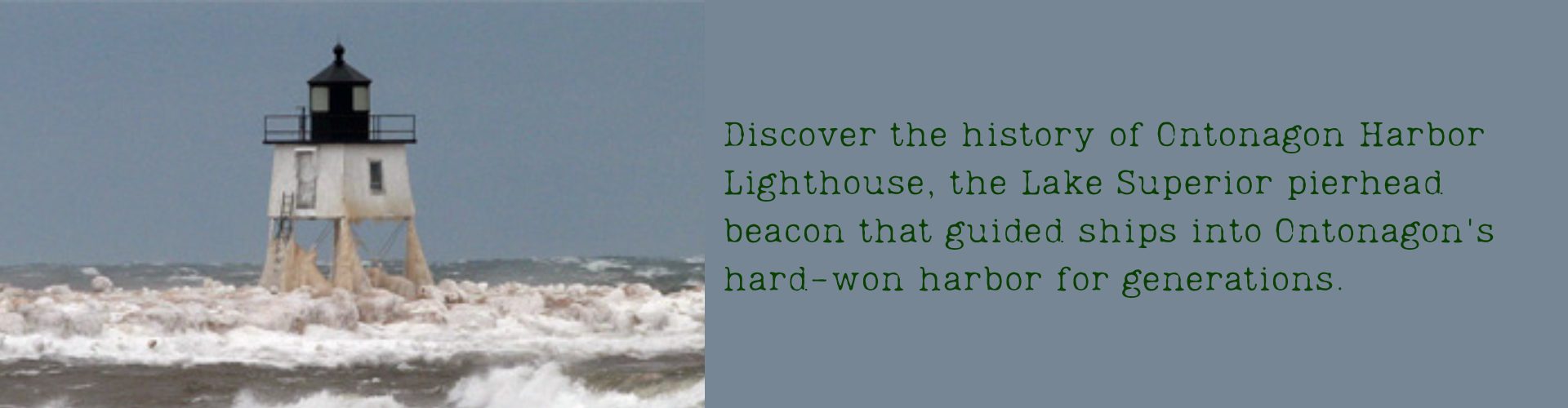
The Beacon at the End of the Pier
For more than a century, mariners entering the Ontonagon River relied on a small lighthouse standing at the end of a long pier extending into Lake Superior.
Known today as the Ontonagon Harbor Lighthouse or Ontonagon Harbor West Breakwater Lighthouse, the beacon’s history is closely tied to the development of Ontonagon Harbor itself. Unlike many lighthouses built to mark dangerous shorelines or rocky points, this light existed because engineers and residents spent decades trying to create a harbor where nature seemed determined not to allow one.
Its story is one of ambitious engineering projects, powerful Lake Superior storms, dedicated lighthouse keepers, and a community’s determination to maintain an important gateway to Michigan’s western Upper Peninsula.
A River That Could Not Be Used
The Ontonagon River is the largest river flowing into the southern shore of Lake Superior.
Despite its size, however, the river was not naturally suited for large vessels. A sandbar at the river’s mouth prevented most ships from entering the harbor safely.
When the famous Minesota Mine opened near Ontonagon in 1848, the problem became increasingly serious. Ships carrying supplies and hauling away valuable copper could not dock directly in the harbor. Instead, they anchored offshore while smaller boats known as lighters transferred cargo between ship and shore.
The process was slow, costly, and often dangerous.
Local leaders realized that if the harbor could not naturally accommodate ships, they would have to reshape the shoreline itself.
Building a Harbor
The first serious attempt came in 1851 when James Carson constructed wooden piers extending into Lake Superior.
His idea was simple. By extending the harbor farther into the lake, ships could load and unload beyond the troublesome sandbar.
Unfortunately, the wooden piers were no match for Lake Superior’s storms.
After successfully completing the Soo Locks in 1855, engineer Charles T. Harvey was recruited to improve the harbor. Harvey constructed stronger piers extending approximately 900 feet into the lake.
Even those improvements proved inadequate.
Meanwhile, residents lobbied the federal government for assistance. Their efforts began as early as 1852, but meaningful action did not arrive until 1867 when a federal harbor improvement project was finally approved.
At the time, the harbor entrance was only seven feet deep.
The federal plan called for parallel piers to confine the river’s flow and extensive dredging to deepen the channel. Work continued for decades, and by 1908 more than $377,000 had been invested in improving the harbor.
The investment proved worthwhile. The value of commerce moving through Ontonagon Harbor far exceeded the cost of the improvements.
The First Pierhead Light
As work on the harbor progressed, mariners needed guidance at the entrance.
A light was established near the outer end of the west pier and first illuminated on September 20, 1875.
The lighthouse served a practical purpose. It marked the harbor entrance and helped vessels align themselves with the dredged channel between the piers.
As construction projects extended the pier farther into Lake Superior, the light was repeatedly moved outward. It was relocated 535 feet lakeward in 1879 and another 865 feet in 1884.
With each move, the keeper’s journey to the lighthouse became longer.
An elevated wooden walkway was eventually constructed above the pier to provide access to the beacon.
Life at the End of the Pier
Responsibility for the harbor light fell to the keeper of the main Ontonagon Lighthouse located near the river’s mouth.
By 1910, Keeper James Corgan faced an impressive daily commute.
To reach the pierhead lighthouse, he first walked approximately 750 feet from the main lighthouse to the pier. From there, he traveled another 600 feet along the pier before climbing onto a 1,200-foot elevated walkway leading to the tower.
The journey was challenging in good weather and undoubtedly memorable during Lake Superior storms.
Corgan was one of the community’s most prominent citizens. Beyond his lighthouse duties, he served at various times as harbor master, deputy customs collector, government appraiser, coroner, vice president of the Ontonagon Businessmen’s Association, and president of the village.
His involvement reflected just how important the harbor was to the community’s future.
The Storm of 1899
Lake Superior eventually demonstrated why building structures at the end of a pier was never easy.
On December 12, 1899, a powerful storm destroyed the existing lighthouse tower.
Exposed directly to the lake’s full force, the structure was swept away by the waves.
A temporary wooden lighthouse was erected the following spring while plans moved forward for a more durable replacement.
The solution arrived later in 1900.
The Iron Lighthouse
The replacement lighthouse represented a significant improvement.
Completed in November 1900, the new structure was a steel pyramidal tower topped with a cast iron lantern room.
The lighthouse stood approximately thirty-three feet tall from its base to the ventilator ball atop the lantern. Inside was a service room accessible directly from the elevated walkway.
The fixed red light displayed from the lantern helped mariners identify the harbor entrance and safely navigate between the piers.
Unlike its predecessor, the iron tower proved capable of withstanding Lake Superior’s harsh conditions.
More than a century later, it still stands.
Technology and Modernization
As navigation technology evolved, so did the lighthouse.
In 1889, improvements had already been made to the earlier beacon, including the installation of an iron gallery around the lantern room to assist with maintenance.
In 1933, an electric siren replaced the older hand operated fog signal, providing a more effective warning during periods of poor visibility.
Following the closure of the main Ontonagon Lighthouse in 1963, the pierhead beacon became the harbor’s primary navigational aid.
Over the years, the original fourth order Fresnel lens gave way to newer lighting systems. In 2013, a solar powered LED beacon was installed, continuing the lighthouse’s long tradition of helping vessels safely enter the harbor.
Preservation and an Uncertain Future
The lighthouse entered a new chapter during the twenty first century.
In 2012, the structure was offered through the National Historic Lighthouse Preservation Act to organizations interested in preserving the historic beacon.
The Ontonagon County Historical Society expressed interest in acquiring the lighthouse, but the transfer never occurred.
Later efforts to auction the structure also failed to result in a completed sale.
As recently as 2024, the federal government was still seeking qualified organizations willing to take ownership and preserve the lighthouse.
Its future remains a work in progress.
A Small Lighthouse with a Big Story
The Ontonagon Harbor Lighthouse is not the tallest lighthouse on the Great Lakes, nor is it the most famous.
Yet few lighthouses tell a story so closely connected to the development of an entire community.
Its existence reflects decades of effort to create a working harbor where nature presented constant obstacles. It witnessed the copper boom, the lumber era, and generations of maritime commerce that helped build Ontonagon and Michigan’s western Upper Peninsula.
Standing at the end of the pier, it remains a reminder of the engineers, lighthouse keepers, and local residents who refused to give up on making Ontonagon Harbor a success.
Explore our full collection of Northern Michigan lighthouse stories here
Start planning your trip today and explore the legacy of Michigan’s maritime history!
📍 Explore the Map Below