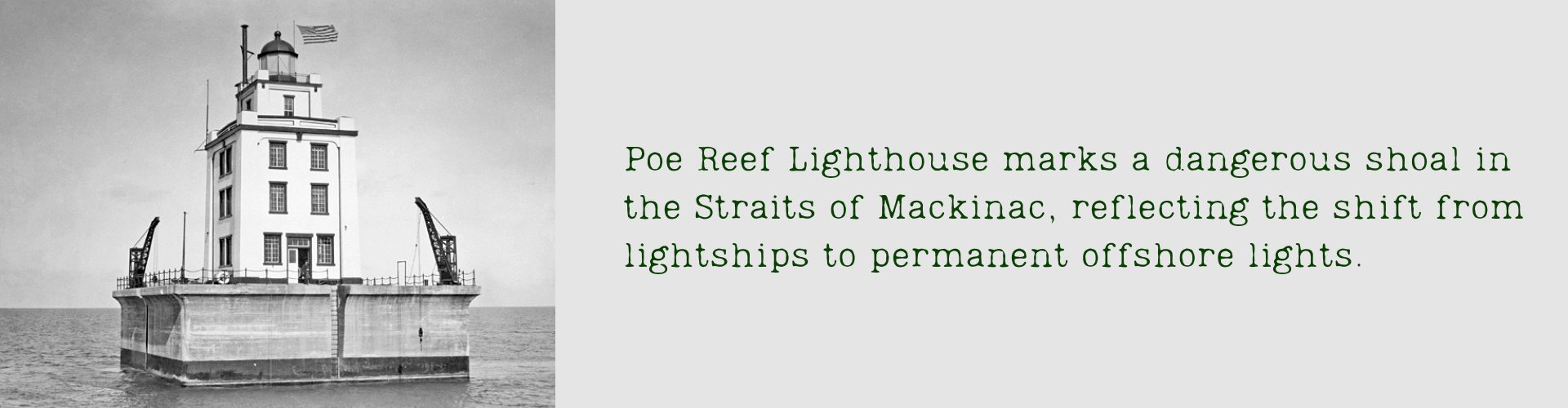
Rising from the waters of the Straits of Mackinac, Poe Reef Lighthouse marks one of the most challenging navigation points along the route between Lake Huron and Lake Michigan. Positioned near the center of the South Channel, the reef has long posed a serious hazard for vessels traveling west toward the open waters beyond the Straits.
A Dangerous Passage in the Straits
The South Channel became increasingly important as steam powered vessels replaced sailing ships and required deeper, more direct routes. Although the channel is roughly three nautical miles wide, Poe Reef sits near its midpoint. To the north, shallow water limits safe passage for large freighters, making precise navigation essential.
Before the construction of a permanent lighthouse, the hazard was marked by a succession of lightships beginning in 1893. These floating stations were difficult to maintain and dangerous for their crews. Severe storms could shift their anchors, leaving captains uncertain of their true position when reliable guidance was most needed.
Building a Permanent Light
By the 1920s, engineers were increasingly constructing fixed offshore lights to replace vulnerable lightships. In 1926, the United States Lighthouse Service decided to build a permanent structure on Poe Reef. Construction was completed in 1928 as part of a broader effort to create a network of reef lights throughout the Great Lakes.
The new lighthouse joined other key navigation aids marking the South Channel, including Fourteen Foot Shoal Light to the south. Together, these lights defined a safe corridor for vessels navigating the Straits.
The same construction crew responsible for Poe Reef also built St. Martin Island Light using a similar design. This practical approach reflected a period of intensive lighthouse construction aimed at improving maritime safety in remote and hazardous waters.
Design and Operation
Originally painted entirely white, Poe Reef Lighthouse closely resembled its counterpart at Martin Reef. Mariners sometimes found the similarity confusing, prompting the decision to add contrasting bands to distinguish the structure more clearly during daylight.
The station was designed to accommodate an onsite crew who could also operate the nearby Fourteen Foot Shoal Light. Over time, both lights were fully automated, reflecting advances in navigation technology. The diaphone foghorn at Poe Reef remains in service, continuing to provide an audible warning during periods of reduced visibility.
The Legacy of Orlando Poe
The reef and lighthouse are named for Orlando Metcalfe Poe, a prominent engineer whose work shaped lighthouse construction across the Great Lakes. During his career, Poe designed numerous significant lights, including those at New Presque Isle, Au Sable, and Seul Choix.
His influence extended beyond lighthouse design. He also played a central role in developing improvements to the Soo Locks, including the structure later known as the Poe Lock. The lighthouse bearing his name stands as a tribute to his contributions to maritime safety.
A Remote but Recognized Landmark
Poe Reef Lighthouse was added to the National Register of Historic Places in 2005, reflecting its importance in the history of Great Lakes navigation. Though the structure is closed to the public, it can be viewed from several locations along the Cheboygan shoreline, including Lighthouse Point and Gordon Turner Park.
For those traveling the Straits today, the lighthouse continues to mark the edge of a once treacherous shoal. Its presence represents a shift from the uncertain era of lightships to the enduring stability of fixed offshore lights.
In the vast waters between islands and mainland, Poe Reef Lighthouse remains a quiet but essential guide for vessels navigating one of the Great Lakes’ most storied passages.
Explore our full collection of Northern Michigan lighthouse stories here
Start planning your trip today and explore the legacy of Michigan’s maritime history!
📍 Explore the Map Below