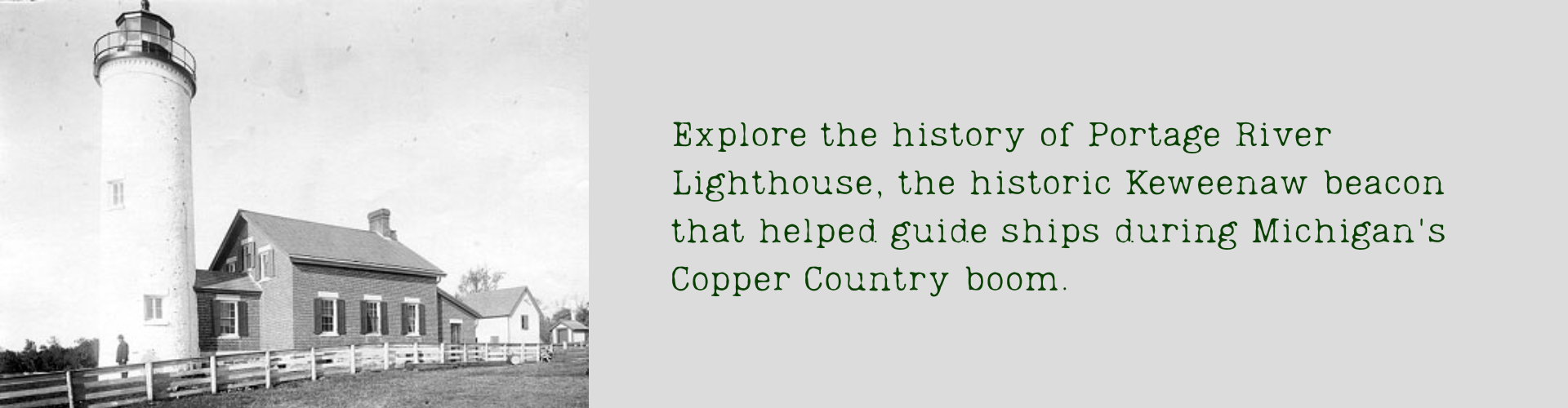
The Light That Helped Build Copper Country
Long before bridges crossed the Keweenaw Waterway and before Houghton became the heart of Michigan’s Copper Country, a small river mouth on Keweenaw Bay served as a gateway to one of the nation’s greatest mining booms.
Standing near that gateway was Portage River Lighthouse, a beacon that guided ships carrying miners, supplies, machinery, and copper through the waters separating Lake Superior from the interior of the Keweenaw Peninsula.
Although the lighthouse ceased operation more than a century ago, its story remains closely tied to the settlement and development of Michigan’s Upper Peninsula.
The Birth of a Port
The story begins with the Portage River and Portage Lake, waterways that nearly cut the Keweenaw Peninsula in half.
In 1846, pioneer merchant Ransom Shelden established a store near the river’s mouth to supply miners heading into the wilderness in search of copper. The following year, he brought his family to the area, becoming the first permanent white settler at Portage Entry.
As mining activity increased, shipping followed.
The steamer Independence, the first steamboat on Lake Superior, soon called at the settlement. In 1851, Shelden moved inland and established another store, laying the foundation for what would eventually become the city of Houghton.
For his role in developing both the community and the mining industry, Shelden later became known as the “Father of the Portage Lake District.”
As maritime traffic grew, residents recognized the need for a lighthouse at the river’s entrance.
Building the First Lighthouse
In February 1853, Ransom Shelden and other citizens petitioned Congress for a lighthouse at Portage River.
Their request was successful.
Just weeks later, Congress appropriated $5,000 for construction of the station.
Work began in 1855 on a fifty-seven-acre site north of the river’s mouth. The original lighthouse consisted of a cylindrical rubble stone tower standing thirty-nine feet tall beside a modest keeper’s dwelling and summer kitchen.
A fifth order Fresnel lens manufactured by Henry Lepaute of France was installed in the lantern room. The light displayed a distinctive characteristic, a fixed white beam accompanied by a red flash every two minutes.
Michael W. Lyons became the station’s first keeper in September 1856.
Although disputes arose regarding the quality of construction, the lighthouse entered service that same year and soon became an important navigational aid for vessels entering Portage River.
A Lighthouse in Trouble
Like many early Great Lakes lighthouses, the first Portage River Lighthouse struggled against the harsh climate of Lake Superior.
By 1868, inspectors found the station in poor condition.
The rubble stone tower was damp and deteriorating. The wooden staircase had begun to decay. Water collected in the cellar of the keeper’s house, while moisture damaged floors, walls, and ceilings throughout the dwelling.
The lantern itself was considered too small and leaked during storms.
The inspection report painted a bleak picture and recommended extensive improvements, including an entirely new dwelling and major modifications to the tower.
Instead of repairing the aging station, the government decided to replace it.
A New Lighthouse for Portage Entry
Congress appropriated $12,000 in 1869 to construct a replacement lighthouse.
While a temporary light guided mariners during construction, workers demolished the original buildings and erected a much larger station.
The new tower rose fifty-one feet above the shoreline and featured a substantial brick design. At its base, the tower measured fourteen feet in diameter before tapering toward the lantern room.
The original Fresnel lens was retained and installed in the new lantern.
Attached to the tower was a handsome two-story brick keeper’s residence containing eight rooms. A covered passageway connected the house directly to the tower, allowing keepers to access the light during storms and harsh winter weather.
The station that survives today is this 1869 replacement.
The Keeper Who Found Stone
Among the lighthouse’s notable keepers was George Craig.
Born in England, Craig immigrated to Canada before moving to the Lake Superior region. In 1861, he undertook a remarkable journey in a small boat along the southern shore of Lake Superior, searching for sandstone deposits.
His exploration led to the discovery of the now famous sandstone near Portage Entry.
Craig established a quarry east of the lighthouse, and for a time the nearby settlement of Craig supported the stone industry. Eventually, larger quarries at Jacobsville overshadowed his operation, but the area’s distinctive red sandstone would become one of the most recognizable building materials in Michigan.
In 1878, Craig became keeper of Portage River Lighthouse and served there for a decade before retiring.
His story illustrates how closely connected the lighthouse was to the broader development of the Keweenaw Peninsula.
Improvements and Protection
As the years passed, the station continued to evolve.
The interval between red flashes was shortened from two minutes to one minute in 1891, improving the light’s usefulness for mariners.
In 1907, a seawall one hundred feet long and nine feet high was built to protect the station from erosion. Cement walkways connected the various buildings, and a brick oil house was added to support lighthouse operations.
The government also formally secured ownership of the surrounding property, purchasing the land in 1883 and later removing roads and buildings that encroached upon the reservation.
The lighthouse remained a prominent landmark at the entrance to Portage River for decades.
Replaced by a New Light
The end of Portage River Lighthouse’s active service arrived in 1920.
On August 1 of that year, a powerful new light was established atop a steel tower at the outer end of the breakwater marking the river entrance. The new beacon, now known as Keweenaw Waterway Lower Entrance Light, was positioned closer to the shipping channel and better served the needs of modern navigation.
As a result, Portage River Lighthouse was discontinued.
Its final keeper, Franklin W. Witz, transferred to the new station. Witz had spent nearly three decades in lighthouse service, including assignments at the remote Stannard Rock Lighthouse before arriving at Portage River in 1902.
With the new breakwater light in operation, the old lighthouse’s work was done.
From Lighthouse to Inn
Unlike many discontinued lighthouses, Portage River Lighthouse escaped demolition.
Ownership passed through several hands over the decades. Although the State of Michigan briefly acquired the property in 1932, it eventually reverted to federal ownership and was sold at auction in 1958.
The lighthouse remained in private hands for many years.
In 2004, Mike and Cheri Ditty purchased the property and transformed it into the Jacobsville Lighthouse Inn. Guests had the opportunity to stay within the historic lighthouse grounds and experience a unique piece of Upper Peninsula history.
Following Cheri Ditty’s passing in 2019, the property was placed on the market and sold again in 2022. The current owners have focused on restoring the historic buildings and preserving the site’s remarkable history.
A Survivor from Copper Country’s Early Days
Today, Portage River Lighthouse stands as one of the oldest surviving reminders of the early years of Michigan’s copper mining boom.
Its story stretches from the arrival of the first settlers and steamships to the development of Houghton, the growth of the mining industry, and the transformation of the Keweenaw Waterway into one of the most important transportation corridors on Lake Superior.
Though its light no longer guides ships, the lighthouse continues to illuminate an important chapter in Northern Michigan history.
Explore our full collection of Northern Michigan lighthouse stories here
Start planning your trip today and explore the legacy of Michigan’s maritime history!
📍 Explore the Map Below