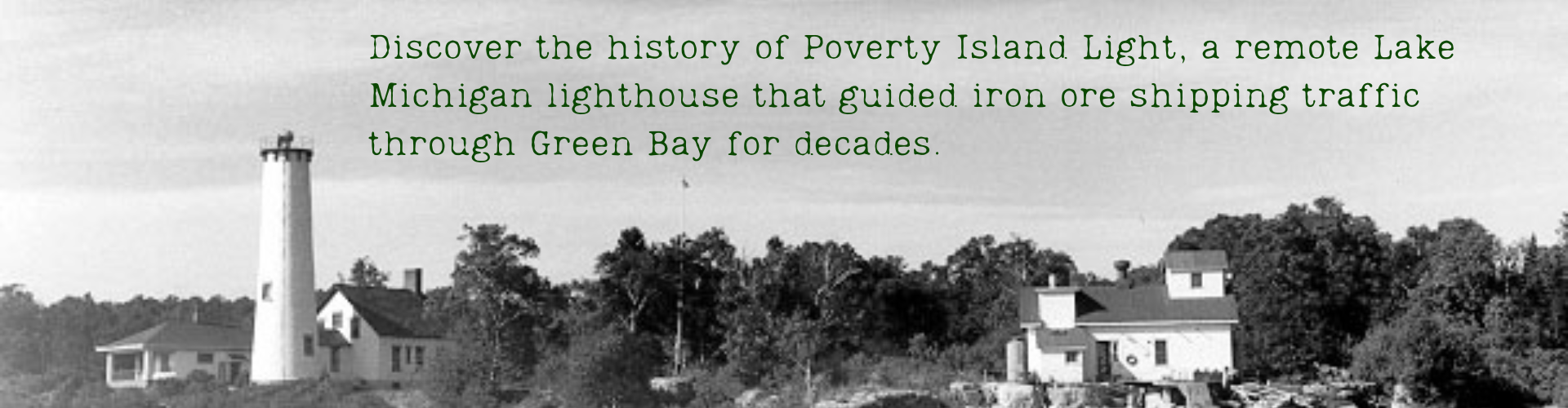
The Isolated Beacon of Green Bay
Far from the mainland and surrounded by the waters of northwestern Lake Michigan, Poverty Island Light has stood watch over one of the Great Lakes’ important shipping passages for more than 150 years.
Located on Poverty Island, nearly six miles south of the Garden Peninsula, the lighthouse was built to guide vessels through the narrow Poverty Island Passage, a route that became increasingly important as Michigan’s iron industry expanded during the nineteenth century.
Today, the lighthouse stands abandoned and weather worn, yet its history remains closely tied to the growth of Upper Peninsula commerce and the mariners who depended on its light.
Iron Ore Creates a Need for Navigation
The story of Poverty Island Light begins with the rapid growth of iron mining in Michigan’s Upper Peninsula.
In 1864, a railroad connection between Escanaba and Negaunee was completed, making it much easier to transport iron ore from inland mines to shipping docks along Lake Michigan. Almost immediately, vessel traffic into Escanaba increased.
Many of those ships traveled through the narrow Poverty Island Passage near the southern shore of Poverty Island. While the route offered a useful shortcut, it also presented challenges, especially after sunset or during poor weather.
Recognizing the danger, the Lighthouse Board requested funding in 1867 for a lighthouse on the island’s southern tip. Congress, however, delayed action for several years before finally appropriating $18,000 in 1873.
Building a Lighthouse on a Remote Island
Construction began shortly after funding arrived, but the project encountered difficulties almost immediately.
Late in the 1873 construction season, a fire destroyed a portion of the building materials that had been staged near the partially completed lighthouse. Despite the setback, work continued the following year.
Unfortunately, funding ran short before the tower could be finished. To provide at least some assistance to mariners, a temporary light was installed while additional appropriations were sought.
Congress eventually provided another $3,000, allowing construction to move forward. The station was completed in 1875, and on August 10 of that year, the permanent light was officially illuminated for the first time.
At its heart was a fourth order Fresnel lens, one of the remarkable optical inventions that revolutionized lighthouse technology during the nineteenth century.
A Familiar Design on Lake Michigan
Visitors familiar with Michigan’s lighthouses may notice that Poverty Island Light closely resembles another well known beacon.
The station was intentionally designed as a near duplicate of the Sturgeon Point Lighthouse in northeastern Michigan.
The tower rises 70 feet above the island and originally displayed its light from a cast iron lantern positioned 65 feet above the ground. Attached to the tower was a combined wood frame and brick keeper’s dwelling where lighthouse keepers and their families lived while tending the station.
The design reflected a practical approach used throughout the Great Lakes, combining living quarters and lighthouse operations into a single efficient structure.
Life at the Station
Keeping the light burning on a remote island was demanding work.
Supplies had to be transported across open water, equipment required constant maintenance, and the light itself needed daily attention. During storms, isolation could last for days.
As shipping traffic continued to grow, additional improvements were made to the station. In 1885, a fog signal building was added to help guide vessels during periods of reduced visibility.
An iron oil house and new docks followed in 1894, improving the station’s ability to store fuel and receive supplies.
Together, these additions transformed Poverty Island Light into a fully equipped navigation station capable of assisting mariners in nearly all conditions.
Automation and Decline
Like many Great Lakes lighthouses, Poverty Island eventually entered the era of automation.
In 1957, the light was automated, eliminating the need for resident keepers. The station buildings were subsequently abandoned, ending more than eighty years of continuous occupancy.
For nearly two more decades, the light continued to operate.
Then in 1976, the original lighthouse was deactivated after a modern light was installed on a nearby skeletal steel tower. The historic tower no longer served an active navigational role.
Unfortunately, little attention was given to preservation at the time. The cast iron lantern was removed and discarded near the lighthouse along with other historic equipment.
A Piece of History Saved
One bright spot emerged during the 1980s.
The discarded lantern was rescued by the Delta County Historical Society and later used in the restoration of Sand Point Lighthouse in Escanaba.
Thanks to that effort, an important piece of Poverty Island’s history survives today rather than being lost to time and neglect.
The lighthouse itself, however, remains abandoned.
Despite its listing on the National Register of Historic Places in 2005, deterioration has continued. In 2011, Lighthouse Digest named Poverty Island Light “America’s Most Endangered Lighthouse,” drawing national attention to its uncertain future.
Standing Watch Over History
Though no longer active, Poverty Island Light remains one of Michigan’s most compelling lighthouse stories.
Its construction was driven by the rise of the iron ore industry. It guided countless vessels through the waters of Green Bay. It survived fire, isolation, changing technology, and decades of neglect.
Today, the lighthouse stands as a reminder of an era when remote stations like Poverty Island played a vital role in keeping Great Lakes commerce moving safely.
Weathered but still standing, it continues to tell the story of the mariners, keepers, and industries that helped shape Michigan’s maritime history.
Explore our full collection of Northern Michigan lighthouse stories here
Start planning your trip today and explore the legacy of Michigan’s maritime history!
📍 Explore the Map Below