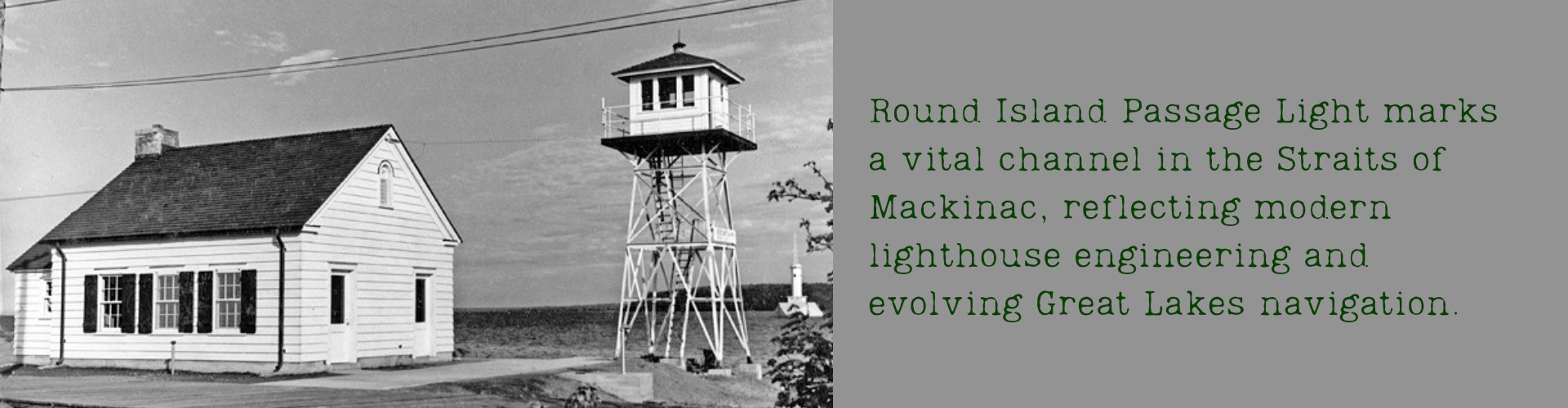
Standing in the waters of the Straits of Mackinac, the Round Island Passage Light marks one of the most important navigation routes connecting Lakes Michigan and Huron. Though built later than many of Michigan’s historic beacons, it represents a period when modern technology and changing maritime needs reshaped lighthouse construction on the Great Lakes.
A Channel of Constant Movement
The Round Island Channel has long served as a key passage for vessels traveling through the Straits. As shipping traffic increased during the late nineteenth century, the need for reliable navigation aids became clear. Constructed in 1895 on nearby Round Island the lighthouse marks the southern edge of the channel.
By the mid twentieth century, however, growing vessel size and changing navigation patterns required additional guidance. In 1936, the United States Coast Guard proposed building a new lighthouse to define the northern side of the navigable passage. World War Two delayed the plans. During this period, a buoy equipped with a radio beacon temporarily marked the site.
Construction of a Modern Light
Work on the Round Island Passage Light finally began in 1947. The project reflected a shift toward more technologically advanced navigation systems. Construction included the installation of underwater power cables connecting the lighthouse to a control house on the southern tip of Mackinac Island.
Completed in 1948 and equipped with a beacon light, fog signal, and radio beacon. Its original signal displayed a flashing green light produced by sealed beam lamps mounted at the top of the tower. One of the last major lights built on the Great Lakes, marking the transition from traditional lighthouse design to more modern, automated systems.
At the time the passage light was placed in operation, the earlier Round Island lighthouse was deactivated. Together, these changes reflected evolving approaches to navigation and maritime safety in the Straits.
Design and Symbolism
The Round Island Passage Light is notable for both its engineering and its cultural symbolism. The structure stands on a timber crib foundation measuring fifty six feet square. Cells along the perimeter are filled with concrete, while interior sections contain rock for added stability.
Above the foundation rises a reinforced concrete superstructure supporting an octagonal tower. A steel enclosure painted red sits atop the deck, providing access to the interior. From there, a five story octagonal steel tower extends upward, reaching more than forty feet in height.
Each side of the tower features a bronze relief depicting an Indigenous figure. These carvings acknowledge the long history of Native American presence in the Straits, where Mackinac Island has long held spiritual and cultural significance.
Technological Changes
Over time, the lighthouse’s equipment evolved to match advances in navigation technology. In 1959, the beacon changed from a green signal to a flashing red light. Officials phased out the radio beacon system in 1962 due to the widespread adoption of new electronic navigation methods.
In 1968, the structure’s appearance was modified with the addition of a red painted base atop its white pier. The light was automated in 1973, reducing the need for direct human oversight. A steel antenna tower that once rose above the structure was removed in the early years of the twenty first century.
Preservation and Continuing Service
The original Round Island lighthouse was relighted in 1996 as a private aid to navigation. Today, both lights help define the channel, continuing a long tradition of maritime guidance in the Straits.
Recognized for its historical and architectural importance, the Round Island Passage Light was listed on the National Register of Historic Places in 2013. That same year, the Coast Guard declared the structure surplus. It was sold at auction in 2014, marking another chapter in its evolving story.
A Landmark in the Straits
Though unmanned and automated, the Round Island Passage Light remains a striking presence on the water. Its layered construction, symbolic design, and technological heritage reflect a time when modern engineering reshaped navigation on the Great Lakes.
For vessels passing through the Straits today, its steady signal continues to provide reassurance in one of Michigan’s most storied waterways.
Explore our full collection of Northern Michigan lighthouse stories here
Start planning your trip today and explore the legacy of Michigan’s maritime history!
📍 Explore the Map Below