A New Light for Lake Superior’s Copper Country
Along the southern shore of Lake Superior, between Eagle River and Eagle Harbor, Sand Hills Lighthouse stands as a reminder of the changing fortunes of Michigan’s Copper Country.
Located in Keweenaw County, the lighthouse was built during a period when shipping patterns along the Keweenaw Peninsula were changing. Communities that had once depended on the copper industry were experiencing quieter harbors, while larger vessels continued traveling the open waters of Lake Superior.
For decades, Eagle River Lighthouse had helped guide ships along this stretch of shoreline. But as the copper boom faded and maritime traffic shifted, the need for a navigational light farther west became increasingly apparent.
A Lighthouse Born from a Changing Shoreline
Sand Hills Lighthouse would eventually replace Eagle River as the primary light for this portion of Lake Superior.
Its history includes years of delayed construction, a relatively short period as a staffed lighthouse, wartime service, and an unusual second life as a bed and breakfast.
The Decline of Eagle River Harbor
Eagle River Lighthouse had served Lake Superior mariners since 1857.
For more than fifty years, it was the only lighthouse between the Keweenaw Waterway and Eagle Harbor Light.
During the height of the copper industry, Eagle River was an important shipping community. Vessels carried supplies into the harbor and transported copper and other goods to markets beyond the Keweenaw Peninsula.
But the copper boom that had supported the community began to decline during the 1870s.
As mining activity diminished, so did the number of ships visiting Eagle River.
By the 1890s, the harbor had become so quiet that the lighthouse service tender was reportedly among the few vessels still calling there.
Meanwhile, ships traveling along the Lake Superior shoreline continued to pass farther offshore.
The existing lighthouse no longer served the needs of most vessels navigating this section of the lake.
Federal lighthouse officials recommended establishing a new station at Sand Hills, where the light would be more useful to passing ships, and discontinuing the older Eagle River station.
A Lighthouse Delayed for More Than Two Decades
Congress authorized construction of Sand Hills Lighthouse in 1893.
Unfortunately, authorization did not come with the funding necessary to build it.
The project remained delayed while the Eagle River Lighthouse continued its service.
In 1908, Eagle River Light was decommissioned and sold, leaving this portion of Lake Superior without a nearby navigational light.
The absence became increasingly concerning as vessels continued traveling past the Keweenaw Peninsula.
Several ships ran aground on nearby Sawtooth Reef in the years following Eagle River’s deactivation.
The dangerous reef demonstrated the need for a dependable warning light along this stretch of shoreline.
Sand Hills was eventually commissioned as a lighthouse project in 1917, more than twenty years after Congress had first authorized its construction.
The new station was located approximately halfway between Eagle Harbor and Ontonagon, providing navigational guidance along a section of Lake Superior that had been without a light for nearly a decade.
Building Sand Hills Lighthouse
Construction of Sand Hills Lighthouse took place during the closing years of World War I.
The station was designed to provide both a navigational light and accommodations for the personnel responsible for operating it.
Unlike the smaller Eagle River Lighthouse, Sand Hills was a substantial facility designed to support multiple keepers.
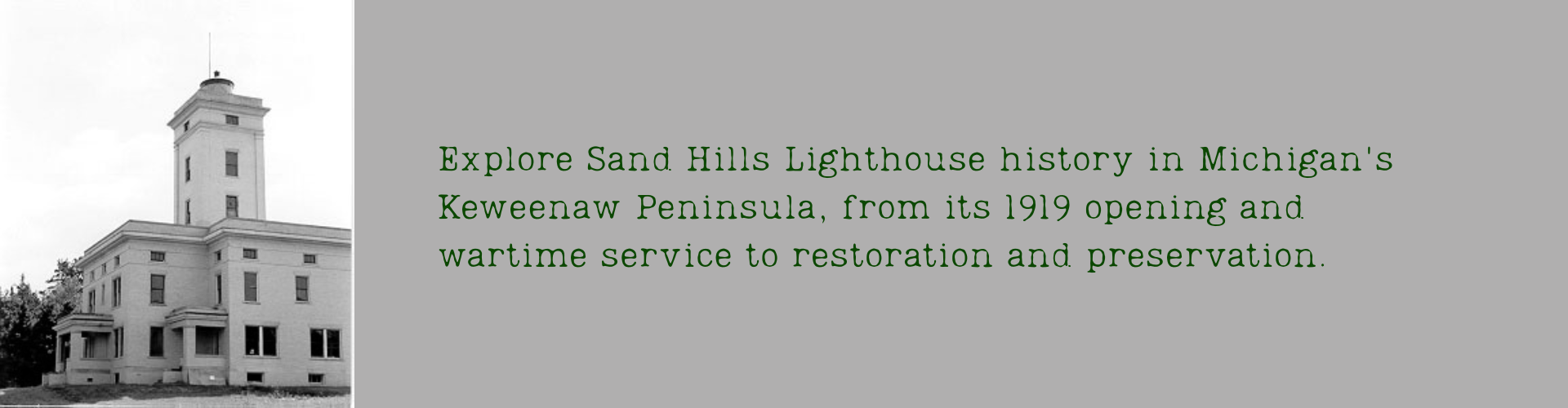
The main lighthouse was constructed as a large brick building with an integrated tower rising above the living quarters.
Its symmetrical design, substantial masonry walls, and prominent lantern room gave it a distinctive appearance along the Lake Superior shoreline.
The tower was positioned to provide a clear view of the surrounding waters, while the adjoining residence offered living and working space for the station’s personnel.
The grounds included several additional structures necessary for maintaining the light and supporting the keepers.
An oil house provided storage for fuel used in the lighting equipment. A garage and barracks building were also part of the station.
A concrete breakwater, constructed in 1917, helped protect the shoreline facilities from Lake Superior’s waves.
The barracks building dated to 1916 and would later become important during the station’s military service.
Construction of the main lighthouse was completed in May 1919.
After decades of planning and delays, Sand Hills Lighthouse was finally ready to guide ships along the Keweenaw Peninsula.
The Light and Its Keepers
Sand Hills Lighthouse originally displayed a fourth order Fresnel lens equipped with an oil vapor lamp.
The lens featured a bullseye arrangement designed to concentrate light into a powerful beam.
The light was visible for approximately 9.6 nautical miles, or about eleven statute miles, under suitable conditions.
For mariners traveling along the southern shore of Lake Superior, it provided an important reference point near Sawtooth Reef and the surrounding shoreline.
The station was staffed by three keepers.
Their responsibilities included maintaining the lighting equipment, monitoring the station, caring for the buildings, and ensuring that the light operated reliably throughout the shipping season.
Life at Sand Hills differed from the experience of keepers assigned to isolated offshore stations.
The lighthouse stood on the mainland, but its location along the rugged Keweenaw shoreline still presented challenges.
Lake Superior weather could change quickly, and winter conditions often brought heavy snow, strong winds, and difficult travel.
The keepers were responsible for maintaining a dependable navigational aid regardless of the conditions outside.
For twenty years, Sand Hills operated as a staffed lighthouse.
That period came to an end as federal lighthouse operations underwent significant changes.
Automation and the Arrival of the Coast Guard
In 1939, the United States Coast Guard assumed responsibility for the nation’s lighthouse system.
That same year, Sand Hills Lighthouse was automated.
Automation eliminated the need for resident keepers to operate the light and maintain its equipment on a daily basis.
For Sand Hills, the change ended two decades of staffed service.
The lighthouse continued guiding ships, but the routines of the keepers and their families were no longer part of life at the station.
The buildings, however, would not remain quiet for long.
World War II brought an entirely different purpose to the Lake Superior property.
Sand Hills During World War II
In 1942, Sand Hills Lighthouse was converted into a Coast Guard training facility.
The station’s substantial buildings and surrounding grounds made it suitable for housing and instructing military personnel.
Approximately 200 trainees could be accommodated at a time.
The lighthouse and its associated structures became part of the wartime training effort, with the former keeper accommodations and barracks serving a new generation of Coast Guard personnel.
For a station originally designed to support three lighthouse keepers, the arrival of hundreds of trainees represented a remarkable change.
The training operation continued into 1943.
That year, Sand Hills closed as a training facility and returned to its original purpose as an automated lighthouse.
Its wartime role had been brief, but it added an unusual chapter to the history of the Keweenaw Peninsula’s maritime stations.
The End of Sand Hills as an Active Lighthouse
Sand Hills Lighthouse continued operating after World War II.
By the 1950s, however, navigation on the Great Lakes had changed considerably.
Improved weather forecasting, radar, and other navigational technologies reduced the dependence of commercial vessels on some traditional lighthouse stations.
In 1954, Sand Hills Lighthouse was decommissioned.
Its active service had lasted approximately thirty five years, including twenty years as a staffed station.
The buildings remained vacant for several years while the federal government considered their future.
Eventually, the property was offered for sale.
In 1958, Sand Hills Lighthouse was sold at public auction for $26,000.
The purchaser was H. Donald Bliss, an insurance agent from the Detroit area.
For the first time since its construction, the lighthouse entered private ownership.
A New Life for Sand Hills Lighthouse
In 1961, the property was sold again.
The new owner was Bill Frabotta, a Detroit photographer and artist who recognized the possibilities of the historic Lake Superior property.
Frabotta used the former fog station as a summer cottage.
Over time, the lighthouse became more than a seasonal retreat.
In 1992, Bill and his wife, Mary, began an extensive restoration project that would transform the property.
The work continued for approximately three years.
The Frabottas restored and adapted the historic buildings, converting the former lighthouse station into a bed and breakfast inn.
The project gave Sand Hills a new purpose while preserving much of the character of the original facility.
For visitors, staying at the lighthouse offered an opportunity to experience a historic Great Lakes landmark in a way that few former lighthouse stations could provide.
The large brick building, surrounding grounds, and Lake Superior setting made Sand Hills a distinctive destination in the Keweenaw Peninsula.
The bed and breakfast operated for many years before closing permanently in 2018.
Preservation and Private Ownership
Sand Hills Lighthouse was listed on the National Register of Historic Places in 1994, recognizing its historical and architectural significance.
The designation came during the period when the Frabottas were restoring the property.
In 2019, the lighthouse was sold to Edward “Bud” Cole, an Eagle River resident and historical preservationist.
Cole also owned Eagle River Lighthouse, creating an interesting connection between the two stations.
Eagle River had been the earlier navigational light along this stretch of Lake Superior, while Sand Hills had been built to replace it.
More than a century after Eagle River was decommissioned, the two historic properties came under the stewardship of the same owner.
Cole’s family history in the Keweenaw Peninsula extends back to the 1850s.
His preservation interests have included several historically significant buildings in Eagle River, along with substantial surrounding acreage.
The Sand Hills property is associated with more than 1,000 contiguous acres, while his holdings in the Eagle River corridor have included more than 4,000 acres.
Today, Sand Hills Lighthouse remains privately owned.
The lighthouse, grounds, and surrounding property are closed to the public.
Where Is the Original Fresnel Lens?
Although Sand Hills Lighthouse no longer operates as a navigational aid, an important part of its original equipment has been preserved.
The station’s fourth order Fresnel lens is on display at the Dossin Great Lakes Museum in Detroit.
The museum, located on Belle Isle, preserves artifacts and stories connected to the maritime history of the Great Lakes.
The lens provides a tangible connection to the years when Sand Hills guided vessels along Lake Superior.
Its carefully arranged glass prisms also demonstrate the technology that made Fresnel lenses such an important advancement in lighthouse illumination.
While the lighthouse itself is privately owned, the lens offers another way to appreciate the station’s contribution to Michigan’s maritime history.
An Unexpected Connection to Alaska
Sand Hills Lighthouse has an unusual architectural connection to another historic American lighthouse.
It is considered a twin of Scotch Cap Lighthouse on Unimak Island, Alaska.
The two stations shared a similar architectural design, but their histories followed very different paths.
On April 1, 1946, a massive tsunami struck Scotch Cap Lighthouse.
The wave destroyed the station and killed all five members of its Coast Guard crew.
The disaster remains the deadliest event to have occurred at a land based Coast Guard light station.
Sand Hills, meanwhile, survived the changing needs of Great Lakes navigation and eventually found a new purpose through private preservation.
The architectural connection between the two lighthouses provides an interesting reminder that lighthouse designs and construction practices extended far beyond the Great Lakes.
Sand Hills Lighthouse Today
Sand Hills Lighthouse remains one of the Keweenaw Peninsula’s distinctive historic maritime landmarks.
Its large brick structure and integrated tower reflect the period when the federal government was constructing substantial lighthouse stations to serve the expanding commercial shipping industry.
Although the light was decommissioned in 1954, the building survived through private ownership and restoration.
The former bed and breakfast has closed, and the property is no longer open to visitors.
The lighthouse and its grounds are privately owned, and public access is not permitted.
Its original Fresnel lens, however, remains preserved at the Dossin Great Lakes Museum.
A Lighthouse That Reflects the Changing Copper Country
The history of Sand Hills Lighthouse is closely connected to the changing economy and maritime needs of the Keweenaw Peninsula.
Its construction followed the decline of Eagle River Harbor, when copper shipping patterns changed and navigational needs shifted toward the open waters of Lake Superior.
The lighthouse served commercial vessels during the final decades of traditional lighthouse keeping, became an automated station, and briefly supported Coast Guard training during World War II.
After its deactivation, private owners gave the historic property a second life.
Today, Sand Hills stands as a reminder of the people who worked along Lake Superior’s shoreline and the changing role of lighthouses in Great Lakes navigation.
Its history also connects two generations of Keweenaw lighthouses, Eagle River and Sand Hills, whose stories reflect more than a century of change along Michigan’s northernmost peninsula.
Explore our full collection of Northern Michigan lighthouse stories here
Start planning your trip today and explore the legacy of Michigan’s maritime history!
📍 Explore the Map Below