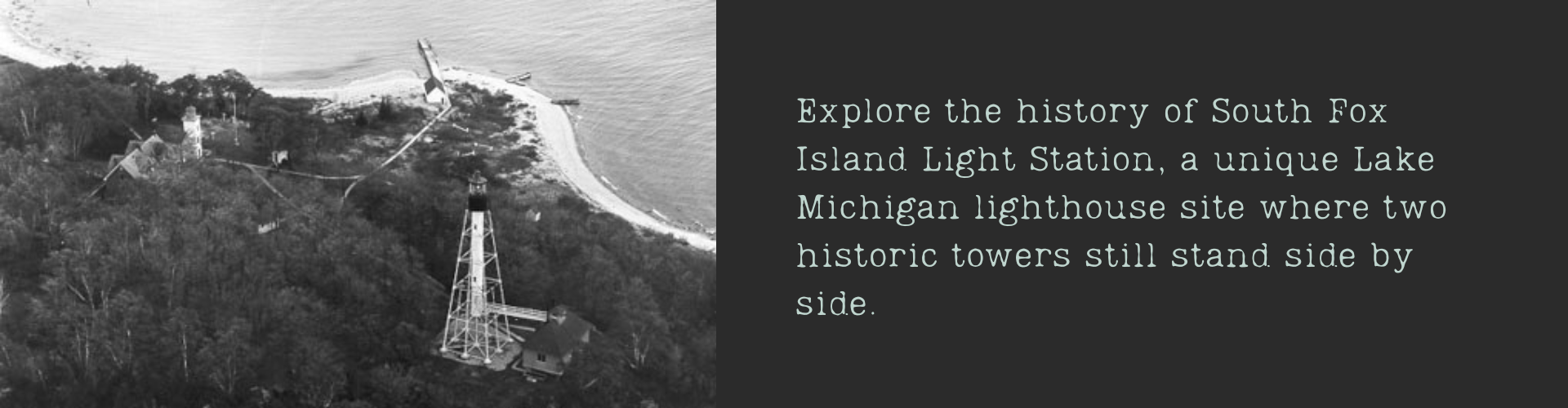
The Lighthouse with Two Towers
Far out in northern Lake Michigan, South Fox Island rises from the water as one of the most remote places in Michigan’s Lower Peninsula. For generations of mariners navigating the waters between Green Bay, the Manitou Passage, and the Straits of Mackinac, the island served as an important landmark and a vital navigational aid.
Today, South Fox Island Light Station is unusual among Great Lakes lighthouses because it has two towers standing side by side in its history. One is the original nineteenth century lighthouse, while the other is a towering steel skeletal structure that began its life hundreds of miles away on the Atlantic coast of Georgia.
Together, they tell a fascinating story of Great Lakes navigation, changing technology, and decades of preservation efforts.
A Light for Northern Lake Michigan
By the 1860s, shipping traffic through northern Lake Michigan was increasing rapidly.
The waters surrounding the Fox Islands were part of important routes used by vessels carrying lumber, grain, iron ore, and manufactured goods throughout the Great Lakes. While South Fox Island provided a useful landmark, the surrounding waters could be challenging, particularly during darkness or poor weather.
Recognizing the need for a lighthouse, Congress appropriated $18,000 in 1867 for construction of a light station on the island.
Work moved quickly, and the lighthouse was first illuminated in November of that same year.
The station featured a keeper’s dwelling built of distinctive Cream City brick with an attached square tower. A fourth order Fresnel lens produced a flashing red beacon that could be seen by mariners traveling through the area.
For ships navigating northern Lake Michigan, the new light quickly became an important guide.
Life on a Remote Island
Operating a lighthouse on South Fox Island required determination and self-reliance.
The island’s isolation meant that keepers often faced harsh weather, long winters, and limited access to supplies. Even routine tasks could become difficult.
In 1880, drifting sand and snow created enough problems that the keeper constructed a fence around the station to help reduce accumulation around the buildings. Additional improvements followed in 1892 when wooden walkways were installed to connect the station’s various structures.
These practical solutions helped lighthouse families navigate the challenging environment while keeping the station operational.
Expanding the Station
As maritime traffic increased, so did the importance of the South Fox Island station.
In 1895, a steam whistle fog signal was added to help vessels navigate during periods of poor visibility. Thick fog often blankets Lake Michigan, making audible warnings just as important as the lighthouse beam itself.
Additional buildings soon followed.
An assistant keeper’s residence was constructed in 1898, reflecting the growing workload associated with operating the station. In 1910, that building was replaced with a substantial red brick duplex that provided housing for multiple lighthouse personnel.
The station eventually grew into a complex that included a fog signal building, oil house, boathouse, workshop, smokehouse, docks, and support structures spread across roughly ten acres.
Together, these buildings created a self-contained community dedicated to keeping mariners safe.
A Lighthouse from Georgia
One of the most unusual chapters in the station’s history began in 1934.
By that time, navigational technology and lighthouse design had evolved significantly. Rather than continue using the original tower, officials decided to install a modern skeletal steel tower closer to the point.
Instead of building an entirely new structure, the Lighthouse Service reused an existing tower from Sapelo Island, Georgia.
The steel tower had originally been constructed there in 1905. After the Georgia lighthouse was discontinued, the structure was carefully dismantled, transported north, and reassembled on South Fox Island.
The resulting tower stood 104 feet tall and provided a more modern navigational aid for mariners.
The original lighthouse was deactivated but left standing, creating the unusual situation of two historic lighthouse towers occupying the same station.
Modernization and Closure
Like many Great Lakes lighthouses, South Fox Island underwent a series of technological upgrades during the twentieth century.
The original kerosene powered light was converted to electricity in 1929. During the same period, the steam whistle fog signal was replaced with a more modern diaphone horn.
Automation arrived in 1958, eliminating the need for resident keepers.
A little more than a decade later, in 1969, the light itself was discontinued.
Unlike many decommissioned lighthouses, however, neither tower was demolished. Both survived, preserving an unusually complete record of the station’s evolution.
Ownership, Preservation, and Controversy
The years after closure brought new challenges.
In 1971, the federal government transferred much of the surrounding land to the Michigan Department of Natural Resources. Ownership of the light station itself followed in 1980.
Questions about the future of South Fox Island became part of a much larger debate during the 1990s when proposals were made to exchange portions of South Fox Island and North Fox Island through a land swap.
The proposal generated considerable opposition from conservation groups, tribal interests, and local officials. After years of legal proceedings and negotiations, a revised agreement left the lighthouse property in public ownership.
Meanwhile, preservation efforts had already begun.
In 1984, members of the Michigan Youth Corps conducted cleanup work at the station. The Fox Island Lighthouse Association was established as a nonprofit organization in 2005 and launched restoration efforts the following year.
Those efforts continue to preserve one of Michigan’s most remote and historically significant lighthouse complexes.
A Rare Historic Landscape
Today, South Fox Island Light Station remains remarkable for its completeness.
The original 1867 lighthouse and keeper’s dwelling still stand. Nearby are the assistant keepers’ quarters, fog signal building, oil house, workshop, boathouse, smokehouse, remnants of docks, and even a small cemetery containing two graves.
The towering steel skeletal lighthouse remains one of the station’s most striking features and serves as a visible reminder of the unusual journey that brought a Georgia lighthouse tower to the shores of Lake Michigan.
In 2021, the station received national recognition when it was listed on the National Register of Historic Places.
Two Towers, One Story
Most lighthouse stations tell the story of a single beacon.
South Fox Island tells the story of two.
The original Cream City brick lighthouse represents the era of Fresnel lenses, resident keepers, and nineteenth century maritime expansion. The steel skeletal tower reflects the modernization of navigation during the twentieth century.
Together, they stand as rare survivors of changing technology and changing times.
On a remote island far from the mainland, South Fox Island Light Station continues to preserve a remarkable chapter of Great Lakes history, one written by keepers, mariners, engineers, and generations of people determined to protect the ships that crossed northern Lake Michigan.
Explore our full collection of Northern Michigan lighthouse stories here
Start planning your trip today and explore the legacy of Michigan’s maritime history!
📍 Explore the Map Below