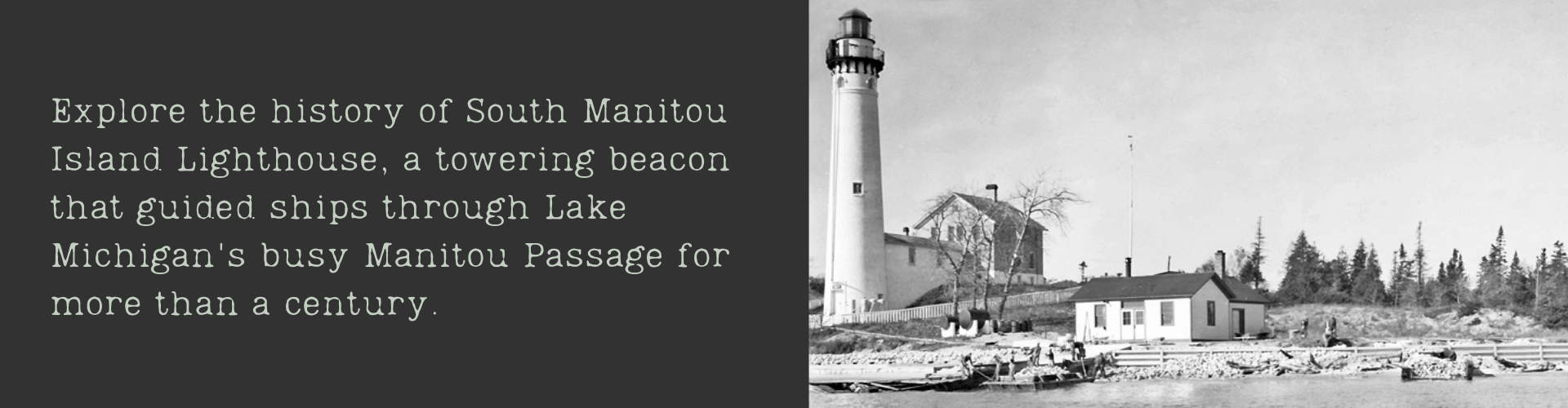
The Beacon of the Manitou Passage
Standing above the dunes on South Manitou Island, the South Manitou Island Lighthouse has watched over one of the busiest and most important waterways in Lake Michigan for nearly two centuries.
Located sixteen miles west of Leland, the lighthouse guided generations of mariners through the Manitou Passage, a shortcut between Chicago and the Straits of Mackinac that saved both time and fuel. For sailors and steamship captains navigating the often-unpredictable waters of Lake Michigan, the light represented safety, shelter, and a reliable path through a busy maritime corridor.
Today, the lighthouse is preserved as part of Sleeping Bear Dunes National Lakeshore, where visitors can climb the tower and learn the remarkable story of one of Michigan’s most important lighthouse stations.
Lighting the Manitou Passage
The federal government recognized the importance of South Manitou Island early in Michigan’s maritime history.
In 1838, Congress appropriated $5,000 for the construction of a lighthouse on the island. At the time, South Manitou offered something few other locations on Lake Michigan could provide: a natural deep-water harbor where vessels could seek refuge during storms. It also served as a critical fueling stop for early wood burning steamships traveling between Chicago and the Straits of Mackinac.
The first lighthouse was completed in 1840 under the care of Keeper William N. Burton. The modest structure featured a lens housed in a cupola and used a Lewis lamp for illumination. Later, it was upgraded with a fourth order Fresnel lens.
For more than a decade, it was the only lighthouse marking the Manitou Passage, helping vessels navigate between the islands and the mainland.
Rebuilding for a Growing Shipping Industry
The original lighthouse soon began to deteriorate.
By 1858, it was replaced with a new lighthouse and keeper’s quarters. However, increasing shipping traffic along the passage eventually revealed shortcomings in the second structure as well. As commercial activity grew, the Lighthouse Service concluded that a taller and more powerful lighthouse was needed.
Construction of the current lighthouse began in 1871 and was completed the following year.
The new tower rose 104 feet above Lake Michigan, making it one of the tallest lighthouse towers on the Great Lakes. A powerful third order Fresnel lens projected its beam nearly eighteen miles across the lake. The increased height allowed mariners to see the light from much greater distances, improving safety along the heavily traveled passage.
Remarkably, the tower was anchored using stout oak logs and stone that reached bedrock deep beneath the shifting sands of the island. That engineering solution helped ensure the lighthouse could withstand the constantly changing dune environment.
A Harbor of Refuge
The lighthouse served a route that was both valuable and dangerous.
The Manitou Passage offered a shortcut that saved ships time and fuel, but it also contained shifting sandbars, rocky shoals, and unpredictable weather. During peak years, as many as fifty to one hundred vessels passed through the passage daily.
South Manitou Island itself was equally important.
Its harbor was considered the only natural deep-water refuge between Chicago and the Straits of Mackinac. When storms swept across Lake Michigan, countless captains altered course for the island’s shelter.
For sailors battling rough seas, spotting the lighthouse beam in the darkness must have been a welcome sight.
The Sheridan Family Tragedy
Among the many keepers who served at South Manitou, few are remembered more than Aaron and Julia Sheridan.
Aaron Sheridan, a wounded Civil War veteran, became keeper in 1866. He and Julia raised their family on the island and operated the station during a period of significant change, including the construction of the current lighthouse tower.
When the new lighthouse entered service, Julia Sheridan was appointed assistant keeper, becoming the only woman officially to serve in that role at South Manitou Island Lighthouse.
Tragedy struck on March 15, 1878.
Aaron, Julia, and their infant son Robert were returning to the island when their boat capsized. All three drowned. Their five surviving children were sent to live with relatives in Illinois. Aaron’s cousin, Lyman Sheridan, later became the next keeper.
Today, descendants of the Sheridan family still visit the island, and gravestones honoring Aaron, Julia, and Robert were placed in the island cemetery in 2006.
More Than Just a Lighthouse
Like many Great Lakes light stations, South Manitou consisted of far more than a tower.
A fog bell was installed in 1839 to assist mariners during periods of poor visibility. In 1874, the station received what may have been the first steam powered fog whistle on the Great Lakes. The powerful signal warned ships when fog obscured the lighthouse beam.
The station also included a whistle shed, oil storage building, fuel magazine, and other support structures necessary to keep the light operating.
Each day, keepers carried fuel up the tower’s 117 steps to refill the lamp that illuminated the Fresnel lens. During periods of poor weather, the light sometimes burned continuously, requiring multiple trips up and down the tower.
Many of these historic outbuildings still stand today, offering visitors a glimpse into daily life at a nineteenth century lighthouse station.
From Active Beacon to Historic Landmark
The lighthouse remained in service until 1958, when the United States Coast Guard decommissioned it. Like many historic stations, it faced an uncertain future afterward.
In the 1980s, preservation efforts helped save the tower when erosion threatened its foundation. Later restoration projects repaired the lantern room and spiral staircase. In 2008, a replica of the original third order Fresnel lens was installed, and in 2009 the lighthouse was relit as a historic beacon. Today, the light shines seasonally from May through November.
The station is listed on the National Register of Historic Places and remains one of the most visited destinations within Sleeping Bear Dunes National Lakeshore. Visitors can climb the tower, view the replica lens, and enjoy spectacular views of the Manitou Passage.
A Light That Still Welcomes Travelers
For more than a century, South Manitou Island Lighthouse guided vessels through one of Lake Michigan’s busiest shipping corridors.
It helped mariners avoid dangerous shoals, find shelter during storms, and navigate safely between Chicago and the Straits of Mackinac. It witnessed the transition from sailing ships to steamships and from oil lamps to modern navigation systems.
Today, although commercial vessels no longer depend on its beam, the lighthouse continues to welcome travelers. Standing high above the dunes, it remains one of Michigan’s most beautiful reminders of the vital role lighthouses played in the history of the Great Lakes.
Explore our full collection of Northern Michigan lighthouse stories here
Start planning your trip today and explore the legacy of Michigan’s maritime history!
📍 Explore the Map Below