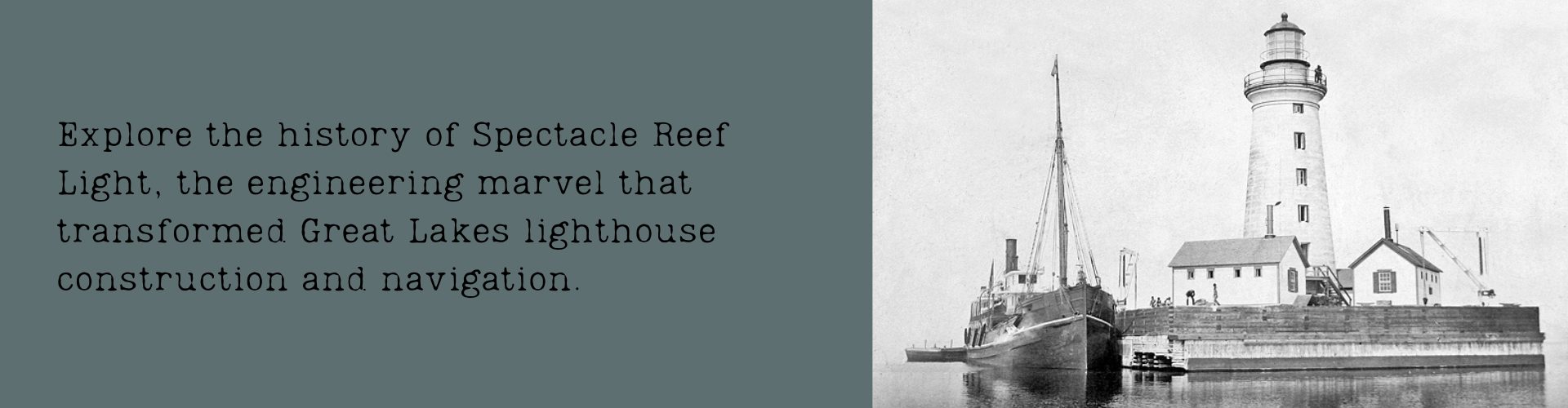
The Engineering Wonder of Lake Huron
More than eleven miles east of the Straits of Mackinac, rising from a lonely reef in northern Lake Huron, stands one of the most remarkable lighthouses ever built on the Great Lakes.
Spectacle Reef Light is often described as one of the greatest engineering achievements in lighthouse history. Built on a submerged reef far from shore, it challenged the limits of nineteenth century construction technology. The project required years of determination, innovation, and hard labor to complete. Even today, nearly 150 years after it first illuminated the waters of Lake Huron, the lighthouse remains an active aid to navigation. In addition, it is a testament to the skill of the engineers who built it.
A Dangerous Reef in a Busy Waterway
During the mid nineteenth century, shipping traffic through the Straits of Mackinac increased dramatically. Vessels carrying iron ore, lumber, grain, and other products moved constantly between Lake Michigan and Lake Huron.
One of the greatest hazards along this route was Spectacle Reef, a submerged formation named for its resemblance to a pair of eyeglasses. Located directly in the path of commercial shipping, the reef was responsible for numerous accidents and shipwrecks. In 1867 alone, two schooners were lost after running aground there. The growing cost of these disasters convinced Congress that building a lighthouse would ultimately be less expensive. This decision was favored over continuing to lose ships and cargo.
Before the lighthouse existed, the reef was marked only by a buoy. While helpful, it offered limited protection in poor weather and darkness.
Building Where No Lighthouse Had Been Built Before
Constructing a lighthouse on Spectacle Reef was unlike building a lighthouse on shore.
The project began in 1870 under the direction of Colonel Orlando Metcalfe Poe and Major Godfrey Weitzel. The challenge was enormous. The reef sat in open water, exposed to storms, waves, and winter ice. There was no nearby island suitable for staging construction. As a result, nearly all work had to take place directly on the reef itself.
Engineers first built a massive timber crib measuring more than 8,400 square feet. Constructed on land much like a ship, it was launched, towed to the reef, and sunk into place. The crib formed a protected work area where crews could create a cofferdam. In turn, they could pump out water and expose the bedrock beneath the lake.
Workers then began laying the massive stone foundation.
Because weather allowed only a short construction season each year, progress was slow. No work was possible during the winter months, and much of the spring and fall were also lost to rough conditions. What should have been a twenty-month construction project ultimately stretched across four calendar years.
The men working on the project lived on site in temporary quarters built atop the reef. Their isolation and the harsh conditions became part of the legend of Spectacle Reef Light.
A Monument of Stone and Engineering
When completed in 1874, Spectacle Reef Light was unlike any lighthouse that had come before it.
The tower rises ninety-three feet above water and extends another eleven feet below the lake surface. Its base measures thirty-two feet in diameter, gradually narrowing as it climbs skyward.
The structure was built using massive blocks of stone that were precisely cut and fitted together. Each course of stone was interlocked and secured with wrought iron bolts. The entire tower was then bonded with Portland cement, creating what engineers essentially considered a single massive stone structure.
The craftsmanship was extraordinary. The stones fit together so accurately that crews could complete an entire course in only a few days.
Many historians consider Spectacle Reef Light to be the finest example of monolithic stone masonry ever constructed on the Great Lakes. Some have called it one of the greatest engineering feats in American lighthouse history.
Ice, Storms, and Survival
Building the lighthouse was only the beginning.
Lake Huron regularly subjected the structure to tremendous forces. Vast sheets of drift ice, sometimes covering thousands of acres, pushed against the tower during winter. Therefore, engineers designed the lighthouse to withstand these pressures by allowing the ice to break and pile up around the structure. This method worked rather than pushing it over.
The challenges were evident even during construction. A severe storm in 1872 caused extensive damage and required costly repairs. After the winter of 1873 and 1874, keepers returned to find ice piled thirty feet high around the tower surrounding the entrance. They had to cut through the frozen mass just to get inside.
Despite these conditions, the lighthouse endured.
The Light That Guided the Great Lakes
When the lighthouse entered service in June 1874, it was equipped with a powerful second order Fresnel lens manufactured in France by Henry Lepaute.
The lens projected a beam visible for miles across Lake Huron and became an essential navigational aid for vessels approaching the Straits of Mackinac. A fog signal station, oil house, storage building, and boat davits supported the operation of the station.
The success of Spectacle Reef Light influenced future lighthouse construction projects throughout the Great Lakes. Engineers applied many of the lessons learned there to later projects such as Stannard Rock Light and other offshore reef lights.
In many ways, Spectacle Reef became the model for a new generation of offshore lighthouses.
Preservation and Legacy
The original Fresnel lens remained in service for more than a century before being removed in 1982 and placed on display at the Inland Seas Maritime Museum in Ohio. A modern acrylic lens now serves as the active beacon.
Recognition of the lighthouse’s significance has continued in recent decades. In 1995, Spectacle Reef Light was selected as Lake Huron’s representative in the United States Postal Service’s Great Lakes lighthouse stamp series.
In 2020, the Spectacle Reef Preservation Society was formed and began restoration efforts to ensure that this remarkable structure survives for future generations.
The Lighthouse That Changed Everything
Many Great Lakes lighthouses are beautiful. Some are historic. A few are engineering marvels.
Spectacle Reef Light is all three.
Built far from shore on a dangerous reef, it transformed navigation through one of the busiest waterways on the Great Lakes. More importantly, it proved that engineers could successfully construct permanent lighthouses in places previously considered impossible.
Nearly a century and a half after its completion, the tower still rises above Lake Huron, standing as both a working lighthouse and one of the greatest engineering achievements in Great Lakes history.
Explore our full collection of Northern Michigan lighthouse stories here
Start planning your trip today and explore the legacy of Michigan’s maritime history!
📍 Explore the Map Below