Standing Guard Over Sanctuary Bay
Along the northeastern shoreline of Michigan’s Lower Peninsula, where Lake Huron stretches toward the horizon, Sturgeon Point Lighthouse has guided mariners for more than 150 years.
The picturesque brick lighthouse sits on a point of land that extends into Lake Huron between Alpena and Saginaw Bay. While visitors today often admire its classic appearance and peaceful setting, the lighthouse was built for a very practical reason. Hidden beneath the water offshore lies a dangerous reef that has threatened ships for generations.
From its construction during Michigan’s great lighthouse building era to its preservation by local volunteers, Sturgeon Point Lighthouse remains one of the state’s most beloved maritime landmarks.
A Lighthouse for a Dangerous Reef
During the nineteenth century, shipping traffic on the Great Lakes expanded rapidly. Lumber, fish, agricultural products, and eventually iron ore moved across Lake Huron in increasing numbers.
The waters off Sturgeon Point presented a particular challenge. A reef extends nearly a mile and a half into Lake Huron. Therefore, it creates a serious hazard for vessels navigating the shoreline. At the same time, the nearby waters offered shelter from storms. This made the area attractive to mariners seeking refuge from rough conditions.
Locally, the protected waters south of the point became known as Sanctuary Bay. In contrast, the waters to the north earned the far less comforting name of Misery Bay.
The United States Lighthouse Board recognized that a lighthouse at Sturgeon Point could accomplish two important goals. It would warn ships away from the dangerous reef while also helping mariners safely navigate along the shoreline. In addition, it helped mariners enter Saginaw Bay.
In 1869, the Lighthouse Board completed the Sturgeon Point Light Station. This was part of a broader effort to improve navigation throughout the Great Lakes.
Built in a Classic Great Lakes Style
Sturgeon Point Lighthouse reflects an architectural style that became popular during the Lighthouse Board’s building boom of the nineteenth century.
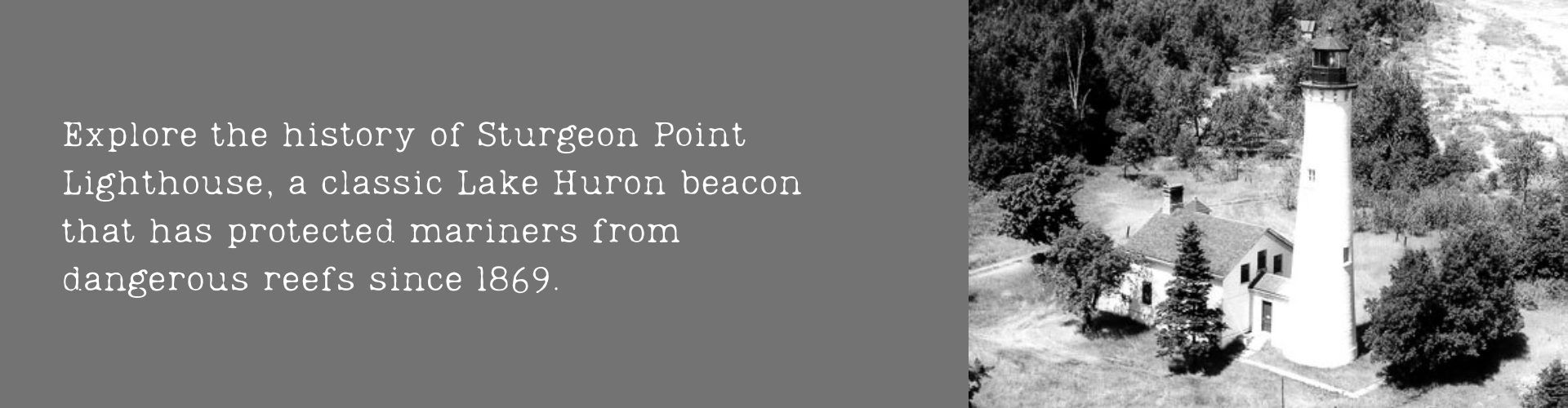
The tower stands 70 feet 9 inches tall and is constructed of brick masonry resting on a sturdy ashlar limestone foundation. At its base, the tower measures 16 feet in diameter. It gradually tapers as it rises toward the lantern room.
Attached to the tower is a two-story keeper’s dwelling built in the Cape Cod style. The house and tower were constructed using the same materials. Thus, they create a unified appearance that remains one of the station’s most recognizable features.
The design proved so successful that it was later copied almost exactly for Poverty Island Lighthouse, built in 1874. The two stations are often described as sibling lighthouses because of their nearly identical appearance.
Today, Sturgeon Point remains one of the finest surviving examples of this classic Great Lakes lighthouse design.
The Remarkable Fresnel Lens
One of the station’s most important features remains in place today.
When the lighthouse entered service, it was equipped with a rare 3½ order Fresnel lens manufactured by Henry Lepaute of France. The lens produced a fixed white light. It also represented some of the most advanced lighthouse technology of its era.
Only a small number of 3½ order Fresnel lenses were ever installed in the United States. Most were located on the Great Lakes.
What makes Sturgeon Point particularly special is that its original lens remains operational. In fact, it is one of only a handful of working Fresnel lenses of its type still in service in the country. It is also one of the few remaining examples in Michigan.
For lighthouse enthusiasts, the lens is among the station’s most significant historical treasures.
Keepers, Lifesavers, and the Coast Guard
Life at Sturgeon Point involved far more than simply maintaining a light.
In 1875, a United States Life Saving Service station was established adjacent to the lighthouse. The organization served as a predecessor to today’s Coast Guard and was responsible for rescuing sailors in distress.
The lighthouse keeper also became the captain of the local surf rescue crew, creating a close partnership between navigation and lifesaving.
The station’s location made that mission particularly important. Numerous vessels encountered trouble in the waters around Sturgeon Point, especially during severe storms.
When the United States Coast Guard was formed in 1915, the Life Saving Service became part of the new organization. The Lighthouse Service followed in 1939, bringing both operations under a single agency.
That same year, the lighthouse was electrified and automated. By 1941, Coast Guard personnel were withdrawn from the station, ending the era of resident keepers at Sturgeon Point.
Witness to Great Lakes History
Throughout its history, Sturgeon Point Lighthouse has watched over one of the busiest stretches of water on Lake Huron.
During the lumber boom, ships loaded with timber passed the point regularly. Commercial fishing fleets worked nearby waters. Later, generations of freighters transported iron ore and other bulk cargoes through the region.
The lighthouse also stood during some of the Great Lakes’ most famous storms.
The devastating Great Lakes Storm of 1913 claimed hundreds of lives across the region. Several ships associated with that disaster were lost in waters not far from Sturgeon Point. Thus, this underscored the importance of reliable navigation aids along this shoreline.
The station’s presence undoubtedly prevented countless accidents over the decades.
Saving the Lighthouse
By the late twentieth century, many historic lighthouse stations faced uncertain futures.
At Sturgeon Point, the keeper’s house had fallen into disrepair. Eventually, the Alcona Historical Society stepped forward in 1982 to lease the property and begin an extensive restoration effort.
The organization transformed the station into a museum and worked to preserve the lighthouse’s historic structures for future generations.
Their efforts proved especially important in 2006 when the United States Coast Guard proposed permanently extinguishing the light. Residents, lighthouse supporters, and preservation advocates quickly rallied in opposition.
More than 5,000 signatures were gathered, public comments poured in, and support came from across Michigan. Ultimately, the effort succeeded.
The light remained active and continues to shine today.
A Lighthouse Still Serving Lake Huron
Now part of Sturgeon Point State Park, the lighthouse remains one of Michigan’s most visited and photographed historic light stations.
The property is owned by the Michigan Department of Natural Resources, while the Alcona Historical Society operates the museum and helps maintain the site. The lighthouse is listed on the National Register of Historic Places. In addition, it continues to be recognized as an important part of Michigan’s maritime heritage.
More than 150 years after it was first illuminated, Sturgeon Point Lighthouse still fulfills the purpose for which it was built. It warns mariners away from the reef. It marks a safe route along the shoreline. Furthermore, it serves as a reminder of the generations of keepers, lifesavers, and sailors who depended upon its light.
Standing above Sanctuary Bay, it remains one of Lake Huron’s enduring guardians.
Explore our full collection of Northern Michigan lighthouse stories here
Start planning your trip today and explore the legacy of Michigan’s maritime history!
📍 Explore the Map Below