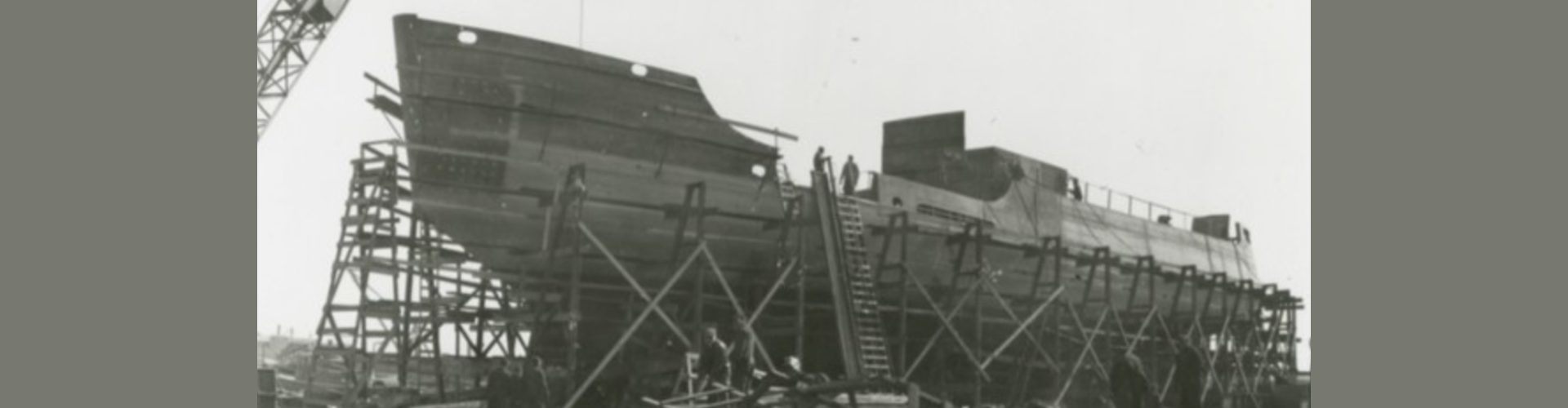
For more than six decades, the USCGC Acacia (WLB-406) quietly shaped commerce, safety, and navigation on the Great Lakes. Built during World War II and retired in 2006, Acacia was the last of the Coast Guard’s 180-foot buoy tenders to leave active service. Her story is one of endurance, adaptability, and essential, but often overlooked maritime labor.
Today, preserved as a museum ship in Manistee, Acacia stands as a rare physical link to the era when buoy tenders formed the backbone of Great Lakes navigation.
Built for War, Designed for the Lakes
Acacia was constructed at the Zenith Dredge Company shipyard in Duluth, Minnesota, with her keel laid on January 16, 1944. She launched on April 7 and commissioned September 1 of the same year. At a cost of $927,156, she was the second-to-last of 39 Iris-class buoy tenders built between 1942 and 1944.
Originally intended to be named Thistle, the ship was renamed Acacia to avoid confusion with a U.S. Army hospital ship. The name also honored the Lighthouse Service tender Acacia, the only tender lost during World War II.
Constructed of welded steel plates reinforced with an ice belt at the waterline, Acacia was built specifically for light icebreaking and buoy work, two roles that defined her career.
A Floating Infrastructure System
Though officially designated a buoy tender, Acacia was a multi-purpose work vessel. Her responsibilities included:
- Maintaining more than 210 navigational aids
- Icebreaking and ice escort operations
- Search and rescue missions
- Firefighting and emergency response
- Logistical support and oil spill response
Each fall, buoys were removed before ice formation and refurbished over winter. Each spring, Acacia redeployed them—sometimes more than 150 in a single operation. This annual cycle made her essential to Great Lakes shipping and safety.
Icebreaking and Industrial Survival
Icebreaking was one of Acacia’s most critical duties. She regularly operated in Lake Erie, Lake Huron, Lake St. Clair, the St. Clair River, and the Straits of Mackinac.
She was a key participant in Operation Coal Shovel, which ensured coal deliveries from Toledo to Detroit during winter, keeping power plants and factories operational.
In January 1945, Acacia freed the icebound freighter James Watt within 30 minutes of arrival after the ship had been trapped for days. Similar rescues followed throughout her service, including freeing tankers, colliers, and escorting ships through frozen channels.
Search, Rescue, and Tragedy
Acacia responded to numerous maritime emergencies. Among the most notable:
- 1951: Assisted the damaged George F. Rand after a collision in the St. Clair River
- 1956: Towed the disabled George Hindman, reopening shipping traffic
- 1966: Participated in recovery operations after the sinking of the Daniel J. Morrell
- 1971: Rescued 16 survivors following a nighttime collision near the St. Clair River mouth
These missions underscore the cutter’s dual role as both infrastructure support and emergency responder.
Modernization and Extended Service Life
In 1975, Acacia underwent a major $9 million overhaul at the Coast Guard Yard in Curtis Bay, Maryland. Improvements included new electrical systems, overhauled engines, modernized crew spaces, and a bow thruster.
This refit extended her operational life by decades and allowed her to remain relevant into the late 20th century.
Beyond the Great Lakes
Though primarily a Great Lakes vessel, Acacia served internationally. She conducted Caribbean patrols in the late 1980s and supported Operation Uphold Democracy in Haiti in 1994, earning the Armed Forces Expeditionary Medal.
Decommissioning and Preservation
Acacia was decommissioned on June 7, 2006, after 62 years of continuous service, the longest of any vessel in her class.
After an unsuccessful attempt to establish a museum in Chicago, Acacia steamed under her own power to Manistee in October 2009. She was formally dedicated as a museum ship in August 2011 and is now preserved alongside the SS City of Milwaukee National Historic Landmark.
A Lasting Legacy
The USCGC Acacia represents the unglamorous but indispensable work that kept the Great Lakes moving for generations. Her preservation ensures that the history of buoy tending, icebreaking, and maritime safety is not lost to time.