The Rise and Fall of the Alpena Motor Car Company
For a brief but ambitious moment in the early 20th century, Alpena believed it was on the verge of becoming something entirely new—an automobile manufacturing hub in a rapidly motorizing America. Long before Alpena became known primarily as a vacation destination and lakeside retreat, the city placed a bold bet on the future of transportation. That bet came in the form of the Alpena Motor Car Company. This short-lived but fascinating enterprise produced the Alpena Flyer, one of Michigan’s many forgotten early automobiles.
Though the company operated for only a few years, its story reflects the optimism, innovation, and risks that defined the Brass Era of American automobiles. Today, with just one known Alpena Flyer still in existence, Alpena’s automotive experiment survives. It serves as a rare and tangible reminder of a time when nearly every town dreamed of building the next great car.
The Automobile Boom Comes to Alpena
The early 1900s were a golden age of experimentation in the American auto industry. Hundreds of manufacturers—many of them small and regional—sprang up almost overnight. Michigan, already home to Ford, Olds, and Packard, became fertile ground for new automotive ventures. In June 1910, Alpena joined the movement with the incorporation of the Alpena Motor Car Company.
Local investors and business leaders were swept up in the promise of automobiles. Approximately $450,000 in stock was raised from around 200 investors. This was an impressive sum for the era and for a northern Michigan town. Early leadership included D. D. Hanover as president and William Krebs as vice president, though Hanover was later replaced by Richard Collins.
From the beginning, the company’s ambitions were enormous. Promotional materials confidently predicted that Alpena would soon become an “Automobile City”. They expected production reaching 2,500 to 3,000 cars per year. While those numbers never came close to reality, they reveal just how strongly people believed in the project.
Factories, Workers, and Big Expectations
The Alpena Motor Car Company’s factory was located at 150 Elm Street and 801 Johnson Street—addresses that referred to the same property, now associated with the Besser Company. While the main factory was under construction, early production began at another site in Alpena to keep progress moving forward.
At its height, the factory employed approximately 70 workers, a notable workforce for the community. Purpose-built manufacturing equipment was installed, signaling confidence that automobile production would be a long-term endeavor in Alpena.
Local newspapers eagerly repeated company projections, reporting that Alpena-built cars would soon be traveling roads across the country. For a brief period, the optimism felt justified.
Meet the Alpena Flyer
Credit: Besser Museum for Northeast Michigan. Used with permission.
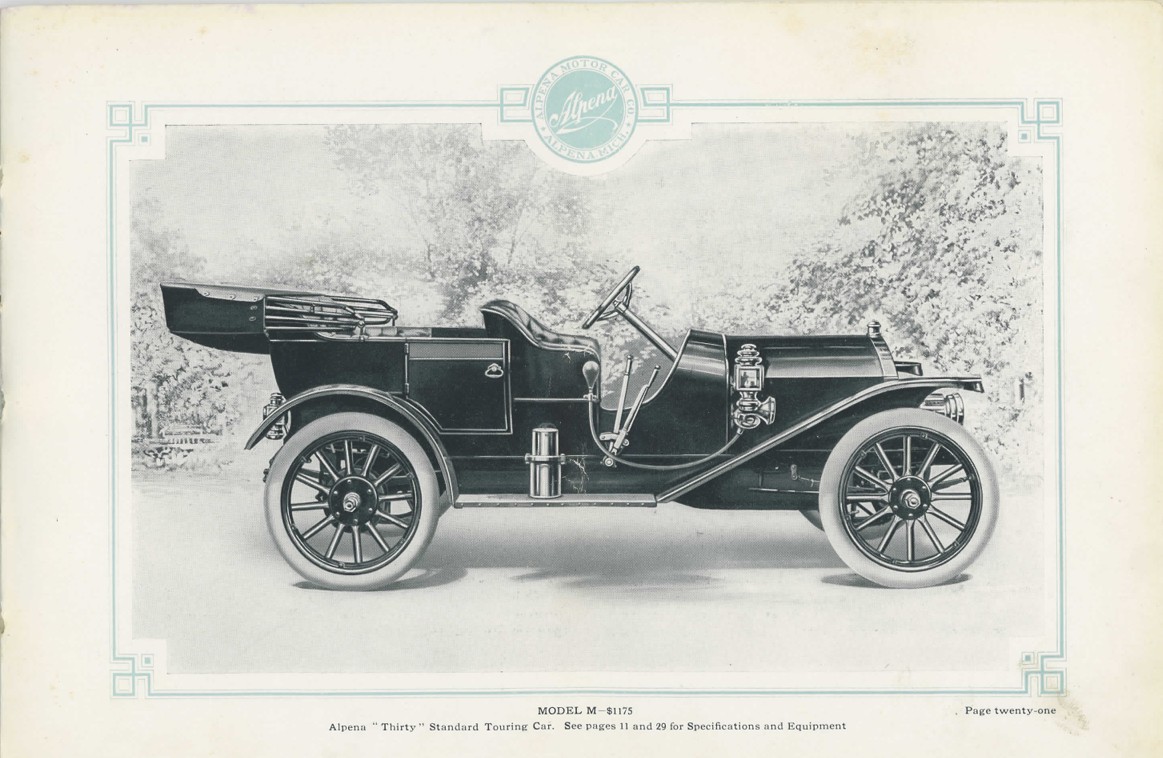
The company’s sole product line was the Alpena Flyer, a light, five-passenger touring car designed to provide exceptional value rather than luxury. The Flyer was offered in 13 different models over its short production run. It was marketed as dependable, efficient, and modern.
Early advertisements praised the Flyer’s “wonderful, silent, powerful and efficient motor,” emphasizing that everything was enclosed, “including valves.” The engine was described as “troubleless,” a bold claim during an era when mechanical reliability was far from guaranteed.
The Flyer featured water-cooled, four-cylinder engines rated between 33 and 35 horsepower. It was paired with a three-speed transmission. A unitized engine and gearbox design, combined with a three-point suspension, helped improve handling and speed. These features set the car apart from many competitors.
Prices ranged from $1,450 to $1,600, placing the Alpena Flyer squarely in the middle of the market. The company made it clear they were not building bargain runabouts or high-end limousines. Instead, it offered “the greatest value in a five-passenger car offered anywhere in America.”
In a remarkable moment of recognition, the 1910 New York Auto Show listed the Alpena Flyer among the top ten cars in the world. This recognition lent national credibility to the young manufacturer.
Production Reality vs. Promotional Promise
Despite bold claims, actual production numbers fell far short of expectations. While the factory was reportedly capable of producing 2,500 cars per year, historians believe that only about 480 Alpena Flyers were built in total. Estimates rarely exceed 500 vehicles.
Still, new Flyers began shipping to customers in 1911, and Alpena briefly joined the ranks of Michigan towns producing automobiles during the industry’s most competitive era.
Legal Trouble and Financial Collapse
Trouble arrived quickly. In 1912, the Alpena Motor Car Company was sued for patent infringement over its three-point suspension design. The patent holder, Emile Huber, claimed the company used the design without authorization.
The lawsuit placed enormous financial strain on the company. Legal costs and declining cash reserves made it difficult to sustain operations. By 1913, Alpena Motor Car was struggling to survive, and in February 1914, the company officially declared bankruptcy.
Its assets were auctioned off and purchased by the Besser Manufacturing Company for just $5,200—a fraction of the investment once poured into the venture. Remaining car parts are believed to have been sold to a Canadian firm. This effectively ended Alpena’s brief chapter in automobile manufacturing.
The Lone Survivor Comes Home
While hundreds of Alpena Flyers once existed, only one is known to survive today—and remarkably, it has returned to Alpena.
Several years ago, local resident Ron Winter set out to locate an Alpena Flyer. What he found was little more than a frame and scattered parts—a true automotive “basket case.” With no better examples available, Winter purchased the remains and committed to restoring the car to its former glory.
The project was entrusted to Restorations Unlimited II. Craftsmen preserved original components whenever possible. They also fabricated missing parts with period accuracy. The restoration took nine years, but the result is extraordinary.
The finished vehicle is a 1911 Standard Touring Alpena Flyer, painted Dark Royal Blue, the only color offered that year. It features a 33-horsepower Northway engine, right-hand drive, and details that make it look as though it just rolled out of the factory—despite being more than a century old.
See the Alpena Flyer at the Besser Museum
Today, this rare Brass Era automobile is on public display at the Besser Museum in Alpena, located just steps from the original factory site on Johnson Street. The Alpena Flyer is not only one of the rarest cars in Michigan history, but it is also a powerful symbol of Alpena’s industrial ambition.
Visitors to the Besser Museum can see the Flyer up close, learn more about Alpena’s manufacturing past, and explore exhibits that highlight the region’s innovation, industry, and community spirit. If you’re interested in early automobiles, Michigan history, or unique local stories, the Alpena Flyer alone is well worth the visit.
A Short-Lived Dream with a Lasting Legacy
The Alpena Motor Car Company existed for only a few short years, but its story captures the bold optimism of the early automobile age. Like many small manufacturers, it was undone by legal challenges, financial realities, and an industry that was rapidly consolidating around larger players.
Yet more than a century later, the Alpena Flyer endures—proof that even brief ventures can leave a lasting imprint. Thanks to preservation efforts and the Besser Museum, Alpena’s automotive dream remains alive. It reminds us that this northern Michigan town once aimed to change how America moved.
This is the only known example of a car built by the Alpena Motor Car Company of Alpena, Michigan. It is a 1911 Alpena Flyer owned by Ron Winter and displayed at the Besser Museum in Alpena.
Alpena history teacher, Bob Lyngos, shares stories about Alpena Motor Car Company’s early days, including how the first Flyer was assembled by the French family on State & Chisholm and driven to the Johnson Street factory