Central Upper Peninsula

The Grand Island Ice Caves Stamp

Capturing Michigan’s Frozen Beauty On January 18, 2020, Michigan’s stunning winter scenery took center stage. A new United States Postal Service (USPS) Priority Mail Express stamp featuring the Grand Island Ice Caves was released. These breathtaking natural formations, located near Munising in Michigan’s Upper Peninsula, are renowned for their ever-changing ice curtains and stalactite-like icicles. These formations transform Grand Island’s sandstone cliffs into a magical winter wonderland. This stamp, designed by Greg Breeding and illustrated by Dan Cosgrove, immortalizes one of Michigan’s most picturesque winter travel destinations. Hiawatha National Forest Grand Island, part of the Hiawatha National Forest, sits just… Read More »


The Toledo War

A Boundary Dispute That Shaped Two States In the early 19th century, a peculiar conflict arose between Ohio and the Michigan Territory. Known as the Toledo War (1835–1836), or the Michigan–Ohio War, this dispute wasn’t a war in the traditional sense but rather a heated political and economic struggle over a sliver of land called the Toledo Strip. The Roots of the Conflict The dispute centered around the 468-square-mile Toledo Strip, which included the mouth of the Maumee River, a vital shipping hub, and fertile farmland to the west. Both Ohio and Michigan saw the area as essential to their… Read More »


The Mataafa Storm of 1905

A Tragic Maritime Disaster on Lake Superior On November 27-28, 1905, the Great Lakes were engulfed by the Mataafa Storm. This was a weather event that became a haunting reminder of nature’s ferocity. With its powerful winds and heavy snowfall, this storm led to the destruction of 29 ships and claimed the lives of 36 seamen. The economic impact was a staggering $3.567 million in shipping losses (in 1905 dollars). The storm was particularly infamous for the fate of the bulk carrier SS Mataafa, from which it derived its name. The Meteorological Conditions The storm system initially moved across the… Read More »


The Mysterious Disappearance of an Air Force Jet Over Lake Superior

On a stormy evening in November 1953, a mystery unfolded over Lake Superior that continues to baffle historians and aviation enthusiasts alike. It began when an unexpected object appeared on the radar of a United States Air Force (USAF) facility. This prompted officials to dispatch two airmen to investigate. What transpired next remains one of the most enduring enigmas of aviation history. The Radar Detection The story started on November 23, 1953, at an Air Defense Command facility located on the U.S.-Canada border. Reports of the weather vary, with some accounts describing snowfall while others mention a stormy atmosphere. At… Read More »


The Legend of the Edmund Fitzgerald

The tale of the Edmund Fitzgerald stands as one of the most mysterious and controversial shipwreck stories of the Great Lakes, rivaled in cultural impact only by that of the Titanic. Since her tragic sinking on November 10, 1975, the Fitzgerald has inspired numerous narratives in books, films, and songs, most notably through Gordon Lightfoot’s haunting ballad, “The Wreck of the Edmund Fitzgerald,” released in 1976. The Final Voyage The Edmund Fitzgerald met her fate on Lake Superior, approximately 17 miles north-northwest of Whitefish Point, Michigan, with all 29 crew members on board. Her last journey commenced on November 9,… Read More »


The Story of the First Madonna and Child Stamp in the U.S.

On November 1, 1966, a small town with a big name—Christmas, Michigan—made history when the U.S. Postal Service released its first Madonna and Child stamp. This release, centered on a 15th-century painting by Hans Memling titled Madonna and Child with Angels, marked a milestone for both the holiday season and American philately. The stamp, designed by Howard C. Mildner and modeled with exceptional detail, brought art and culture to the forefront of seasonal postage, quickly becoming a favorite across the country. A Record-Breaking Stamp The Madonna and Child stamp was immensely popular upon its release. Demand soared, leading the U.S…. Read More »


Hauntings Across Michigan’s Upper Peninsula

The Upper Peninsula of Michigan is a place of natural beauty. But be careful, lurking within its forests, historic sites, and lonely trails are tales of hauntings that send shivers down the spine. From ghostly apparitions to mysterious lights, the U.P.’s paranormal stories span the region, each with its own eerie flavor. Western Upper Peninsula Paulding Lights Near Watersmeet, the Paulding Lights have been spotted since 1966. Some believe the glow is the lantern of a long-dead railroad brakeman. Others think it’s the spirit of a lost mail carrier or a Native American dancing in the night. Whatever the cause,… Read More »


The Forgotten Gold Rush of the Upper Peninsula

Gold Nuggets

In the heart of Michigan’s rugged Upper Peninsula lies a hidden treasure trove. It is not the typical kind you might imagine, but one that gleams just as brightly, gold. Yes, you heard it right, gold! But this is not the California Gold Rush or the Klondike. This is the story of grit, perseverance, and the pursuit of dreams. The forgotten gold rush of the Upper Peninsula is rarely in the annals of gold mining history. In the late 1800’s the Upper Peninsula was buzzing with activity. While many flocked to the region for its rich copper deposits, a few… Read More »


Manistique Lime Kilns

Lime Kilns

Nestled in the picturesque town of Manistique in Michigan’s Upper Peninsula, there stands a silent witness to history – Lime Kilns. These unassuming structures have more tales to tell than meet the eye. Lime Kilns in Manistique have a rich history that is often overlooked. One of the most intriguing aspects is the story of George Nicholson, a shrewd businessman who built a six kiln lime plant in Manistique, which later became the Manistique Lime and Stone Co. The process of turning dolomite limestone into quicklime involved intense labor, with workers using dynamite to break up the limestone formations and… Read More »


Hauntings in Central Upper Peninsula

Old City Orphanage - Holy Cross Orphanage Marquette

Join us at Northern Michigan History as we journey through our 5-part series, uncovering the secrets of the most haunted destinations in Northern Michigan. Our fourth installment leads us to the quest for specters in the Central Upper Peninsula. Surprisingly, we didn’t need to venture too far, as the Marquette area and its surroundings offer a multitude of uncanny encounters and strange happenings! Marquette County Old City Orphanage (formerly known as Holy Cross Orphanage): This Catholic orphanage was built in 1915 and was abandoned in the mid-60s after serving as a Catholic orphanage. The orphanage has a long history of… Read More »


Fort Wilkins

Flagpole in front of Lake Fanny Hooe at Fort Wilkins

Fort Wilkins is a historic military outpost located in Copper Harbor at the northern tip of Keweenaw Peninsula. It was established in 1844 by the U.S. Army during a time of increased tensions between miners and the local Ojibwe people in the Keweenaw Peninsula, which is known for its rich copper deposits. The fort was named after Secretary of War William Wilkins. The Army built 27 structures, including a guardhouse, powder magazine, 7 officer’s quarters, two barracks, two mess halls, hospital, storehouse, sutler’s store, quartermaster’s store, bakery, blacksmith’s shop, carpenter’s shop, icehouse, four quarters for married enlisted men, stables, and… Read More »


Chappee Rapids

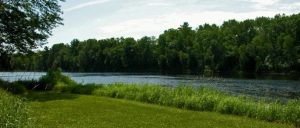
Chappee Rapids Area

Between 1670 and the early 1800s the Menominee River Basin was visited by Explorers, missionaries, and fur traders. They passed by on the water route of the Menominee River and Green Bay. Journals of the seventeenth and early eighteenth-century explorers talk about a small Algonquin tribe in the Menominee River Basin. They were known as “The wild rice people.” The explorers talked about a tribe of 40-80 men living in a village at the mouth of the river. By the early 1800s The Menominee numbered about 500 and lived in numerous villages scattered throughout Wisconsin. Stanlislaus Chappieu In 1794 on… Read More »